

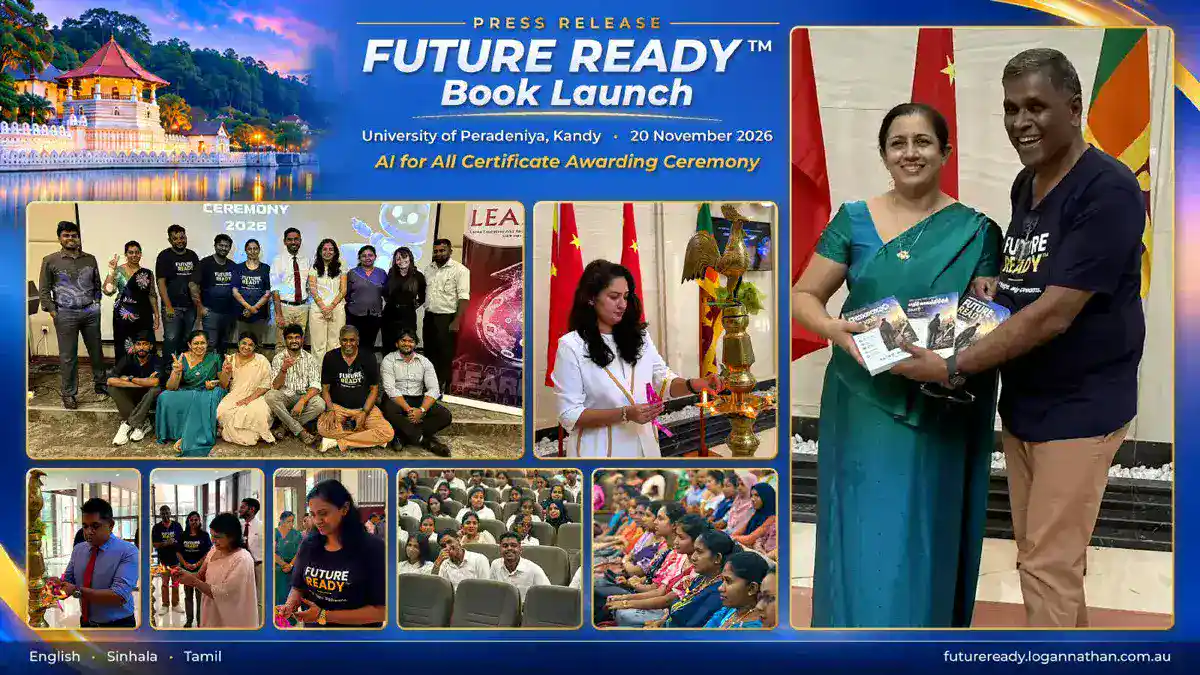
Key Highlights at a Glance
- National Initiative: Future Ready training rollout launched at the University of Peradeniya
- Institutional Partners: Jointly staged with Lanka Education and Research Network (LEARN)
- Trilingual Curriculum: Guide published simultaneously in English, Sinhala, and Tamil
- Target Demographics: University undergraduates, regional secondary educators, and school administrators
COLOMBO (SriLankaBiz): The University of Peradeniya and the Lanka Education and Research Network have launched a trilingual initiative to cultivate practical AI skills across undergraduates and educators, aligning higher education with Sri Lanka’s high-tech export strategy.
The programme, staged during the AI for All Certificate Awarding Ceremony at Peradeniya, introduced the youth and educator handbook titled Future Ready, authored by technology entrepreneur Logan Nathan. The event connected academic research with grassroots classroom instruction, focusing on how emerging digital competencies can strengthen domestic labor productivity and export-oriented IT service revenue.
Connecting Academic Foundations with Everyday Problem Solving
The launch brought together two distinct cohorts, bridging tertiary student research and regional secondary school teaching methodologies.
The initial session engaged university undergraduates, examining how artificial intelligence can be deployed to test hypothesis structures, analyze complex datasets, and validate engineering models. The second track convened secondary school educators and principals from Kandy and surrounding districts, equipping teachers with frameworks to evaluate automated assignments, detect synthetic output, and cultivate critical verification habits among students.
Speaking at the forum, Professor Roshan Ragel emphasized that building early artificial intelligence competencies is essential for expanding Sri Lanka’s high-value service exports. He noted that academic institutions must move beyond abstract computer science theories to embed functional, everyday competencies into curriculum design.
| Programme Track | Target Participant Profile | Core Curriculum Focus |
|---|---|---|
| Undergraduate Track | Engineering and science students | Dataset verification, hypothesis testing, and software development workflows |
| Educator Masterclass | Kandy district school teachers | Synthetic content evaluation, grading integrity, and prompt reasoning checks |
| Trilingual Publishing | Provincial schools islandwide | Standardized reference materials released in English, Sinhala, and Tamil |
Institutional Focus on Practical AI Skills
The Peradeniya rollout marks the third phase of a national roadshow, following preceding sessions conducted at the National Library Hall in Colombo and the University of Jaffna.
Author Logan Nathan explained that discussions with university cohorts across the Western, Northern, and Central provinces highlighted strong student demand for structured guidance on modern technology workflows. He pointed out that acquiring practical AI skills requires young learners to master prompt iteration, scrutinize machine-generated assumptions, and uphold intellectual accountability rather than passively copying algorithmic output.
The handbook provides structured blueprints for parents and classroom teachers to encourage analytical reasoning, creative experimentation, and digital resilience as generative technologies permeate corporate and academic environments.
Business & Economic Impact
The drive to embed practical AI skills into the tertiary education pipeline directly addresses Sri Lanka’s acute tech workforce constraints. While the domestic Information Technology and Business Process Management (IT-BPM) industry targets $3 billion in annual export earnings by 2027, corporate employers continue to face a shortage of graduates equipped with modern enterprise workflows.
Industry analyses indicate that business process outsourcing, financial accounting, and legal services are undergoing rapid automation. By introducing scalable practical AI skills training at provincial state universities and feeder schools, the island builds human capital resilience against technological disruption.
Connecting national educational research networks like LEARN with regional classrooms ensures that provincial undergraduates can compete effectively for high-paying remote knowledge-economy jobs, distributing digital prosperity outside Colombo’s commercial core.