

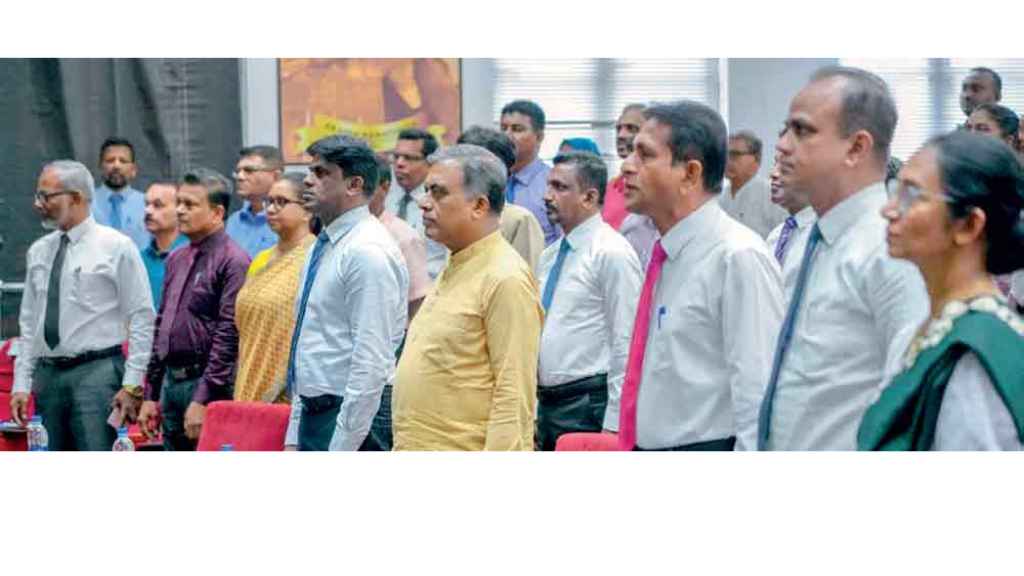
World Intellectual Property Day commemorated in Sri Lanka with a special programme highlighting the value of creativity and innovation, particularly within the evolving sports industry and its growing reliance on intellectual property frameworks.
World Intellectual Property Day commemorated with focus on innovation in sports
A special event to mark World Intellectual Property Day was held at the Duncan White Auditorium of the Ministry of Youth Affairs and Sports, bringing together policymakers, officials, and industry stakeholders to examine the role of intellectual property in economic and technological development. Observed annually on April 26, this year’s theme, “IP and Sports: Ready, Set, Innovate,” focused on how intellectual property rights underpin innovation, branding, and design in the global sports ecosystem.
The event was presided over by Deputy Minister of Trade, Commerce, and Food Security R.M. Jayawardena, with the participation of Sports Deputy Minister Sugath Thilakaratne, Youth Affairs and Sports Ministry Secretary Aruna Bandara, and National Intellectual Property Office Director General Geethanjali Ranawaka. Their presence underscored the increasing policy-level attention being directed toward strengthening Sri Lanka’s intellectual property system as a driver of long-term growth.
Addressing the gathering, Jayawardena emphasised that intellectual property encompasses a broad spectrum of human creativity, ranging from literary and artistic works to inventions, trademarks, and industrial designs. He highlighted that securing these rights ensures creators receive fair economic returns, while also contributing to broader national objectives such as innovation-led growth, industrial competitiveness, and cultural preservation. Within the context of intellectual property Sri Lanka, such protections are increasingly viewed as essential infrastructure for a modern, knowledge-based economy.
The intersection between sports and intellectual property emerged as a key discussion point during the programme. Thilakaratne, in his remarks, pointed to the evolving nature of the sports industry, where performance is no longer solely dependent on physical ability but is increasingly shaped by data analytics, equipment innovation, and digital platforms. He noted that as sports technology advances, the importance of safeguarding intellectual property rights becomes more pronounced, particularly in areas such as athlete training methodologies, proprietary technologies, and branding assets.
From a systems perspective, Sri Lanka’s intellectual property framework is governed by the Intellectual Property Act No. 36 of 2003, with administrative oversight provided by the National Intellectual Property Office. This legal architecture defines the mechanisms through which creators and innovators can secure protection for their work, ensuring both legal recognition and commercial viability. Officials at the event reiterated that strengthening enforcement and awareness remains a priority, especially as digital transformation accelerates the creation and dissemination of intellectual assets.
The global dimension of intellectual property was also highlighted, with reference to the role of the World Intellectual Property Organization (WIPO), which administers 26 international treaties facilitating cross-border protection of intellectual property rights. These frameworks enable creators and businesses in Sri Lanka to access international markets while safeguarding their innovations, thereby contributing to job creation and the emergence of new industries. The alignment between domestic regulations and global standards is considered critical in enhancing the country’s competitiveness in sectors such as technology, creative industries, and sports innovation.
The discussion extended to the broader economic implications of intellectual property systems. A well-functioning intellectual property ecosystem not only incentivises creativity but also attracts investment, supports entrepreneurship, and fosters technological advancement. In the context of IP and sports innovation, stakeholders noted that intellectual property rights play a crucial role in monetising sports content, protecting brand equity, and enabling partnerships across media, technology, and sponsorship domains.
Participants also emphasised the need for capacity building and education to ensure that creators, athletes, and entrepreneurs are equipped to navigate intellectual property processes effectively. Without adequate awareness, many innovations risk remaining unprotected, limiting their commercial potential and undermining incentives for further development. This gap is particularly relevant in emerging sectors where innovation cycles are rapid and competitive pressures are high.
The event concluded with a renewed call to strengthen Sri Lanka’s intellectual property ecosystem through policy reforms, institutional capacity, and stakeholder collaboration. Ensuring a transparent, efficient, and accessible system was identified as a prerequisite for sustaining innovation and supporting the country’s transition toward a knowledge-driven economy.
As World Intellectual Property Day commemorated across the country, the discussions reinforced a central premise: protecting intellectual property is not merely a legal function but a strategic imperative that underpins creativity, economic resilience, and long-term national development.