

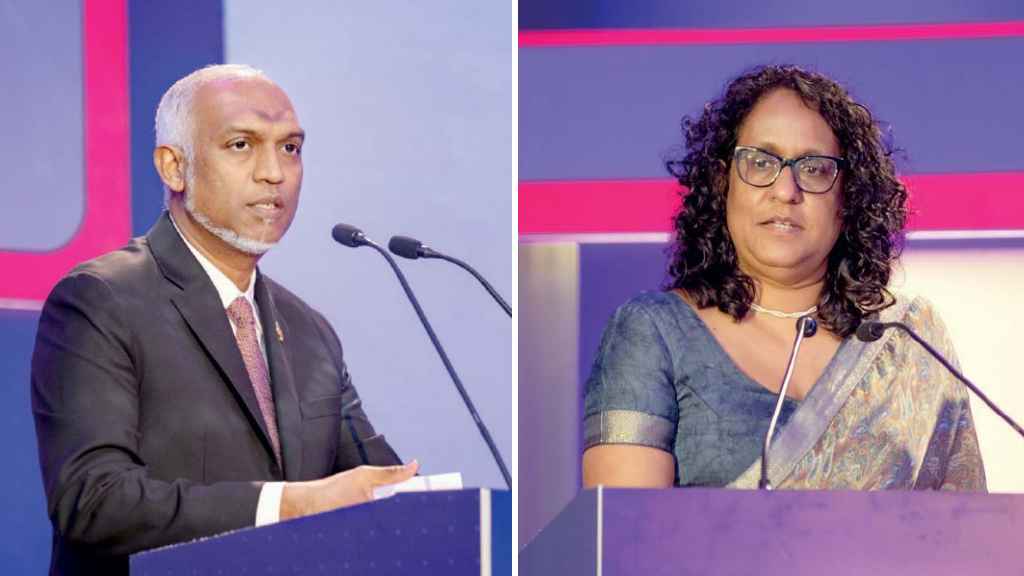
SL-Maldives push for stronger economic ties at Colombo business forum took centre stage as leaders from both nations reaffirmed their commitment to deepening economic cooperation and expanding bilateral partnerships. The high-level forum in Colombo reflected growing optimism around trade, investment and long-term collaboration.
SL-Maldives push for stronger economic ties gains momentum in Colombo
The Maldives–Sri Lanka Business Forum drew more than 400 business leaders, policymakers and investors, signalling renewed momentum in strengthening economic engagement between the two Indian Ocean neighbours. The event highlighted not only shared economic priorities but also a longstanding relationship rooted in trust, cultural ties and mutual support.
Maldives President Mohamed Muizzu, addressing the gathering, described his country as being at a “pivotal moment” in its development journey. He characterised the Maldives as “a nation on the rise,” underpinned by resilience and a forward-looking vision for sustainable growth. Emphasising the importance of bilateral cooperation, he noted that Sri Lanka and the Maldives share deep historical, cultural and economic connections that continue to evolve.
President Muizzu underscored that the Maldives’ development strategy is centred on people, supported by technology and guided by environmental sustainability. He highlighted the critical role of the private sector, stating that private sector-led growth remains a central pillar of the national economic agenda. According to him, the government is actively implementing reforms designed to improve the business environment, attract investment and foster entrepreneurship.
Among the key measures outlined were a modernised foreign investment framework and revised investor entry requirements. These reforms, he explained, are aimed at ensuring greater clarity, predictability and transparency, thereby strengthening investor confidence and facilitating sustained economic expansion.
Sri Lanka’s Prime Minister Dr. Harini Amarasuriya echoed similar sentiments, noting that Sri Lanka is also navigating a crucial phase in its economic recovery and transformation. She pointed out that the country has successfully managed a series of recent challenges, including global economic pressures and adverse weather conditions in late 2025, through disciplined fiscal policies and structural reforms.
“We are steadily building a stronger and more stable economic foundation,” she said, adding that Sri Lanka is on a clear path toward sustainable growth. Her remarks reinforced the shared trajectory of both nations as they seek to stabilise and expand their economies in a challenging global environment.
A notable aspect of her address was the emphasis on the enduring friendship between the two countries. She recalled the Maldives’ support to Sri Lanka following Cyclone Ditwah, expressing appreciation for the assistance extended by the Maldivian government and its people. This, she noted, reflects a relationship that extends beyond formal economic ties into genuine partnership and solidarity.
Tourism emerged as a key sector for enhanced collaboration. The Prime Minister highlighted Sri Lanka’s record tourist arrivals in 2025 despite external challenges, pointing to opportunities for joint initiatives in sustainable tourism, high-end travel experiences and medical tourism. These sectors, she suggested, offer significant potential for mutual benefit.
In terms of trade, she acknowledged that bilateral exchanges—valued at approximately US$137 million in 2025—remain below their full potential. She called for targeted efforts to expand cooperation, particularly in areas such as food production and fisheries processing, where both countries possess complementary strengths.
Maldives Minister of Economic Development, Transport and Trade Mohamed Saeed reinforced the need to translate dialogue into tangible outcomes. He highlighted the Maldives’ ongoing efforts to diversify its economy beyond tourism, with a focus on logistics, digital services, renewable energy, fisheries and financial services.
According to the Minister, these sectors are central to positioning the Maldives as a strategic hub in the Indian Ocean. He also noted that recent reforms and prudent fiscal management have contributed to improved macroeconomic stability, enabling major infrastructure developments, including expanded airport capacity and enhanced connectivity.
Saeed further identified global supply chain shifts, digital transformation and climate resilience as critical areas for bilateral cooperation. His remarks aligned with broader regional trends, where countries are increasingly seeking collaborative approaches to navigate evolving economic and environmental challenges.
The forum underscored a shared recognition among leaders that the existing foundation of historical and cultural ties provides a strong platform for future growth. President Muizzu called for building “meaningful partnerships that shape our shared future,” while Minister Saeed emphasised that the forum should lead to concrete action rather than remain a platform for dialogue alone.
The SL-Maldives push for stronger economic ties reflects a strategic alignment between the two nations at a time when regional cooperation is becoming increasingly vital. With both countries pursuing reform-driven growth agendas and seeking to attract investment, the potential for expanded collaboration remains significant.
As discussions transition into implementation, stakeholders from both sides appear focused on converting policy commitments into measurable outcomes. The forum has set a clear direction for advancing trade, investment and sector-specific partnerships, reinforcing the role of Sri Lanka and the Maldives as interconnected economic partners in the Indian Ocean region.