

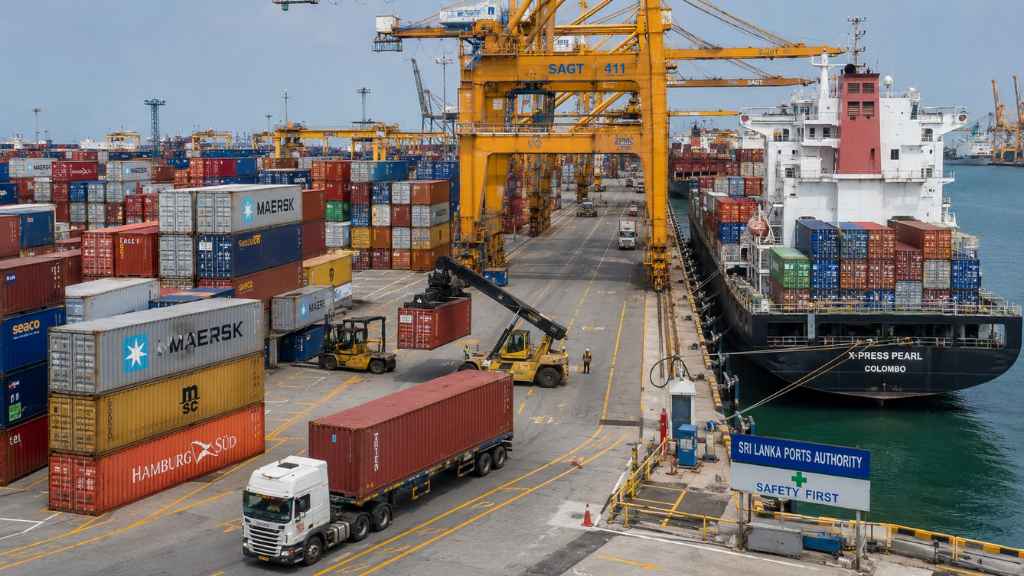
Trincomalee Port projects must be guided by proven commercial demand and financial viability rather than ambitious infrastructure plans, according to Sri Lanka Ports Authority (SLPA) Chairman Dr. Parakrama Dissanayake.
Trincomalee Port projects require viability and cargo demand, says SLPA Chief
Addressing the Sri Lanka-German Business Forum 2026, Dr. Dissanayake stressed that future investments in Trincomalee should be backed by strong economic fundamentals, cargo generation potential, and improved connectivity to ensure sustainable returns.
The SLPA Chairman’s remarks come amid ongoing discussions about accelerating development at Trincomalee Port, which has long been viewed as a strategic asset due to its natural harbour and location along key maritime routes. However, Dr. Dissanayake cautioned that large-scale investments should only proceed after comprehensive financial feasibility assessments are completed.
He noted that the existing National Port Master Plan, developed by the Asian Development Bank (ADB), identifies a range of potential projects for Sri Lanka’s port sector. While the plan outlines several opportunities for expansion and development, many of these proposals have not yet undergone rigorous financial evaluation.
According to Dr. Dissanayake, the ADB is expected to revise the master plan with greater emphasis on financial sustainability and commercial viability, ensuring that future developments are aligned with realistic market demand and investment returns.
Drawing lessons from the development experience of Hambantota Port, he emphasized that port infrastructure should be developed only when there is sufficient demand to support operations and generate revenue.
“Ports have to be demand-driven because constructing a port is extremely expensive,” he said, highlighting the importance of avoiding investments that may struggle to attract cargo volumes or shipping traffic.
The SLPA is currently engaged in discussions with several organizations to identify opportunities that could generate economic activity and cargo demand in the Eastern Province before major infrastructure commitments are made. The objective is to create a stronger commercial foundation that can support future port expansion.
Among the initiatives under consideration is a proposal by the Board of Investment (BOI) to establish a logistics hub in Trincomalee. The plan includes the potential release of approximately 300 acres of land in the Kappalturai area for investment and industrial activities.
While acknowledging the potential benefits of such a development, Dr. Dissanayake stressed that connectivity remains a critical challenge. He argued that road, rail, and supply chain infrastructure must be improved before Trincomalee can effectively function as a competitive logistics and trade center.
“If you want to create a logistics hub, you must first get the connectivity right. Without proper connectivity, it will be difficult to make it a reality,” he said.
The SLPA Chairman also highlighted the evolving dynamics of the global shipping industry, where a small number of major operators increasingly influence international trade routes and port selection decisions.
According to him, the world’s ten largest shipping lines now control nearly 84% of global shipboard container capacity. This concentration gives major carriers significant leverage in determining which ports receive regular shipping services and cargo volumes.
As a result, smaller and emerging ports face intense competition in attracting global shipping traffic, regardless of the scale of infrastructure investments made by individual countries.
“We are at the mercy of 10 shipping lines,” Dr. Dissanayake remarked, underscoring the challenges faced by ports seeking to establish themselves within global maritime networks.
His comments reflect a broader shift in Sri Lanka’s port development strategy, which increasingly prioritizes commercial demand, shipping connectivity, and logistics competitiveness over purely infrastructure-led expansion.
Industry observers note that while Trincomalee possesses significant long-term potential, its success will depend on the ability to attract investors, generate cargo volumes, improve transport links, and integrate with regional and global supply chains.
Dr. Dissanayake reiterated that development plans alone are insufficient without market support and investor confidence. Sustainable port growth, he argued, requires a careful balance between infrastructure investment and actual demand from shipping lines, exporters, importers, and logistics operators.
As Sri Lanka seeks to strengthen its position as a regional maritime and logistics hub, policymakers are increasingly focusing on projects that can demonstrate clear commercial value. The planned review of the National Port Master Plan is expected to play a key role in shaping future investment decisions and ensuring that Trincomalee Port projects are aligned with both economic realities and long-term national development goals.