

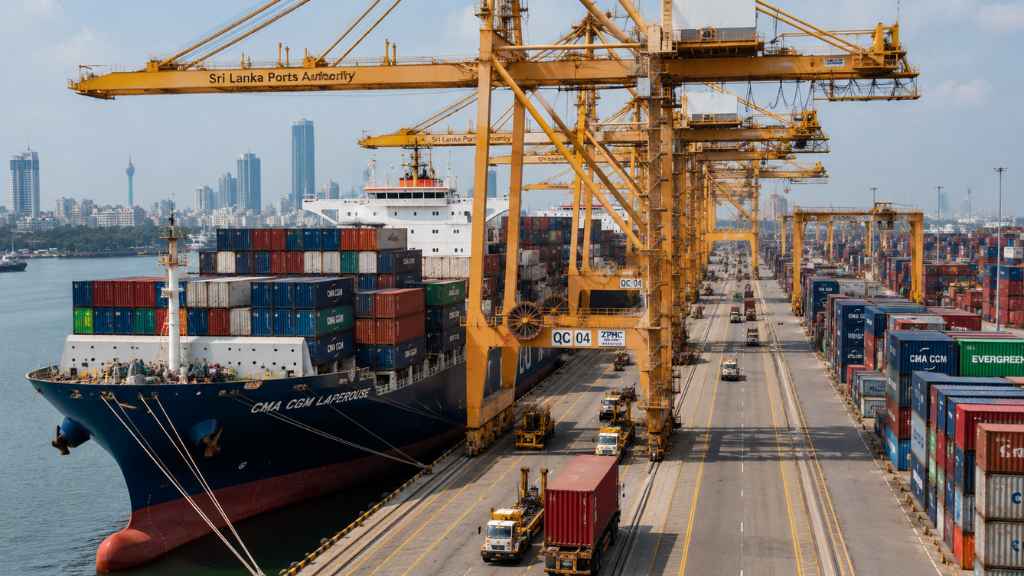
Sri Lanka Maritime Infrastructure Investment can attract substantial European capital if the country maintains policy stability, regulatory transparency, and fiscal discipline, according to global experts speaking at the Sri Lankan-German Business Forum 2026 in Colombo.
Sri Lanka Maritime Infrastructure Investment hinges on policy clarity and investor confidence
Industry leaders, multilateral lenders, and policymakers stressed that Sri Lanka’s strategic location along major global shipping routes offers significant opportunities, but sustained reforms and institutional certainty remain essential to unlocking large-scale foreign investment.
The discussion comes at a critical stage in Sri Lanka’s economic recovery, as the country continues implementing reforms under the International Monetary Fund (IMF) program while pursuing major maritime development projects aimed at strengthening its position as a regional logistics and trade hub.
Representing the German Federal Ministry for Economic Affairs and Energy, Tobias Pierlings outlined what he described as the three pillars required to attract international investors: stability, reliability, and transparency. He noted that Sri Lanka occupies a unique geographical position along some of the world’s busiest maritime trade routes connecting East Asia and Europe.
According to Pierlings, recent disruptions in global shipping networks have demonstrated how vulnerable international trade can become when strategic maritime corridors are affected. Such disruptions can lead to sharp increases in energy and fertilizer prices while creating significant challenges for global supply chains.
He emphasized that Sri Lanka must continue its ongoing debt restructuring efforts and strengthen its sovereign credit profile to regain access to international financial markets. Improved sovereign ratings, he said, would help unlock German investment protection mechanisms and export credit guarantees, enhancing investor confidence in the country.
The focus on Sri Lanka Maritime Infrastructure Investment aligns closely with ambitious expansion plans announced by the Sri Lanka Ports Authority (SLPA). Speaking at the forum, SLPA Chairman Dr. Parakrama Dissanayake revealed plans to develop an investment pipeline valued at up to US$ 2 billion over the next one to three years.
The initiative aims to transform Sri Lanka from a traditional transshipment destination into a comprehensive logistics and supply chain center. With Colombo Port currently operating above 70% capacity utilization and handling demand estimated at 9.3 million TEUs, authorities believe additional infrastructure is urgently required to accommodate future growth.
As part of this strategy, the SLPA intends to invite Expressions of Interest before the end of the year for the development of a dedicated logistics facility on a 14-acre land bank. The project is expected to play a key role in establishing a modern Colombo Port logistics hub capable of supporting expanding regional trade flows.
European Union representatives also reinforced the importance of predictable policymaking and transparent governance structures. Dr. Johann H. Hesse, Head of Cooperation for the Delegation of the European Union to Sri Lanka and the Maldives, highlighted the EU’s Global Gateway initiative as a potential source of financing support.
The initiative combines grants from the European Commission with financing from international financial institutions to support strategic infrastructure projects. Hesse noted that investors are particularly interested in commercially viable ventures such as port terminals and logistics facilities, but require confidence in long-term policy consistency and contract enforcement.
He stressed the importance of creating a pipeline of well-prepared and bankable projects capable of attracting international financing.
From the multilateral development perspective, the World Bank Group echoed similar views. Rukshila Shihanthinie Gooneratne, Operations Officer for the World Bank Group’s Country Management Unit in Sri Lanka, said project preparation remains one of the most critical factors influencing investor decisions.
She explained that transparent procurement procedures, competitive bidding processes, and stable policy frameworks are essential prerequisites before long-term financing can be mobilized. The World Bank’s broader objective, she added, is to facilitate private sector-led growth that generates employment opportunities while enabling the public sector to play a supportive role.
The forum also highlighted the importance of local financial institutions in facilitating investment. Commercial Bank of Ceylon PLC Executive Director and Chief Operating Officer Hasrath Munasinghe observed that Sri Lanka is well-positioned to benefit from evolving global trade patterns. However, he noted that foreign investors continue to monitor policy consistency as a key indicator of investment attractiveness.
Development finance institutions likewise expressed readiness to support European investments in Sri Lanka’s maritime sector. DEG Country Director Kunal Makkar emphasized that clear regulations and predictable policies help create bankable concession agreements that attract commercial investors.
Experts concluded that Sri Lanka’s ability to maintain a transparent, rules-based business environment will ultimately determine the success of Sri Lanka Maritime Infrastructure Investment initiatives. With billions of dollars in potential projects under consideration, policy certainty and strong governance are expected to remain decisive factors in attracting long-term international capital and transforming the island into a world-class maritime and logistics destination.