

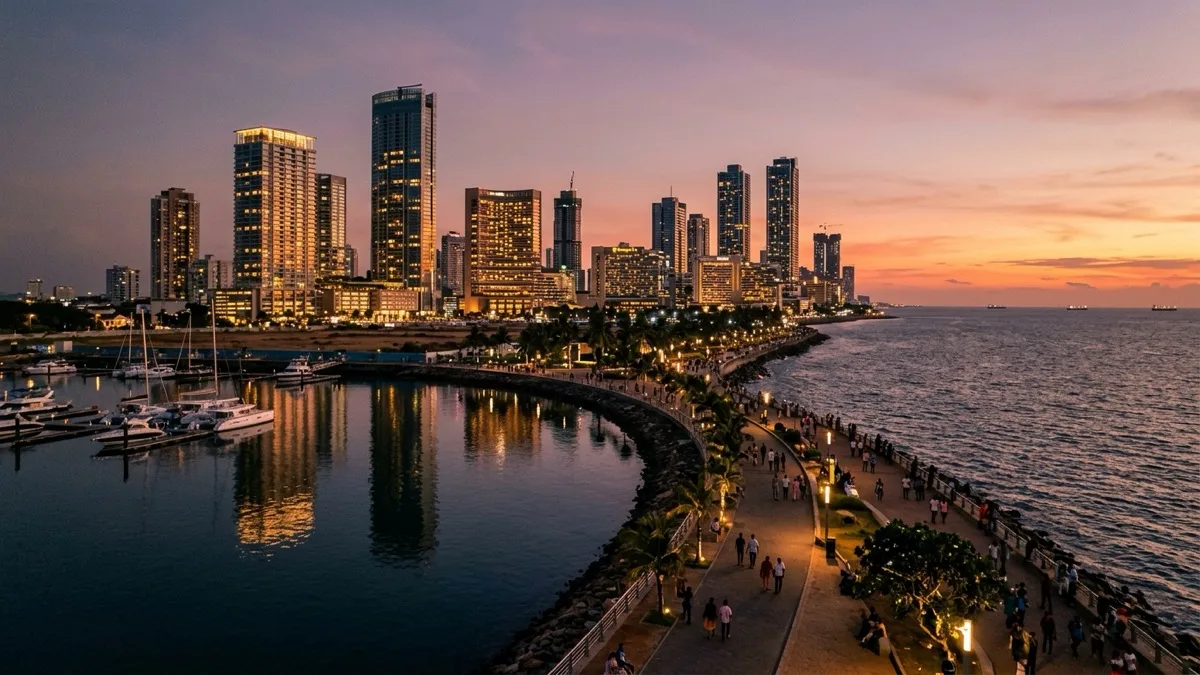
Fiscal Incentive Review at a Glance
- Policy Scope: Reviewing tax exemptions under BOI agreements, SDP Act, and Port City Commission
- Fiscal Benchmark: Aligning revenue generation with 2027 Budget gross borrowing ceiling of LKR 3.8 trillion
- Revenue Objective: Phasing out open-ended corporate tax exemptions while maintaining targeted capital capex allowances
- Target Ratio: Raising tax-to-GDP ratio toward 15% under IMF debt-sustainability commitments
- Investor Protection: Preserving grandfathered clauses on active capital investments to safeguard legal certainty
COLOMBO (SriLankaBiz): Long-standing Port City tax holidays and special investment tax incentives granted under Board of Investment agreements are undergoing formal evaluation by fiscal authorities to widen Sri Lanka direct tax base following the presentation of the 2027 Budget.
Ministry of Finance officials confirmed that the government is assessing whether tax concessions granted under the Strategic Development Projects Act and special economic zone regulations have produced commensurate employment, technology transfer, and net foreign direct investment inflows.
Evaluating Port City Tax Holidays Against Revenue Requirements
Fiscal policy advisers in Colombo point out that the review of Port City tax holidays does not intend to disrupt existing committed contracts, but rather to establish transparent expiration horizons and sunset clauses. The government 2027 Budget estimates gross borrowing requirements at roughly LKR 3.8 trillion, with debt servicing consuming nearly 79% of projected recurrent revenues.
In this environment of strict fiscal consolidation, open-ended corporate exemptions create domestic market distortions between protected concessionaires and unsubsidized domestic businesses paying standard corporate income tax rates of 30%. By recalibrating Port City tax holidays into accelerated capital depreciation allowances, authorities aim to reward tangible physical capital deployment rather than paper profit sheltering.
| Investment Framework | Current Concession Horizon | Standard Domestic Rate | Proposed Rationalisation Approach | Fiscal Policy Impact |
|---|---|---|---|---|
| Port City Businesses of Strategic Importance | Exemptions up to 25 to 40 years | 30% Corporate Income Tax | Time-bound sunset clauses and minimum effective rates | Curbs revenue leakage from base erosion |
| Strategic Development Projects (SDP) Act | Customized corporate tax waivers | Standard Customs, VAT, and CIT | Replaced by capital expenditure investment credits | Directly links incentives to actual capex |
| General BOI Export Manufacturers | Concessionary zero-rated import duties | Standard import tariffs and PAL | Standardized customs screening under Single Window | Prevents leakage into domestic tariff areas |
| Domestic Corporate Sector | Standard tax regime | 30% Corporate Tax + 18% VAT | Maintained without rate increases | Establishes horizontal tax fairness |
Balancing Foreign Investor Confidence and Domestic Tax Equity
International financial institutions, including the IMF and visiting global fund managers, have continually advised Sri Lankan authorities to shift from discretionary corporate tax holidays toward predictable regulatory structures, streamlined customs administration, and stable foreign currency repatriation channels.
A sudden withdrawal of approved privileges risks investor disputes. Treasury planners emphasize that any revisions to Port City tax holidays will apply to prospective applicant projects, while grandfathering existing bilateral commitments. Transparent governance standards and the elimination of ad-hoc ministerial discretion represent the primary goals of the ongoing legislative review.
Implications for Colombo Special Economic Zone Projects
For international developers, institutional tenants, and family offices assessing regional offshore hubs, shifting away from open-ended Port City tax holidays aligns Sri Lanka with global minimum tax standards under the OECD Pillar Two framework. Multinational corporations subject to global minimum taxation cannot exploit un-taxed offshore profits without facing top-up taxes in their home jurisdictions.
Consequently, modernizing the incentives structure around high-quality dispute resolution, commercial arbitration courts, and world-class digital infrastructure provides a more durable competitive foundation than tax waivers alone. The successful realignment of Port City tax holidays will test the government ability to safeguard fiscal sustainability without dampening private investment appetite.