

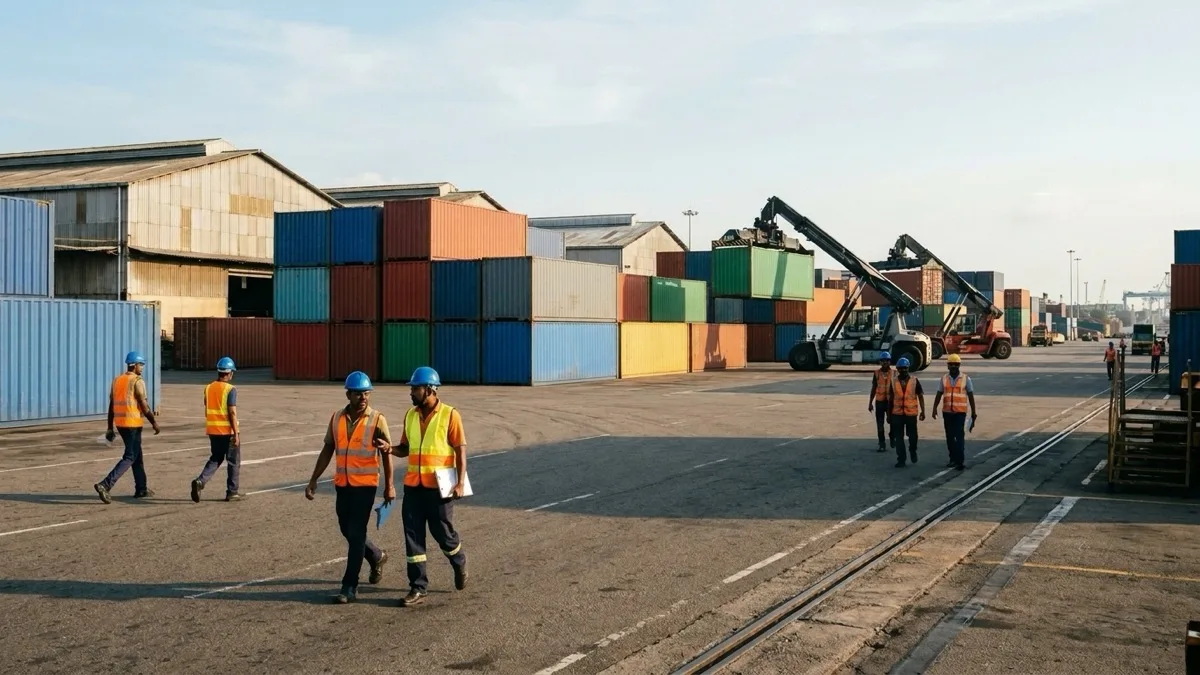
Terminal Expansion Highlights
- Capital Outlay: USD 750 Million deep-water port infrastructure project
- Handling Capacity: Doubled from 1.6 Million TEUs to 3.2 Million TEUs annually
- Berthing Specs: Continuous 1,400-meter quay designed for three ultra-large vessels
- Historic Milestone: Absorbed 2.0 Million TEUs within initial 18 months of operation
COLOMBO (SriLankaBiz): Colombo West International Terminal has doubled its operational container handling capability to 3.2 million TEUs annually following the completion of its 750 million dollar Phase II expansion, project consortium partners Adani Ports and Special Economic Zone, John Keells Holdings, and the Sri Lanka Ports Authority announced.
The major deep-water infrastructure enhancement equips the Port of Colombo with the capacity to berth three ultra-large container vessels concurrently along an uninterrupted 1,400-meter quay wall with a 20-meter draft depth, reinforcing Sri Lanka’s transshipment primacy in the Indian Ocean.
Infrastructure Scale of Colombo West International Terminal
The expansion of the Colombo West International Terminal represents the largest private foreign direct investment project commissioned within the Sri Lankan maritime sector. Developed under a 35-year Build-Operate-Transfer (BOT) public-private partnership, the terminal is owned 51 percent by India’s Adani Ports, 34 percent by blue-chip conglomerate John Keells Holdings PLC (CSE: JKH), and 15 percent by the Sri Lanka Ports Authority (SLPA).
The newly expanded facility features automated ship-to-shore (STS) cranes and electric rubber-tyred gantry (e-RTG) cranes, creating zero-tailpipe-emission yard operations. These technological specifications allow the terminal to process high-density container stacking while reducing average container dwell times.
Remarkably, the terminal crossed the operational milestone of handling 2.0 million TEUs within its first 18 months of phased operations, demonstrating rapid market adoption by major global carrier alliances such as MSC, Maersk, and the Premier Alliance.
| Project Parameter | Phase II Specifications | Strategic Role |
|---|---|---|
| Annual Capacity | 3.2 Million TEUs | Doubled from 1.6M TEUs baseline |
| Total Capital Investment | USD 750 Million | Funded via equity and DFC international loans |
| Quay Wall & Water Depth | 1,400 Meters / 20M Draft | Accommodates 24,000+ TEU mega vessels |
| Consortium Ownership | Adani (51%), JKH (34%), SLPA (15%) | 35-year Build-Operate-Transfer concession |
Commercial and Financial Benefits for John Keells Holdings
For John Keells Holdings, the operational ramp-up of Colombo West International Terminal represents a high-margin foreign currency earnings driver. JKH’s transportation and ports sector is set to record substantial equity earnings contributions as the terminal scales toward steady-state utilization.
Financed with backing from the United States International Development Finance Corporation (DFC), which provided a 553 million dollar long-term debt package, the terminal enjoys a stable financing framework with insulated capital costs.
The strategic integration between Adani Ports’ extensive coastal terminal network in India and the Colombo hub ensures strong base-cargo security. Container cargo moving from Mundra, Hazira, and Ennore is seamlessly consolidated at CWIT before transferring onto trans-Pacific and European services.
Impact on Port of Colombo 2028 National Capacity Target
The rapid expansion of the terminal supports the Sri Lankan government’s broader objective of scaling the Port of Colombo into a 13 million TEU per year mega-hub by 2028. CWIT alone is projected to handle roughly 25 percent of the port’s total container throughput once fully optimized.
By deploying automated deep-water infrastructure ahead of competing Indian Ocean ports, Sri Lanka consolidates its status as the regional logistics nexus. The project demonstrates how private capital partnerships can successfully modernize national utility assets while delivering sustainable foreign exchange dividends to the domestic economy.