

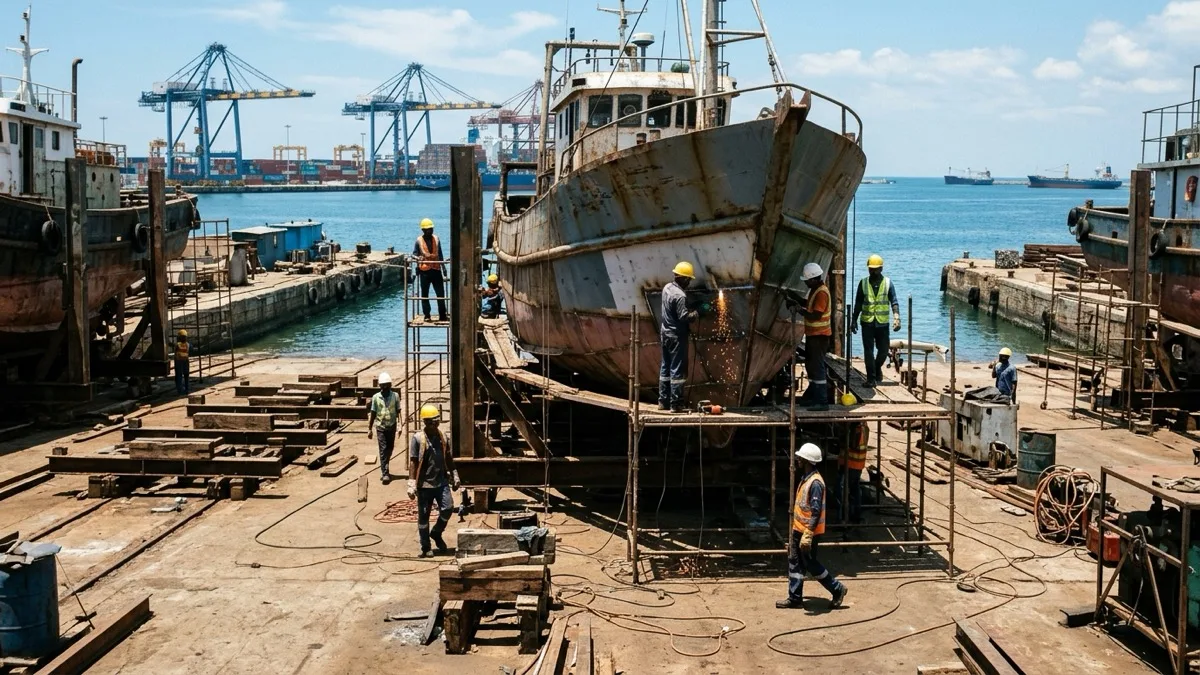
Maritime Strategy at a Glance
- Inaugural Milestone: Advisory Committee on Marine-Based Industries convened Nov 16, 2026
- Joint Leadership: Co-chaired by industry executives Kaushal Rajapaksha and Ricky Barnett
- Primary Objective: Secure alternative coastal land to relocate boatbuilding outside Colombo Port
- Operational Focus: Resolving acute container yard congestion and vessel repair bottlenecks
- Policy Horizon: Aligned with National Export Development Plan (2026 to 2030) and Expo 2027
COLOMBO (SriLankaBiz): The official Marine Advisory Committee launch took place in mid-November 2026 under the auspices of the Export Development Board, initiating a national public-private push to allocate coastal land for boatbuilding and relieve severe yard congestion at the Port of Colombo.
Convened on November 16, the Advisory Committee on Marine-Based Industries brought together senior naval architects, commercial shipyard operators, customs officials, and port planners under the joint leadership of Co-Chairmen Kaushal Rajapaksha and Ricky Barnett.
Strategic Priorities Behind Marine Advisory Committee Launch
A central issue addressed during the session was the critical shortage of usable industrial waterfront land inside the Port of Colombo. As international shipping container throughput expands, heavy fabrication and leisure boat manufacturing occupy valuable dockside space better allocated to transshipment logistics and container handling cranes.
The committee agreed to accelerate site identification along the Western and Southern coastal belts to develop dedicated marine fabrication clusters. Establishing standalone boatbuilding industrial zones outside city limits will permit domestic fabricators to scale vessel construction while lowering port-related rental and utility overheads.
| Strategic Action Area | Lead Implementing Entity | Existing Operational Bottleneck | Targeted Industrial Outcome |
|---|---|---|---|
| Coastal Land Allocation | Urban Development Authority and EDB | Severe space constraints in Colombo Port | Dedicated slipways along southern coast |
| Raw Material Tariff Review | Ministry of Finance and Sri Lanka Customs | Anomalous HS codes on composite resins | Standardized zero-tariff export inputs |
| Ship Repair Capabilities | Colombo Dockyard and Private Operators | Limited drydock turnaround capacity | Expanded regional offshore servicing |
| Nautical Tourism Expansion | Sri Lanka Tourism Development Authority | Underdeveloped marina infrastructure | High-yield superyacht docking facilities |
Harmonized System Codes and Fiscal Tariff Rationalisation
Beyond physical land allocation, the committee prioritized resolving tariff classifications on imported marine inputs. Boat fabricators have long struggled with compounding Port and Airport Development Levies (PAL) and customs duties assessed on marine-grade resin, specialized fiberglass yarn, navigation electronics, and inboard diesel engines.
The committee submitted technical proposals to the Ministry of Finance to align raw material HS codes under bonded warehouse mechanisms, ensuring domestic shipbuilders compete on parity terms with regional competitors in India and Malaysia.
Long-Term Alignment with National Export Targets
The Marine Advisory Committee launch serves as an institutional anchor for the National Export Development Plan (2026 to 2030). Industry stakeholders are preparing a portfolio of investment-ready coastal projects to be showcased at Sri Lanka Expo 2027, highlighting local capabilities in commercial workboats, patrol vessels, and ocean leisure craft.
By coordinating industrial policy between customs, environmental protection agencies, and port authorities, the committee aims to turn Sri Lanka strategic maritime location into sustained industrial revenue, generating high-skilled engineering employment and foreign currency export earnings.