

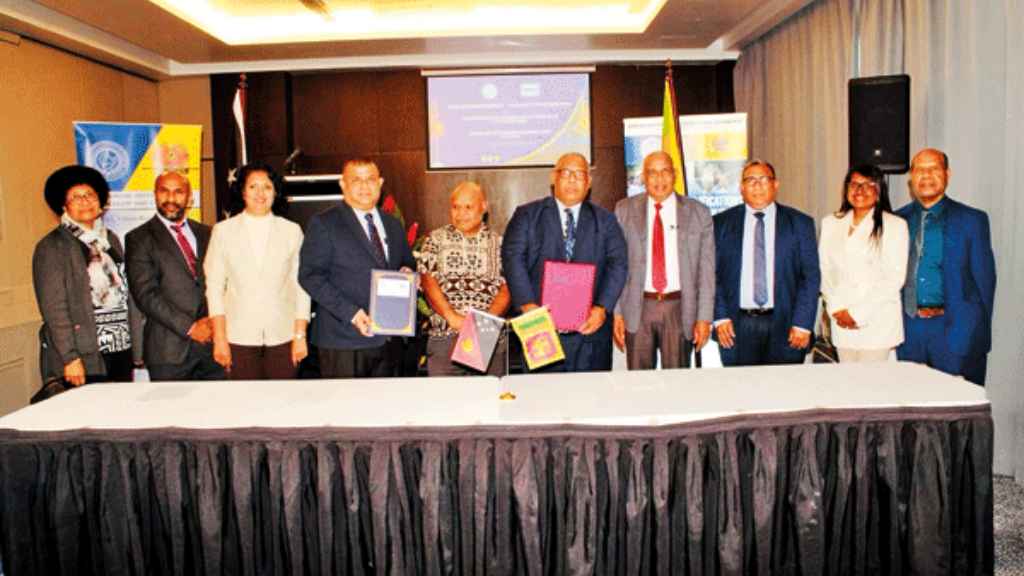
The NIBM SILAG partnership marks a significant step in Sri Lanka’s global education footprint, showcasing how locally developed competency-based learning models can reshape public sector training and higher education systems in emerging economies.
NIBM SILAG partnership supports PNG public service transformation
The collaboration between the National Institute of Business Management (NIBM) and the Somare Institute of Leadership and Governance (SILAG) represents a strategic shift in how Sri Lanka positions its intellectual capital on the global stage. This consultancy initiative is aimed at modernising Papua New Guinea’s public service training ecosystem using NIBM’s Outcome-Based Learning (OBL) framework, which has already been institutionalised within Sri Lanka.
Globally, higher education is transitioning from rigid, content-heavy systems toward flexible, competency-driven models aligned with labour market demands. The NIBM SILAG partnership reflects this shift by addressing one of the most persistent structural issues in education systems—namely, the disconnect between academic output and industry expectations. Traditional teaching methods, often centred on memorisation and examination performance, have increasingly failed to produce graduates equipped with practical, workplace-ready skills.
NIBM’s OBL framework reverses the conventional curriculum design process. Instead of focusing on content delivery, it begins with clearly defined learning outcomes aligned with industry requirements. From there, curricula, teaching methodologies, and assessment mechanisms are structured to ensure that learners acquire measurable competencies. This approach produces graduates with both Technical Competencies (TC) and Career Readiness Competencies (CRC), including communication, adaptability, and problem-solving capabilities.
The NIBM SILAG partnership is particularly notable as it marks one of the first instances of a Sri Lankan state-owned education institution exporting its pedagogical model as an intellectual service. This aligns with broader economic objectives of transitioning from labour and commodity exports to knowledge-based services. It also provides a practical reference point for Sri Lanka’s ongoing education reform agenda led by the Ministry of Education Sri Lanka.
Under the agreement, SILAG will undergo a structured transformation to become a premier public sector training institution in Papua New Guinea. The reform framework includes strengthening governance, enhancing ICT infrastructure, implementing quality assurance systems, and diversifying revenue streams to ensure financial sustainability. A key long-term objective is the transition of SILAG into the Somare Public Service University by 2027, with full institutional consolidation expected by 2029.
The Papua New Guinea context adds further relevance to the initiative. SILAG, historically linked to the country’s independence movement, has long been a central institution in public administration training. However, evolving governance demands and economic complexities necessitated a modern, results-oriented training model. NIBM was selected due to its demonstrated success in improving graduate employability and fostering entrepreneurial skills within Sri Lanka.
A critical component of the NIBM SILAG partnership is its focus on embedding competency-based progression within the public service. This ensures that appointments and promotions are tied to structured training outcomes rather than tenure alone. Such a system introduces meritocracy, accountability, and performance-driven career pathways within the public sector.
From a Sri Lankan perspective, the partnership offers valuable lessons for domestic reforms. The country continues to grapple with graduate unemployment and skill mismatches, particularly in non-technical disciplines. NIBM’s model directly addresses this gap by integrating real-world applications such as internships, business simulations, and project-based learning into academic programmes.
Events such as the “NIBM | Beyond Books (OBL Expo) 2024” have demonstrated how students can translate theoretical knowledge into practical outputs across sectors including IT, business, and entrepreneurship. This experiential learning model enhances employability while also encouraging innovation and self-employment.
Entrepreneurship is another pillar reinforced through NIBM’s ecosystem. Initiatives such as the NEO Ventures Hub, launched with the support of Harini Amarasuriya, provide a structured pathway for students to convert ideas into viable business ventures. This aligns with national policy priorities to cultivate job creators rather than job seekers, particularly in a rapidly digitising global economy.
The broader implications of the NIBM SILAG partnership extend into the domain of soft power. By exporting educational expertise, Sri Lanka enhances its international influence through knowledge sharing and institutional collaboration. This form of engagement strengthens bilateral relationships, supports capacity building in partner nations, and positions Sri Lanka as a credible player in global education reform.
The concept of “intellectual minerals” encapsulates this shift—referring to the monetisation of a nation’s cognitive and creative capabilities. As global demand grows for specialised knowledge services, education consultancy emerges as a high-value export segment with significant growth potential.
For policymakers, the key takeaway is that structural reforms in education must be complemented by systemic changes in teaching philosophy, institutional governance, and industry engagement. The success of competency-based models such as OBL underscores the need for a holistic transformation that prioritises outcomes over processes.
As Sri Lanka advances its 2026 education reform agenda, the NIBM SILAG partnership provides a validated framework for aligning education systems with economic realities. It demonstrates that when education is designed around measurable competencies and real-world applicability, it can serve as a catalyst for both individual advancement and national development.