

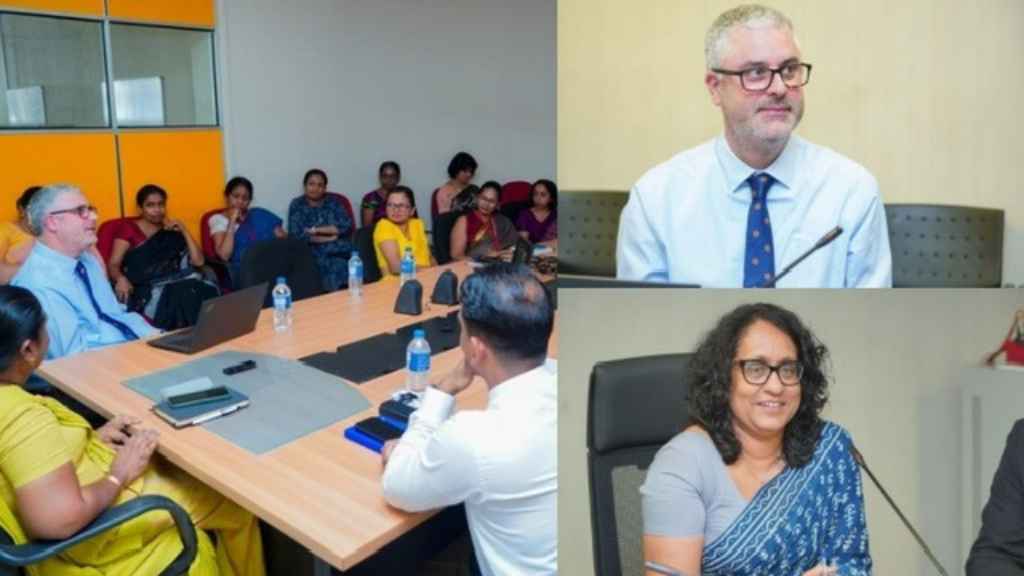
Prof. Harding meets PM on new education evaluation reforms, aiming to align Sri Lanka’s classroom assessment system with international standards while reducing pressure on students and teachers under the Grade 6 module-based framework.
Prof. Harding meets PM to discuss Sri Lanka’s new assessment and evaluation reforms
A landmark meeting took place at the Ministry of Education, Isurupaya, between Prime Minister Dr. Harini Amarasuriya, Minister of Education, Higher Education and Vocational Education, and Professor Luke William Harding, a globally recognised expert in language research and educational assessment. The discussions focused on implementing new education evaluation reforms to enhance learning outcomes in Sri Lanka.
Professor Harding, visiting Sri Lanka from March 20 to 25, 2026, engaged in policy discussions and workshops with key stakeholders including the Digital Task Force, the Evaluation and Assessment Committee, the Department of Examinations, the National Institute of Education, and the National Education Commission. He also led a dedicated session on teacher professional development, emphasising the importance of equipping educators with the tools to assess students effectively and fairly.
During the meeting, the Prime Minister highlighted that the proposed evaluation system, particularly for Grade 6, will be module-based and aligned with international best practices. She stressed that teachers must receive clear guidance to ensure classroom activities are assessed qualitatively, supporting students’ abilities and fostering learning without imposing undue pressure. The reforms are designed to help students identify strengths, pursue personal growth, and achieve educational goals in a balanced and supportive environment.
Deputy Minister Dr. Madura Seneviratne, Ministry Secretary Nalaka Kaluwewa, Commissioner General of Examinations Indika Liyanage, and members of the Education Reform Evaluation Committee were also present at the meeting. Together, they discussed practical strategies for implementing the framework, focusing on assessment standardisation, data-driven evaluation, and continuous teacher training.
Professor Harding noted that global education systems increasingly prioritise formative assessment over purely exam-based evaluation. He emphasised that meaningful, qualitative assessment allows teachers to provide targeted feedback and enables students to engage more actively in their learning journey. By introducing these reforms, Sri Lanka seeks to modernise its education sector, providing students with globally competitive skills while nurturing creativity and critical thinking.
The discussions also addressed the integration of technology into the assessment process. The Digital Task Force shared insights on digital platforms that can support module-based assessments, record progress, and streamline teacher reporting. The collaborative approach ensures that both traditional teaching methods and innovative digital tools contribute to the evaluation process.
The Ministry of Education anticipates that the new assessment framework will be gradually rolled out across schools, beginning with pilot programs for Grade 6 classes. These reforms are expected to create a foundation for long-term improvements in education quality, aligning Sri Lanka’s schooling system with international benchmarks and best practices.
By engaging international experts like Professor Harding and coordinating with local education authorities, the government aims to implement reforms that are evidence-based, practical, and contextually relevant. Teacher training remains a central pillar, ensuring educators are fully prepared to apply the evaluation system effectively and consistently.
As the reform process advances, stakeholders emphasise transparency, continuous monitoring, and iterative feedback to refine assessment methods. The engagement with Professor Harding underscores Sri Lanka’s commitment to education excellence, student-centred learning, and building a robust foundation for future generations.