

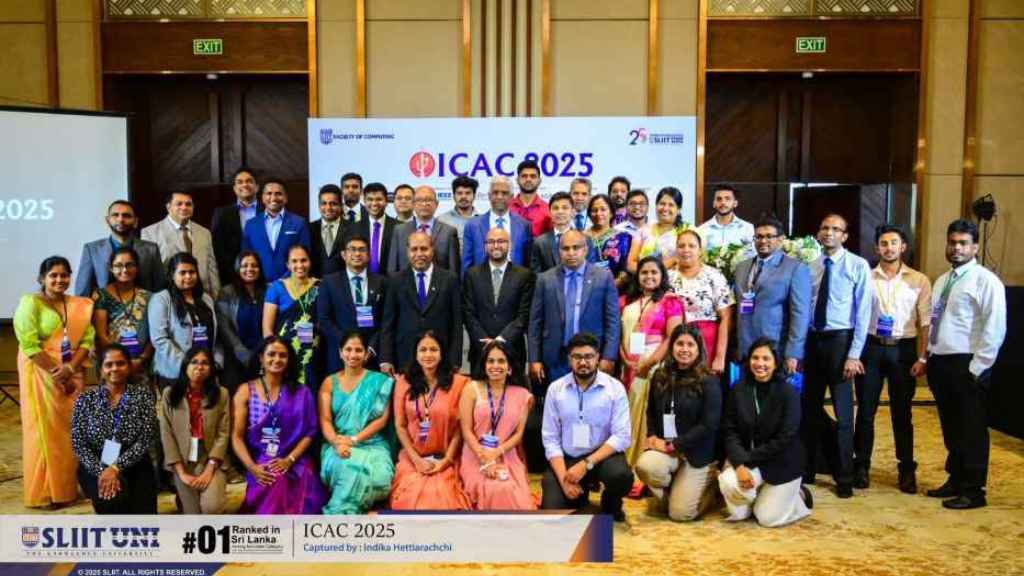
SLIIT ICAC 2025 concluded in Sri Lanka this December, positioning the country at the forefront of global discussions on artificial intelligence, quantum computing, and next-generation digital technologies shaping the future of modern computing research.
SLIIT ICAC 2025 highlights global research in AI, quantum and emerging technologies
SLIIT ICAC 2025 has reinforced Sri Lanka’s growing prominence in global computing research, bringing together leading academics, industry practitioners, and early career researchers to explore the future of advanced digital technologies. The International Conference on Advancements in Computing concluded on December ninth and tenth at Monarch Imperial in Sri Jayawardenepura Kotte under the theme “The Future of Computing: AI, Quantum and Beyond.”
Organised by the Faculty of Computing at SLIIT, the conference served as a critical platform for intellectual exchange, interdisciplinary collaboration, and the dissemination of high-impact research. Over two intensive days, participants engaged in discussions that spanned artificial intelligence, quantum computing, data science, networking, software engineering, and emerging computational paradigms shaping the next era of technology.
The scale and competitiveness of ICAC 2025 highlighted its growing international stature. Nearly two thousand authors submitted a total of 462 research papers across twelve technical tracks, reflecting strong global interest and academic rigour. Following a stringent double-blind peer review process, only 116 papers were selected for presentation, ensuring a high standard of originality, relevance, and scholarly contribution across all accepted research.
Keynote addresses provided strategic depth to the conference agenda. Distinguished speakers Professor Igor Bray, John Curtin Distinguished Professor at Curtin University in Australia, and Professor Carson Kai Sang Leung from the University of Manitoba in Canada, delivered insights that bridged theoretical research with real-world application. Their presentations underscored the global relevance of computing research emerging from forums such as ICAC and its role in shaping technology-driven economies.
Beyond paper presentations, SLIIT ICAC 2025 distinguished itself through a comprehensive programme of pre- and post-conference workshops designed to enhance practical learning and interdisciplinary engagement. Pre-conference workshops conducted during the event covered topics including Internet of Things and networking for crisis management, confidential federated computing, generative artificial intelligence tools for research workflows, text analytics for user-generated content, and agentic AI for enterprise transformation. These sessions enabled participants to engage directly with cutting-edge methodologies and tools used in contemporary research and industry.
The post-conference workshops, scheduled following the main event, extend this learning experience through hands-on exposure to advanced computing applications. These sessions include the use of generative adversarial networks in medical image analysis, an interdisciplinary research workshop, and a three-day MongoDB educator training programme. Together, they reflect ICAC’s emphasis on applied research, skill development, and industry relevance.
SLIIT ICAC 2025 continues to build its reputation as a premier Scopus-indexed academic conference. The event has achieved a Google Scholar h-index of 16, signalling its growing citation impact and research influence. Technical co-sponsorship from the IEEE Sri Lanka Section further strengthened the conference’s credibility, while all accepted and presented papers are slated for submission to IEEE Xplore, subject to established quality and scope requirements.
Industry collaboration played a central role in the conference’s success. MongoDB participated as the Platinum Sponsor, alongside key partners including Curtin University Colombo, SLIIT Research and International, Sysco LABS, Creative Software, Peoples Leasing, and the ICT Academy of India. These partnerships underscored the conference’s relevance to both academic research and enterprise innovation.
Reflecting on the event’s impact, Dr Prasanna Sumathipala, General Chair of ICAC 2025, described the conference as a celebration of innovation, collaboration, and the future of computing. He noted that the strength of the technical programme, the calibre of international keynote speakers, and the breadth of workshops collectively pushed the boundaries of knowledge across artificial intelligence, quantum technologies, and emerging computing disciplines.
The success of SLIIT ICAC 2025 illustrates the growing role Sri Lankan academic institutions play in global research ecosystems. By fostering dialogue between academia and industry, encouraging early career researchers, and maintaining rigorous publication standards, the conference has strengthened international research networks and inspired new directions for innovation.
As computing technologies continue to evolve at an unprecedented pace, forums such as ICAC serve as critical incubators for ideas that will define future digital infrastructure, intelligent systems, and data-driven societies. With its expanding reach and strong scholarly foundation, ICAC 2025 has firmly positioned itself as an influential voice in shaping the future of computing research.