

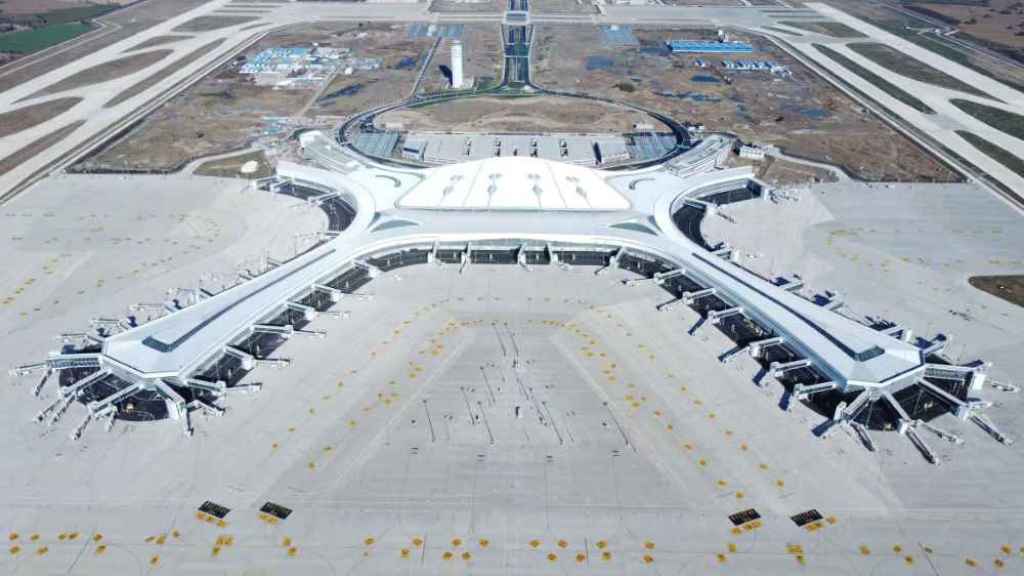
Hohhot Air Silk Road hub development reached a major milestone as Shengle International Airport completed its on-site verification test flight, signalling Inner Mongolia’s first 4F-class airport is entering the final stage before full commercial operations.
Hohhot Air Silk Road hub advances as Shengle International Airport nears opening
The successful completion of a calibration aircraft test flight at Hohhot Shengle International Airport marks a decisive step in establishing the Hohhot Air Silk Road hub as a strategic gateway connecting China with Eurasia. The smooth landing on November 25 confirmed that Inner Mongolia’s first 4F-class airport has transitioned from construction into operational readiness, placing it among China’s most advanced aviation facilities.
As a 4F-class airport, Shengle International Airport meets the highest civil aviation standards, enabling it to accommodate the world’s largest and most technologically advanced commercial aircraft. This classification positions the airport as a key regional aviation centre, a critical alternative landing site within the Beijing–Tianjin–Hebei airport cluster, and a Class I international aviation port. Its role extends beyond domestic connectivity, aligning closely with China’s Belt and Road Initiative by strengthening east–west and cross-border transport links.
Hohhot’s rise as a modern aviation hub is deeply rooted in history. For centuries, the city has served as a natural crossroads where commerce, culture, and movement converged. During the Northern Wei Dynasty, Shengle functioned as a strategic capital controlling vital routes between the Central Plains, grasslands, and desert regions. In later dynasties, trade corridors extending toward Mongolia and Russia passed through Hohhot, cementing its role as a conduit for economic exchange long before modern infrastructure emerged.
This legacy continued through the Qing Dynasty, when Guisui City became a crucial node on the Grassland Silk Road. From the late seventeenth century to the early twentieth century, the historic Tea Road, stretching over 13,000 kilometres from southern China to Russia, ran directly through Hohhot. Merchants, travellers, and caravans transformed the city into a vibrant centre of international trade and cultural interaction, laying foundations that resonate in its present-day ambitions.
Today, those historic routes are being reimagined in the sky. Shengle International Airport is designed to anchor the modern “Air Silk Road,” linking North China with Mongolia, Russia, and onward to Europe. The airport’s strategic positioning enables it to function as a northern gateway, reinforcing Hohhot’s integration into regional and global aviation networks while supporting China’s broader connectivity strategy.
Architecturally, the airport reflects both innovation and cultural identity. From an aerial perspective, the terminal resembles a finely crafted saddle, symbolising the horse-riding heritage of the grassland cultures that shaped the region. The terminal’s 600-metre-long eave, inspired by the flowing khata ceremonial scarf, creates a welcoming gesture to arriving passengers. Inside, skylights formed by spindle columns, cables, and inflatable membranes evoke the structure of a traditional Mongolian yurt, allowing natural light to frame expansive views of sky and cloud.
Beyond its design, Shengle International Airport is engineered as a functional platform for global engagement. As a key node along the Belt and Road land corridor and the China–Mongolia–Russia economic corridor, the airport strengthens logistical efficiency while supporting passenger mobility, cargo throughput, and international exchange. Its development signals a shift in Hohhot’s economic orientation toward high-value connectivity and services.
Capacity projections underline the airport’s long-term ambitions. By 2030, Shengle International Airport aims to handle 28 million passengers annually, process 320,000 tonnes of cargo and mail, and support 244,000 aircraft movements. Looking further ahead to 2050, passenger numbers are expected to rise to 65 million, cargo volumes to 800,000 tonnes, and aircraft movements to exceed 500,000 annually, positioning the airport among China’s major aviation hubs.
Recognising the needs of international travellers, the airport has also invested heavily in digital infrastructure. Civil communication facilities have been completed ahead of opening, with a seamless access plan implemented to ensure uninterrupted connectivity. All three major telecommunications operators operate on a shared network, allowing passengers to remain connected from arrival through departure, a critical feature for business and transit travellers.
Route expansion forms a central pillar of future growth. By 2025, Hohhot is set to deepen cooperation with Xi’an and Qingdao airports, leveraging their extensive international networks. Through these partnerships, transfer services will link Hohhot to destinations across Japan, South Korea, Central Asia, Southeast Asia, and Northwest China, expanding its reach as a transit hub.
In parallel, Hohhot’s geographic proximity to Russia and Mongolia supports the development of new transfer corridors connecting Northeast and Northwest China with Eurasian markets. These aerial bridges are expected to stimulate trade, tourism, and cultural exchange while reinforcing the Hohhot Air Silk Road hub’s strategic value.
As Shengle International Airport rises above the grasslands, it represents more than infrastructure. It symbolises continuity between history and modern ambition, transforming ancient trade routes into contemporary air corridors. With its official opening approaching, the airport is poised to inject fresh momentum into Inner Mongolia’s development and strengthen China’s northern gateway to the world.