

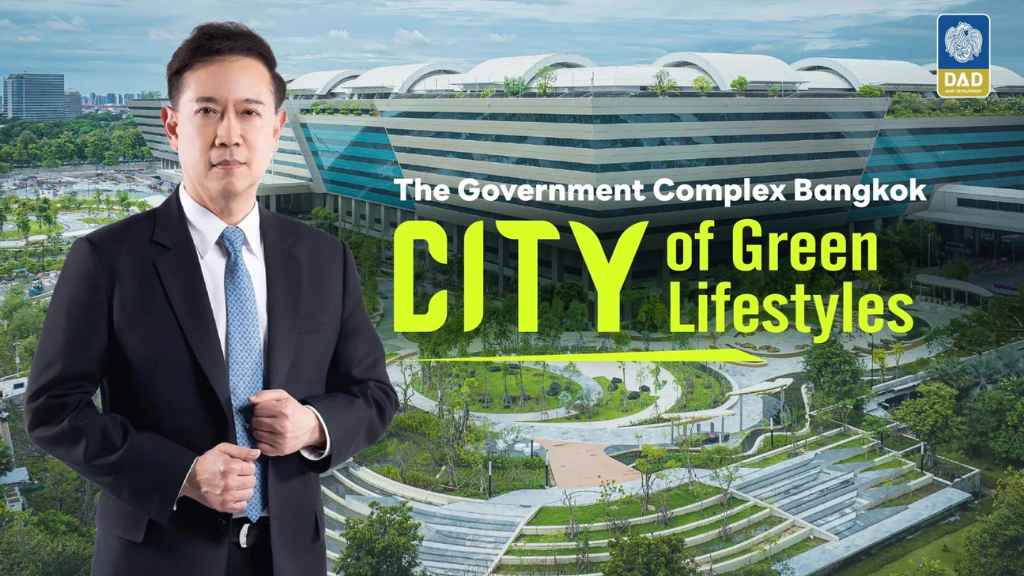
Thailand Green Government City has officially taken shape in Bangkok as Dhanarak Asset Development transforms the Government Complex into a walkable, climate-responsive urban environment, positioning state-led development at the forefront of sustainable city planning in Southeast Asia.
Thailand Green Government City reshapes Bangkok’s Government Complex
Thailand Green Government City has emerged as a defining example of how public-sector land can be reimagined to meet the demands of climate resilience, human wellbeing, and modern urban life. Announced in Bangkok by Dhanarak Asset Development Co., Ltd. (DAD), the state-owned enterprise managing Thailand’s Government Complex, the project marks the country’s first fully integrated green government city concept.
The multi-year redevelopment reflects a strategic shift in how government districts are planned and experienced. Rather than functioning solely as administrative enclaves, the Government Complex is now positioned as shared civic infrastructure, where environmental performance, accessibility, and public use are central design priorities. Under the leadership of DAD President Dr. Nalikatibhag Sangsnit, the initiative reframes state-owned land as a living part of the city rather than a restricted bureaucratic zone.
For decades, Thailand’s government precincts were designed primarily to process paperwork and house institutions, often isolating them from surrounding communities. The transformation of the Government Complex challenges that legacy by prioritising how people move, interact, and experience public space throughout the workday. The result is an environment that supports walking, social connection, and daily contact with nature, while maintaining its core administrative functions.
At the heart of the redevelopment is a newly completed 5.1-rai landscaped connector linking Buildings B and C within the complex. Previously dominated by vehicular traffic and noise mitigation infrastructure, the corridor has been converted into a pedestrian-focused green passage that connects offices, public transport access points, and shared amenities. This intervention redefines circulation within the site, encouraging walking and reducing reliance on internal vehicle movement.
Designed as climate-responsive urban infrastructure, the landscaped connector plays multiple roles beyond aesthetics. Expanded tree canopy reduces surface temperatures, permeable ground treatments improve stormwater absorption, and shaded pathways enhance comfort in Bangkok’s tropical climate. By functioning simultaneously as a climate buffer and a social space, the area supports both environmental performance and daily human activity.
A notable aspect of the project is its decision to open previously restricted government land to broader public use. This move softens the physical and symbolic boundary between the Government Complex and the surrounding city, allowing citizens to engage with the space for exercise, informal meetings, and community interaction. In doing so, the initiative challenges traditional notions of how government precincts relate to urban life.
The Thailand Green Government City initiative aligns closely with national sustainability priorities, including environmental, social, and governance principles and the country’s bio-circular-green economic framework. Design interventions across the complex focus on increasing green cover, expanding permeable surfaces, and creating flexible spaces that can adapt to different forms of use throughout the day and year.
Over the past six years, DAD has increased green space within the Government Complex by more than 47 rai. When combined with adjacent landscaped zones, the total green area now exceeds 138 rai, forming one of the largest continuous public green spaces in northern Bangkok. This scale underscores the project’s ambition, demonstrating that incremental, system-based transformation can deliver city-level impact without large-scale land acquisition.
Urban analysts note that the project’s emphasis on repurposing existing assets offers a replicable blueprint for other governments across Asia, where the public sector remains one of the largest landholders. Instead of relying on headline megaprojects, the approach focuses on gradual adaptation, integrating sustainability into everyday infrastructure decisions.
International recognition has reinforced the project’s credibility. In 2025, DAD became the only public-sector organisation to secure Asia-level International Innovation Awards for two consecutive years. The accolades recognised the Government Complex Smart City initiative and the GCC Super Application, a digital platform that integrates transport guidance, navigation, and public services across the complex. Selected from more than 160 entries across 30 countries, the awards highlight Thailand’s growing leadership in sustainable, technology-enabled public administration.
For Dr. Nalikatibhag, the significance of Thailand Green Government City extends beyond architecture or landscape design. It reflects a broader redefinition of the state’s role in shaping urban environments. By demonstrating that sustainability can improve health outcomes, reduce environmental stress, and enhance social interaction, the project positions green infrastructure as both economically rational and socially necessary.
As cities across the region grapple with climate pressures, population density, and declining public space, the Government Complex Bangkok stands as evidence that government-led development can model more humane, balanced urban futures. In this context, governance itself becomes part of the urban experience, shaped by how spaces support daily life rather than merely how institutions operate within them.