

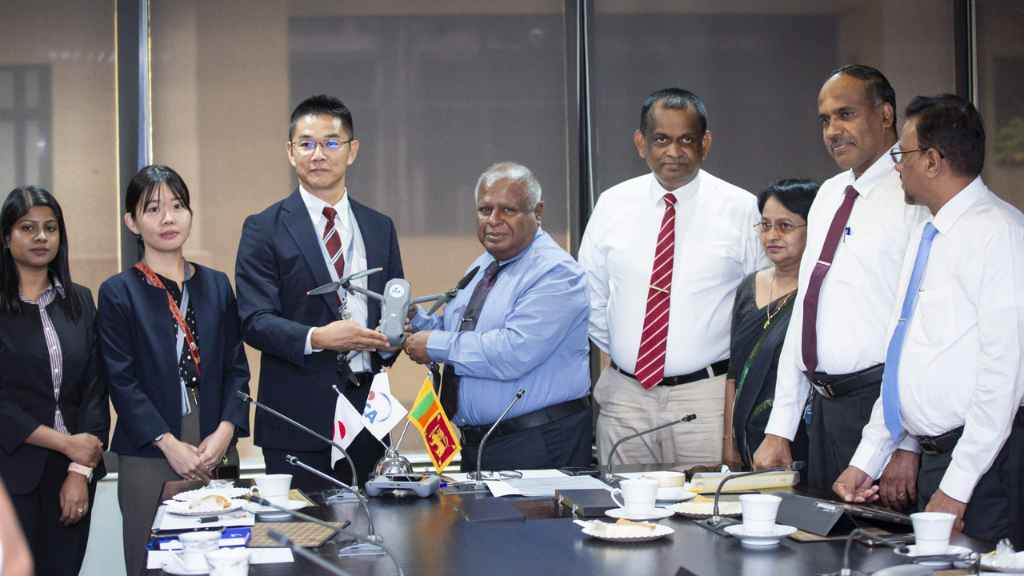
JICA drones for Sri Lanka RDA have been deployed to strengthen landslide prevention and emergency response across the national road network. The advanced aerial systems were handed over following urgent requests after Cyclone Ditwa, marking a significant upgrade in disaster-risk monitoring capacity.
JICA drones for Sri Lanka RDA strengthen landslide risk response after Cyclone Ditwa
The Japan International Cooperation Agency has provided advanced unmanned aerial vehicles to the Road Development Authority under a technical cooperation initiative aimed at enhancing resilience in road transportation. The project, titled the Project for Strengthening the Capacity of Landslide Disaster Prevention for Resilient Road Transportation in Sri Lanka (2025–2028), focuses on improving hazard screening, slope evaluation, data management, and rapid response in landslide-prone districts.
The deployment follows severe weather linked to Cyclone Ditwa, which exposed vulnerabilities along key transport corridors. In response, the RDA sought aerial reconnaissance tools capable of conducting high-precision terrain analysis without exposing engineers to unstable slopes. According to Minoru Matsunoshita, Senior Representative of the Japan International Cooperation Agency Sri Lanka Office, the newly delivered drones will be used to examine hazardous slopes from the air and expand field investigations in affected regions beginning March 2026.
From a technical standpoint, the drones significantly expand the RDA’s surveillance and diagnostic capability. Equipped with high-resolution imaging sensors and advanced mapping systems, they allow engineers to perform real-time assessment of damaged terrain, generate accurate topographic surveys, and construct three-dimensional models of unstable slopes. This enables early identification of high-risk locations and supports the design of targeted mitigation measures such as slope reinforcement, drainage correction, and controlled debris removal.
The integration of aerial data into decision-making processes marks a structural shift in how Sri Lanka manages landslide risks along its road infrastructure. Historically, slope inspections relied heavily on ground-based surveys, which are time-consuming, labor-intensive, and sometimes hazardous during post-cyclone conditions. Drone-enabled assessments reduce response time while improving spatial accuracy, allowing authorities to prioritise interventions based on empirical risk metrics rather than visual estimation alone.
Under the project framework, teams comprising RDA engineers and Japanese experts will conduct wide-area field surveys across cyclone-affected districts. The objective is twofold: first, to assess the structural integrity of slopes and embankments; and second, to determine appropriate emergency stabilisation measures at each critical site. The findings will also inform the selection of pilot areas for long-term resilience planning.
A key institutional gain lies in the integration of drone-generated data into the Sri Lanka Road Asset Management System. By embedding high-resolution geospatial datasets within the existing infrastructure database, authorities can strengthen predictive modelling, track slope deterioration patterns, and enable faster mobilisation during extreme weather events. This data interoperability enhances coordination between engineering teams, disaster management units, and policymakers.
The initiative reflects broader cooperation between Sri Lanka and Japan in climate adaptation and infrastructure resilience. Landslides remain one of the most persistent natural hazards affecting the island’s central highlands and transport arteries, particularly during monsoon and cyclone seasons. Disruptions to national roads carry economic costs, interrupt supply chains, and delay emergency services, underscoring the importance of preventive monitoring.
The JICA-supported programme emphasises capacity building alongside technology transfer. While the drones provide immediate operational advantages, the long-term objective is to institutionalise advanced hazard-screening methodologies within the RDA. Training components are expected to strengthen technical competencies in aerial data interpretation, geotechnical risk mapping, and digital modelling.
In addition to rapid hazard detection, the drones support continuous monitoring of vulnerable road sections. Periodic aerial scans can detect early signs of slope movement, surface cracking, or drainage blockages. Such pre-failure indicators are critical in reducing the probability of catastrophic slope collapse. By shifting from reactive repairs to predictive maintenance, the RDA can optimise resource allocation and reduce lifecycle costs associated with road rehabilitation.
The handover of JICA drones for Sri Lanka RDA also signals a shift toward evidence-based disaster management. Rather than relying solely on historical risk maps, authorities can now generate updated terrain analytics following each extreme weather event. This enhances resilience planning not only for current infrastructure but also for future road development in landslide-prone corridors.
As climate variability intensifies, infrastructure agencies face increasing pressure to combine engineering discipline with digital innovation. The deployment of these advanced systems represents a strategic step in aligning Sri Lanka’s road management practices with international resilience standards. Over the 2025–2028 project period, the accumulated data and field experience are expected to inform national policy on slope stabilisation and disaster-ready transport systems.
By embedding aerial intelligence into operational workflows, the initiative strengthens institutional preparedness while protecting critical road networks that underpin economic activity and regional connectivity.