

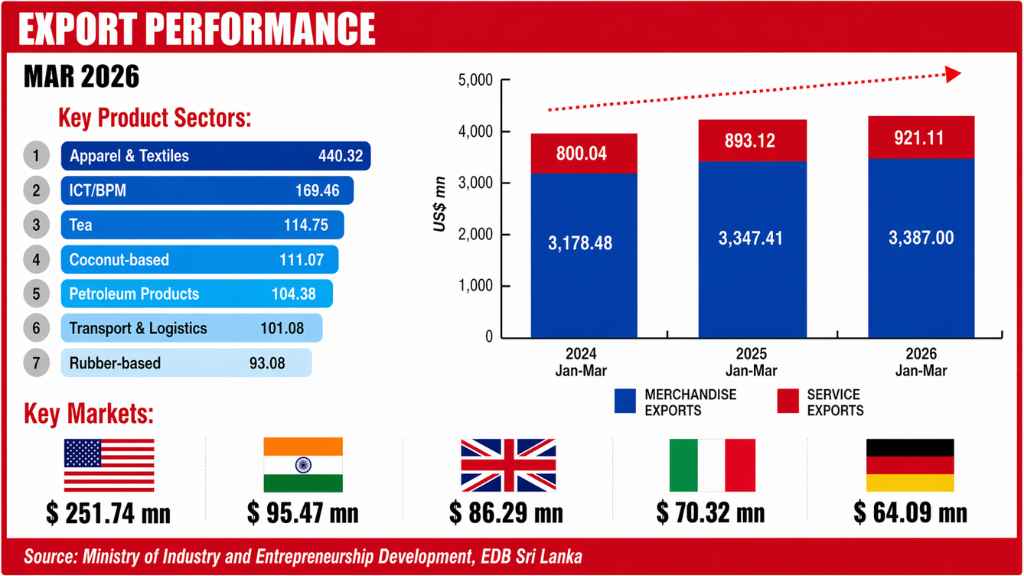
1Q exports edge up to $ 4.3 b as Sri Lanka’s export sector demonstrated resilience in early 2026, even as escalating geopolitical tensions disrupted global trade flows and weighed heavily on March performance.
1Q exports edge up to $ 4.3 b despite Middle East disruptions
Sri Lanka’s total export earnings reached over $ 4.3 billion in the first quarter of 2026, marking a modest 1.6% year-on-year increase, according to the Sri Lanka Export Development Board. Merchandise exports grew by 1.2% to surpass $ 3.3 billion, while services exports expanded by 3.13% to $ 921.11 million, supported by steady growth in ICT/BPM, logistics, financial services, and construction.
However, the positive quarterly trajectory masked a notable contraction in March. Total exports for the month declined 5.2% year-on-year to $ 1.46 billion, reflecting the direct impact of geopolitical instability in the Middle East. Industry sources attributed the downturn to disruptions in shipping routes, particularly linked to tensions surrounding the Strait of Hormuz, which triggered delays, rerouting of cargo, and increased operational costs.
Merchandise exports in March fell by 4.94% to $ 1.18 billion, while services exports dropped by 6.26% to $ 286.92 million. On a month-on-month basis, exports declined 10.63% compared to February, underscoring the severity of the disruption.
EDB Chairman and CEO Mangala Wijesinghe described the first-quarter outcome as a reflection of underlying resilience. He noted that despite short-term setbacks, the sector continues to show signs of recovery supported by stable merchandise trade and a growing contribution from services.
The apparel and textiles sector remained the largest contributor to export earnings, generating $ 1.27 billion during the January–March period. However, the sector contracted by 8.06% year-on-year, largely due to weaker demand in key markets such as the United States and the European Union. Exports to the US declined by 6.37%, while shipments to the EU and the United Kingdom also recorded notable decreases.
In contrast, several emerging sectors demonstrated strong growth momentum. Coconut-based exports increased by over 20%, reaching $ 314.09 million, driven by higher demand for value-added products such as coconut oil, desiccated coconut, and activated carbon. Electrical and electronic components (EEC) exports surged by 44.18% to $ 142.02 million, reflecting robust performance in transformers, cables, and industrial components.
Processed food and beverages also recorded significant gains, with export earnings rising by 26.05% to $ 174.5 million. Similarly, seafood exports expanded by 30.93% to $ 63.16 million, supported by strong demand for fresh and frozen fish.
On the services front, ICT/BPM exports grew by 31.15% to $ 468.72 million, while financial services exports increased by 38.23%, highlighting the sector’s increasing role in Sri Lanka’s export mix. These gains reinforce the importance of services as a stabilizing factor amid volatility in goods exports.
Despite these positive developments, several traditional export sectors faced headwinds. Tea exports declined by 5.22% to $ 351.58 million, while rubber and rubber-based products recorded a marginal decrease of 0.96%. Spices and essential oils also contracted by 5.38%, largely due to sharp declines in pepper and clove exports.
Geographically, export performance varied across markets. While exports to India grew by 12.02%, making it Sri Lanka’s second-largest export destination, shipments to the US and UK declined due to softer demand and trade constraints. The United Arab Emirates experienced a sharp contraction, particularly in March, reflecting the broader impact of regional tensions.
Meanwhile, markets such as Italy, Belgium, China, and Japan recorded positive growth, indicating diversification efforts are beginning to yield results. Exports to the EU overall increased modestly during the quarter, providing some offset to declines in traditional Western markets.
Looking ahead, Sri Lanka has set an ambitious export target of $ 20 billion for 2026, aiming for 10–12% growth. Merchandise exports are projected to exceed $ 15.7 billion, while services exports are expected to reach $ 4.3 billion. These targets align with a broader long-term strategy to boost export earnings to $ 36 billion by 2030 through value addition, market diversification, and expansion of services exports.
While the March downturn highlights the vulnerability of global trade to geopolitical shocks, the broader 1Q exports edge up to $ 4.3 b trend suggests that Sri Lanka’s export sector retains a degree of structural resilience. Sustained policy support, coupled with diversification into high-growth sectors, will be critical in maintaining momentum amid an uncertain global environment.