

Hambantota International Port attracts major global shipping lines as leading container operators explore new routing options. The engagement reflects shifting global trade dynamics driven by geopolitical uncertainty and evolving maritime logistics strategies in the Indian Ocean region.
Hambantota International Port attracts major global shipping lines amid shifting trade routes
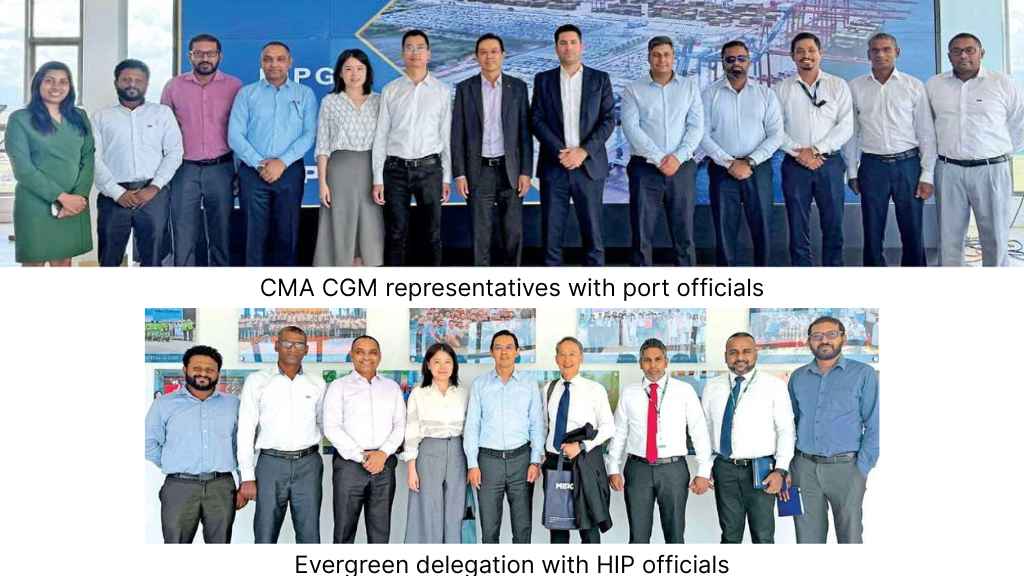
Hambantota International Port Group (HIPG) has recently hosted senior representatives from two of the world’s leading container shipping companies, CMA CGM and Evergreen Marine Corporation, marking a notable increase in international commercial engagement at the facility. The discussions focused on the potential introduction of new container services through Hambantota as global shipping networks continue to adjust to evolving geopolitical and operational pressures.
The growing interest comes at a time when instability in parts of the Middle East is prompting major carriers to reassess traditional East–West trade routes. In this context, Hambantota International Port attracts major global shipping lines seeking alternative hubs that offer operational resilience and strategic positioning along critical maritime corridors.
Located just 10 nautical miles off one of the world’s busiest shipping lanes, Hambantota International Port has steadily emerged as a potential transshipment and logistics hub in the Indian Ocean. Its geographic advantage allows vessels to access key international routes without significant deviation, making it increasingly attractive for carriers seeking efficiency and risk diversification.
According to port officials, the recent visits by CMA CGM’s overseas representatives and Evergreen Marine’s local team reflect exploratory engagements aimed at evaluating the port’s operational readiness. Discussions reportedly covered container handling capacity, yard availability, turnaround times, and potential service integration opportunities.
Industry observers note that the current global shipping environment has created a unique window of opportunity for emerging ports. With supply chain disruptions, route volatility, and rising geopolitical risk influencing carrier decisions, ports that offer reliability and scalability are gaining increased attention. Within this landscape, Hambantota International Port attracts major global shipping lines that are actively exploring contingency routing strategies.
Theresa Liu, Senior Deputy General Manager – Commercial and Marketing at HIPG, highlighted that the port’s expanding infrastructure has played a key role in attracting international interest. She noted ongoing investments in container yard expansion and cargo handling equipment upgrades, which have strengthened the port’s operational capabilities and readiness to accommodate larger volumes of container traffic.
She further emphasized that the port has demonstrated operational resilience even during adverse regional conditions, including disruptions caused by extreme weather. This reliability factor, according to industry stakeholders, is increasingly important for global carriers prioritizing schedule integrity and supply chain stability.
Although no formal service agreements have been announced, the level of engagement from top-tier shipping lines is widely interpreted as a positive indicator for the port’s long-term development strategy. Analysts suggest that Hambantota is gradually transitioning from its traditional role as a bulk and RoRo-focused facility toward a more diversified, multi-purpose maritime hub.
This transition aligns with broader structural changes in global maritime trade. Shipping companies are increasingly prioritizing port efficiency, digital integration, and strategic location when designing their network routes. As a result, Hambantota International Port attracts major global shipping lines that are seeking flexible infrastructure capable of supporting evolving logistics requirements.
The Indian Ocean region, in particular, has become a focal point for maritime competition and cooperation. As trade volumes continue to grow between Asia, Africa, and Europe, ports positioned along key transit corridors are expected to play an increasingly significant role in global supply chains. Hambantota’s proximity to major sea lanes positions it as a potential alternative node within this expanding network.
Industry analysts also highlight that geopolitical uncertainty has accelerated diversification strategies among global carriers. Instead of relying on a limited number of traditional transshipment hubs, shipping lines are now evaluating secondary and emerging ports to reduce operational risk. This shift has contributed to renewed attention on facilities such as Hambantota International Port.
The port’s development strategy appears to be aligned with these global trends, focusing on infrastructure expansion, operational efficiency, and service diversification. Investments in cargo handling systems and yard capacity improvements are expected to further enhance its competitiveness in the regional maritime sector.
At a broader level, Hambantota International Port attracts major global shipping lines not only due to its geographic location but also because of its potential to support integrated logistics solutions. The ability to handle containerized cargo alongside bulk and vehicle shipments positions it as a flexible asset within regional shipping networks.
As discussions continue with international carriers, stakeholders in Sri Lanka’s maritime sector are closely watching how these engagements evolve. While formal service announcements remain pending, the current trajectory suggests increasing integration of Hambantota into global shipping considerations.
Ultimately, the developments at Hambantota International Port reflect a wider transformation in global trade logistics. As shipping routes adapt to new economic and geopolitical realities, ports that combine strategic location with operational reliability are likely to gain prominence. In this evolving landscape, Hambantota International Port is steadily positioning itself as a key contender within the Indian Ocean maritime ecosystem.