

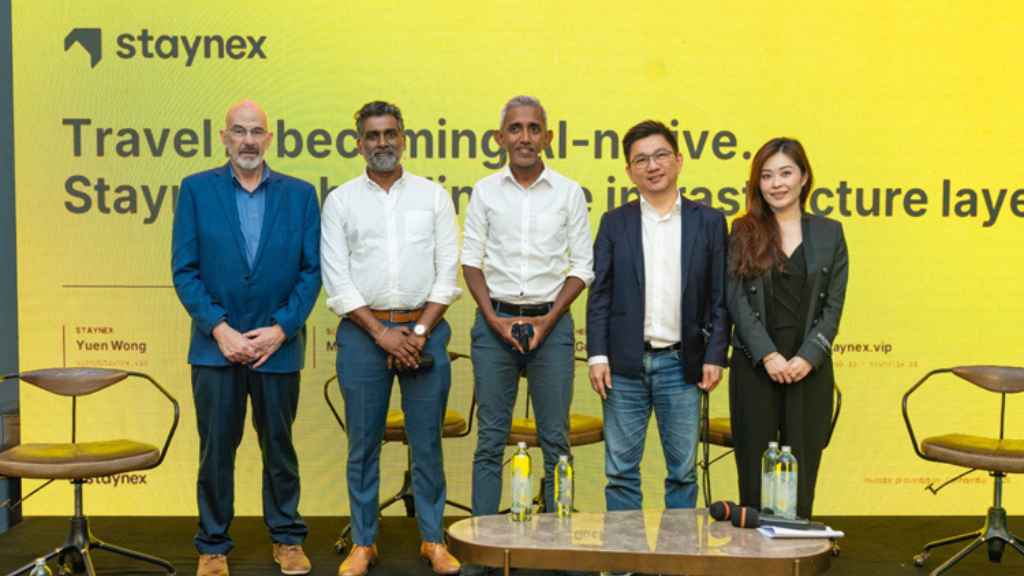
Sri Lanka Positioned as a High-Value Tourism and Innovation Hub was the central theme of a high-level fireside panel that brought together global entrepreneurs, tourism leaders, and policymakers to discuss how the country can strengthen its global competitiveness through technology, AI, entrepreneurship, and smarter tourism strategies.
Sri Lanka Positioned as a High-Value Tourism and Innovation Hub through AI and travel innovation
The panel discussion, held under the theme “The Sri Lanka Destination Stack – How can travel innovation, entrepreneurship, and digital / AI infrastructure help Sri Lanka win globally?”, featured global entrepreneur Jeff Hoffman, entrepreneur Jeevan Gnanam, hospitality investor Yuen Wong, and Sri Lanka’s Deputy Minister of Tourism. The session was moderated by investor and strategist Cherrie Chan.
The conversation focused on how Sri Lanka can move beyond conventional destination marketing and position itself as a more strategic, future-ready tourism and innovation ecosystem capable of attracting not only visitors, but also investment, talent, and global partnerships.
Panelists noted that Sri Lanka Positioned as a High-Value Tourism and Innovation Hub requires a shift away from competing purely on affordability or mass-market tourism. Instead, the focus should be on attracting higher-value travellers, long-term investors, digital professionals, founders, creators, and entrepreneurs who can contribute meaningfully to the country’s broader economic ecosystem.
A key area of discussion was the importance of improving travel innovation and strengthening the country’s digital infrastructure to support modern tourism experiences. Speakers highlighted the growing role of AI-driven technologies in improving travel planning, personalised visitor experiences, intelligent matchmaking between destinations and travellers, and more effective tourism distribution systems.
The panel also explored how Sri Lanka can better organise and present its tourism offerings through trusted local curation, stronger storytelling, and improved global visibility. While Sri Lanka is internationally recognised for its beaches, wildlife, tea, hospitality, culture, and sporting heritage, participants observed that much of the country’s deeper tourism value remains underrepresented in global content platforms and international narratives.
According to the speakers, high-quality storytelling and curated digital experiences could help Sri Lanka differentiate itself in an increasingly competitive global tourism market. This includes showcasing authentic local experiences, wellness tourism, adventure travel, cultural immersion, and long-stay opportunities that appeal to modern global travellers.
The panelists stressed that Sri Lanka’s tourism strategy should focus not only on increasing arrival numbers but also on improving the quality and economic impact of tourism activity. They argued that attracting “smart money” — long-term investment and strategic partnerships — is equally important in creating sustainable tourism growth and broader economic value.
Sri Lanka Positioned as a High-Value Tourism and Innovation Hub also depends heavily on collaboration between government institutions and the private sector. Participants highlighted the need for a more execution-focused environment that enables innovation, improves investor confidence, and simplifies market accessibility for international partners.
Discussions further examined how tourism can intersect with entrepreneurship, technology, and the digital economy to create broader opportunities beyond traditional hospitality. The integration of AI, digital infrastructure, and entrepreneurial ecosystems was identified as an important factor in shaping Sri Lanka’s next phase of economic and tourism growth.
Moderator Cherrie Chan described Sri Lanka not simply as a destination, but as a “stack” consisting of inventory, distribution, trust, talent, and AI capabilities. She noted that the challenge ahead lies in how effectively the country can organise, articulate, and scale that stack to compete globally.
The discussion took place against the backdrop of Sri Lanka’s tourism recovery, with the country surpassing pre-pandemic visitor levels in 2025 by recording approximately 2.36 million international arrivals. Industry stakeholders believe this recovery provides momentum for the country to reposition itself strategically within the global tourism and investment landscape.
Participants at the forum expressed optimism that Sri Lanka possesses the natural assets, human capital, and entrepreneurial potential required to build a globally competitive tourism ecosystem. However, they emphasised that achieving this vision would require stronger coordination, investment in digital infrastructure, enhanced global branding, and a long-term commitment to innovation-driven growth.
The event ultimately highlighted a broader shift in how Sri Lanka’s tourism future is being viewed — not only as a hospitality industry, but as a wider platform connecting travel, technology, investment, talent, and entrepreneurship within a rapidly evolving global economy.