

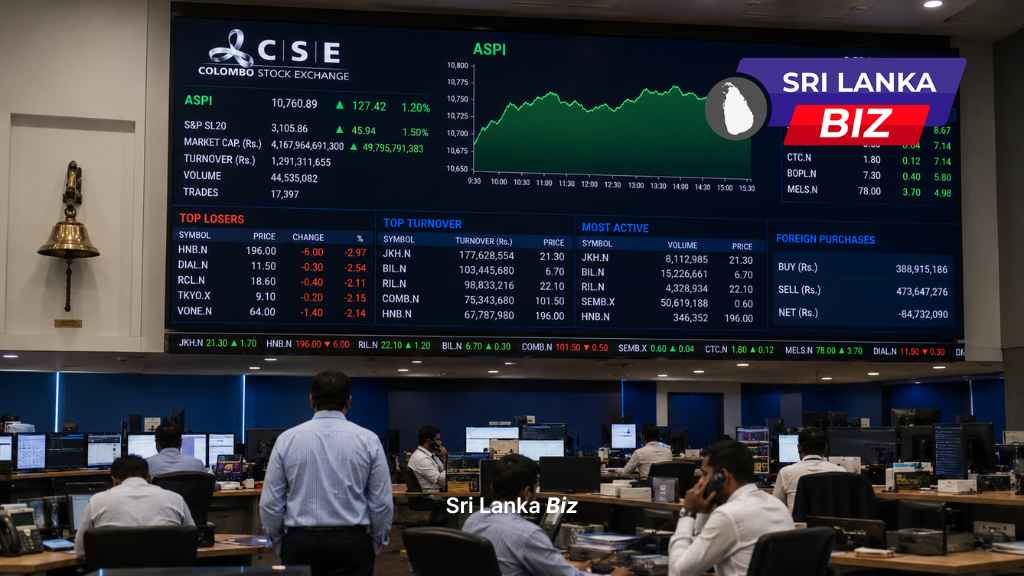
Sri Lanka rupee weaker; bond yields higher as currency market sentiment remained cautious while government securities continued to trade at elevated levels amid ongoing investor uncertainty and broader market pressures.
Sri Lanka rupee weaker; bond yields higher amid market pressure
Market dealers said the telegraphic transfer rate for the US dollar was quoted at Rs. 334.5000 buying and Rs. 343.5000 selling during trading, while no spot quote was immediately available for the rupee. The movement reflects continued pressure within the foreign exchange market as traders closely monitor liquidity conditions, import demand, and external market developments.
Meanwhile, government bonds traded weaker across several maturities, with yields moving higher and spreads remaining relatively wide. Analysts noted that higher yields generally indicate softer bond prices as investors seek improved returns in response to market risks and expectations surrounding interest rates and fiscal conditions.
Among actively traded securities, the bond maturing on 15 June 2029 was quoted at 9.05/20 percent, while the bond maturing on 15 September 2029 traded at 9.15/35 percent.
The 15 December 2029 maturity was quoted at 10.20/35 percent, slightly higher compared to the previous market level of 10.20/30 percent. Dealers attributed the movement to cautious investor sentiment and limited buying interest within medium-term maturities.
Longer-dated securities also recorded higher yield levels. The bond maturing on 1 October 2032 was quoted at 10.90/11.10 percent, while the 1 November 2033 maturity rose to 11.30/35 percent from the earlier level of 11.10/35 percent.
Similarly, the bond maturing on 15 June 2034 was quoted at 11.30/45 percent compared to the previous 11.35/42 percent range, while the 15 August 2036 maturity traded at 11.40/60 percent.
Sri Lanka rupee weaker; bond yields higher as investors continue evaluating domestic liquidity conditions, future monetary policy direction, and external economic risks affecting emerging markets.
Financial market participants noted that government bonds remain sensitive to developments in inflation expectations, fiscal policy management, and foreign exchange stability. Rising yields can increase borrowing costs for governments and influence overall market financing conditions.
The foreign exchange market has also remained closely tied to broader macroeconomic developments, including export earnings, remittance inflows, tourism performance, and external debt-related expectations.
Currency dealers said market activity remained relatively cautious, with participants monitoring dollar demand from importers and institutional clients while assessing the Central Bank’s policy signals regarding liquidity and exchange rate management.
Sri Lanka’s government securities market has experienced fluctuations in recent months as investors adjust positions in response to evolving economic indicators and global financial conditions. Analysts noted that international interest rate movements and geopolitical developments continue to influence investor appetite toward emerging market debt instruments.
Government bonds are considered a key indicator of market confidence and future economic expectations. Higher yields often reflect increased risk perceptions or expectations of tighter financial conditions, while lower yields generally signal stronger investor confidence and stable economic sentiment.
Market observers also highlighted that the widening spreads across certain maturities suggest continued uncertainty regarding medium and long-term economic conditions. Investors typically demand higher returns when market volatility increases or when economic visibility remains limited.
Sri Lanka rupee weaker; bond yields higher while traders continue awaiting clearer signals on future market direction, particularly regarding liquidity management, foreign exchange inflows, and domestic economic performance.
Economists noted that maintaining stability within both the bond market and the foreign exchange market remains important for broader investor confidence and financial sector resilience. Stable currency conditions and manageable borrowing costs are often viewed as essential components for supporting economic recovery and sustaining investment activity.
The Central Bank’s monetary policy decisions, inflation outlook, and fiscal developments are expected to remain closely watched by investors in the coming weeks as markets continue adjusting to changing domestic and international conditions.
Market participants believe that sustained improvements in tourism earnings, export performance, and foreign inflows could help support currency stability over the medium term, although global financial volatility may continue creating short-term pressure within local financial markets.