

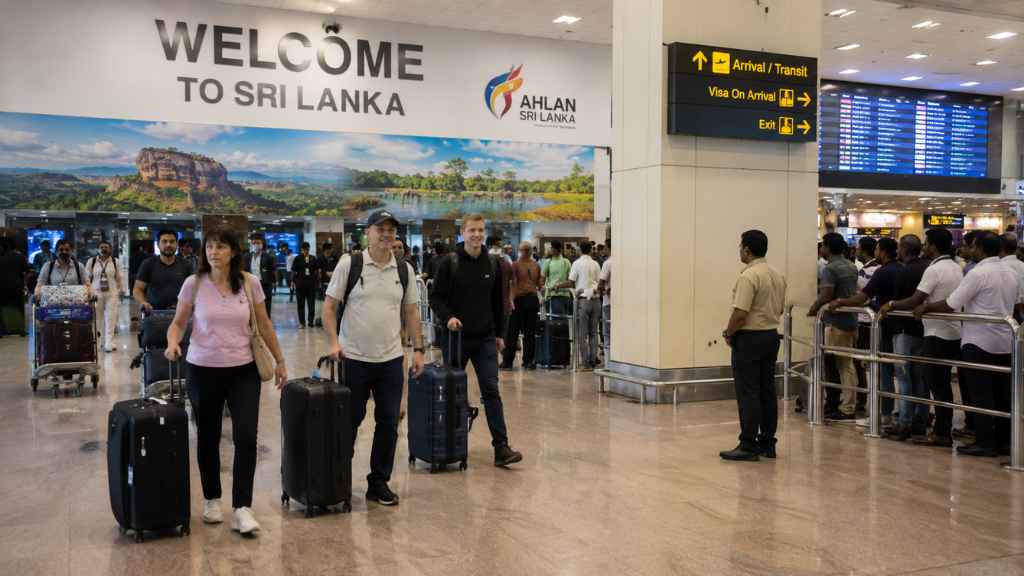
Sri Lanka tourist arrivals improve in May after falling on ME conflict as the island nation recorded a gradual recovery in visitor numbers following months of disruption caused by escalating geopolitical tensions and aviation interruptions linked to the Middle East conflict.
Sri Lanka tourist arrivals improve in May despite Middle East conflict impact
Official tourism data showed that Sri Lanka welcomed 75,465 tourists during the first 17 days of May 2026, only 0.9 percent lower compared to the same period last year, signaling a stabilisation in travel demand after sharp declines recorded in March and April.
The latest figures mark a notable improvement for Sri Lanka’s tourism sector, which had faced mounting pressure after regional airspace disruptions, flight cancellations, and operational limitations affecting major Gulf airline networks significantly impacted inbound travel flows.
Tourist arrivals into Sri Lanka declined 19.8 percent year-on-year in March to 183,979 visitors, while arrivals in April fell even further by 22.3 percent to 135,643 tourists compared to the corresponding months in 2025.
However, analysts noted that the improving May trend reflects the gradual restoration of airline schedules and the resumption of more stable regional flight connectivity after weeks of disruption linked to the Middle East conflict.
Sri Lanka tourist arrivals improve in May after falling on ME conflict as the country recorded an average daily arrival of 4,439 visitors during the first 17 days of May, exceeding the full-month daily average of 4,288 tourists recorded during May 2025.
Tourism industry stakeholders said the improving arrival momentum provides cautious optimism for the sector, although concerns remain regarding broader revenue performance and long-term market stability.
The recent escalation of the Middle East conflict has significantly affected Sri Lanka’s tourism recovery trajectory, which had been steadily improving following the country’s 2022 economic crisis. Aviation disruptions, airspace closures, and reduced Gulf carrier operations weakened tourist inflows from key international markets and created uncertainty across the regional travel industry.
The impact has been particularly visible in tourism revenue performance. Official data showed that foreign exchange earnings from tourism declined sharply by 37 percent year-on-year in March 2026 to US$ 223.7 million, followed by another 39 percent decline in April.
As a result, cumulative tourism revenue for the first quarter of 2026 fell by 15 percent to US$ 954 million, raising concerns over Sri Lanka’s ability to achieve its ambitious annual tourism targets.
Authorities had previously projected 3 million tourist arrivals and tourism earnings between US$ 4 billion and US$ 4.5 billion for 2026 as part of broader economic recovery efforts and foreign exchange stabilisation strategies.
Industry analysts warn that continued geopolitical instability and prolonged aviation disruptions could place additional pressure on the country’s external sector, particularly given tourism’s importance as a key foreign exchange earner.
Sri Lanka tourist arrivals improve in May after falling on ME conflict, but economists note that gross tourism receipts alone may not fully translate into strong net foreign exchange gains due to the sector’s high import dependency and economic leakage.
According to industry estimates, approximately US$ 1.13 billion of the US$ 3.2 billion generated through tourism in 2025 leaked out of the country through procurement-related imports including food, fuel, and operational supplies.
This leakage factor continues to place strain on Sri Lanka’s balance of payments position as the country simultaneously faces pressure from widening merchandise trade deficits and elevated external financing needs.
Tourism sector stakeholders have increasingly called for stronger policies to improve domestic value retention by strengthening local supply chains, encouraging local sourcing, and promoting sustainable tourism-related industries capable of generating broader economic benefits.
Despite the challenges, analysts believe Sri Lanka retains strong long-term tourism potential due to its diverse attractions, improving infrastructure, and strategic location within the South Asian region.
The recent improvement in visitor arrivals during May is being viewed as an encouraging signal for the sector, particularly if airline operations continue normalising and geopolitical conditions stabilise over the coming months.
Market observers also highlighted that sustained recovery in tourism revenue will remain critical for Sri Lanka’s broader economic outlook, given the sector’s role in generating employment, supporting businesses, and strengthening foreign exchange reserves.
While uncertainties linked to the Middle East conflict remain, the latest tourism arrival figures suggest that Sri Lanka’s travel industry is gradually regaining momentum after one of its most challenging periods since the post-crisis recovery began.