

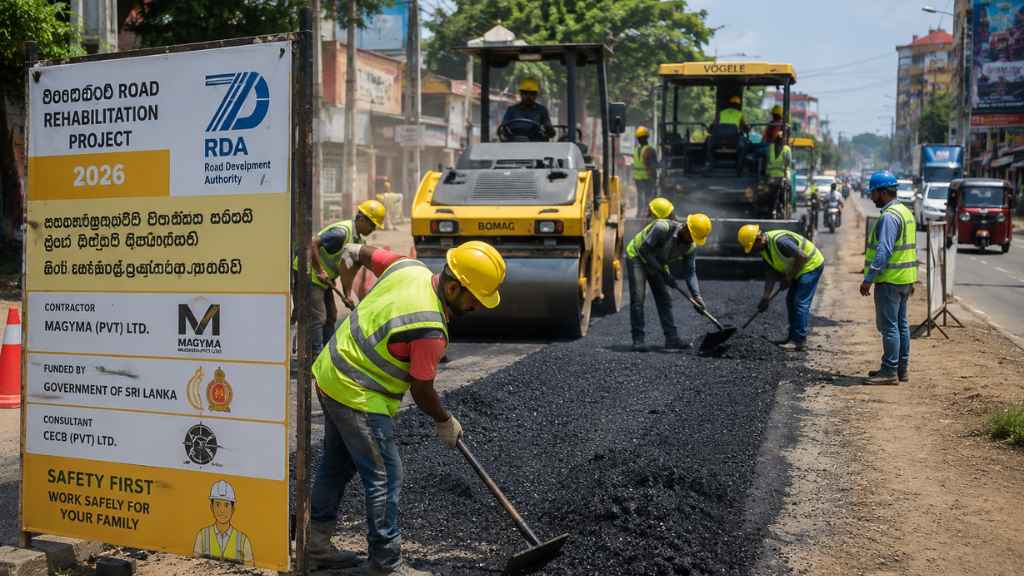
Sri Lanka construction activity contracts in April 2026: PMI as rising raw material costs and labour shortages continued to weigh on the sector’s performance. Industry participants also reported supply disruptions linked to ongoing tensions in the Middle East.
Sri Lanka construction activity contracts in April 2026: PMI amid rising material costs
Sri Lanka’s construction sector recorded a slowdown in April 2026, with activity levels falling into contraction territory according to the latest Purchasing Managers’ Index (PMI) released by the Central Bank of Sri Lanka.
The Construction PMI registered 45.7 in April, remaining below the neutral threshold of 50, indicating a contraction in overall business activity within the sector. The decline comes at a time when construction firms are grappling with higher input costs, shortages of key materials, and ongoing challenges in securing skilled labour.
According to the Central Bank, many survey respondents pointed to shortages of petrochemical-based raw materials and escalating costs caused by the conflict in the Middle East as significant obstacles affecting project execution. Rising prices have increased uncertainty across the industry and have made it more difficult for contractors to complete projects within agreed budgets and timelines.
Despite the overall contraction, some indicators within the survey showed signs of resilience. The New Orders Index remained in expansion territory at 62.9, although it eased from 67.2 recorded in March. Respondents attributed the continued growth in new orders to the availability of projects, particularly road rehabilitation and infrastructure-related activities.
However, several firms indicated that rising material costs may lead to delays in launching or continuing certain projects. Contractors noted that some developments may require price renegotiations before work can proceed, creating additional uncertainty for both project owners and construction companies.
The latest construction PMI data suggest that while demand for construction services remains present, the industry’s ability to convert new opportunities into completed work is being constrained by operational challenges. This divergence between project availability and execution capacity has become increasingly evident in recent months.
Employment conditions within the Sri Lanka construction sector remained relatively positive, with the Employment Index recording 55.9 in April. Although slightly lower than March’s reading of 57.1, the figure indicates that firms continued to recruit workers in response to ongoing project requirements.
Nevertheless, labour shortages remain a major concern for the industry. Many surveyed firms reported difficulties in finding workers across most skilled labour categories, including technical and specialized construction trades. The shortage of qualified personnel has contributed to project delays and increased labour costs, further pressuring contractor margins.
Another key indicator pointing to weaker sector performance was the Quantity of Purchases Index, which declined sharply to 42.6 from 55.7 in the previous month. The decrease reflects reduced purchasing activity by construction firms as overall work volumes slowed and companies adopted a more cautious approach to procurement amid rising costs.
Supply chain pressures also remained evident during the month. The survey showed that suppliers’ delivery times continued to lengthen, suggesting ongoing logistical challenges in obtaining materials and equipment. Delays in deliveries have become a recurring issue for many firms, affecting project schedules and operational efficiency.
Analysts note that the performance of the Sri Lanka construction sector remains closely linked to broader economic conditions, including inflation, exchange rate movements, and global commodity prices. The continued rise in energy and raw material costs has placed additional strain on businesses already operating in a challenging environment.
The contraction recorded in April highlights the fragile nature of the sector’s recovery despite the availability of new projects and infrastructure opportunities. While construction activity has benefited from government-supported road rehabilitation work and improving economic stability, firms continue to face significant cost and resource constraints.
Looking ahead, industry participants are expected to closely monitor developments in global energy markets and supply chains, as well as domestic economic conditions. The ability to stabilize input costs and address labour shortages will likely play a crucial role in determining whether the construction PMI returns to expansion territory in the coming months.
For now, the latest survey suggests that the sector remains under pressure, with rising costs, supply disruptions and workforce shortages continuing to weigh on overall construction activity across Sri Lanka.