

Sri Lanka rupee at 336.25/35 to US dollar spot on Monday as the local currency weakened slightly against the US dollar, while government bond yields remained largely stable amid subdued activity in the secondary market, according to market dealers.
Sri Lanka rupee at 336.25/35 to US dollar spot as bond yields remain steady
The Sri Lankan currency was quoted at 336.25/35 to the US dollar in the spot market, compared with 335.50/336.25 recorded during the previous trading session. Dealers indicated that market activity was relatively muted, with limited trading volumes observed in the secondary bond market.
Despite the slight depreciation of the rupee, market participants reported that overall conditions remained stable, with no significant movements in government securities. Analysts noted that investors continued to monitor liquidity conditions, interest rate expectations, and broader economic developments that could influence currency and debt market performance in the coming weeks.
Among government securities, bond yields showed only marginal changes. A treasury bond maturing on August 1, 2030, was quoted at 12.10/40 percent, compared with 12.05/20 percent in the previous session. Meanwhile, a bond maturing on March 15, 2035, was quoted at 12.95/13.05 percent, up slightly from 12.80/13.00 percent.
The modest increase in bond yields reflected cautious market sentiment rather than any major shift in investor expectations. Dealers described the secondary market as “not very active,” suggesting that investors largely maintained their positions while awaiting fresh economic indicators and policy signals.
Foreign exchange market data also showed the telegraphic transfer rates for major currencies against the Sri Lankan rupee. The US dollar was quoted at 331.5000 buying and 340.5000 selling. The euro stood at 379.5100 buying and 393.4270 selling, while the British pound was quoted at 440.8796 buying and 454.9252 selling.
Currency market participants continue to closely monitor external factors including global interest rate trends, international commodity prices, and capital flows, all of which can influence exchange rate movements in emerging markets such as Sri Lanka. The country has experienced greater exchange rate stability in recent months compared with periods of heightened volatility seen during the economic crisis.
The latest market performance comes as Sri Lanka continues its broader economic recovery efforts, supported by fiscal reforms, improved foreign reserves, and a gradual normalization of financial market conditions. Stability in the currency market remains a key factor for businesses engaged in international trade, importers, exporters, and investors assessing opportunities within the country.
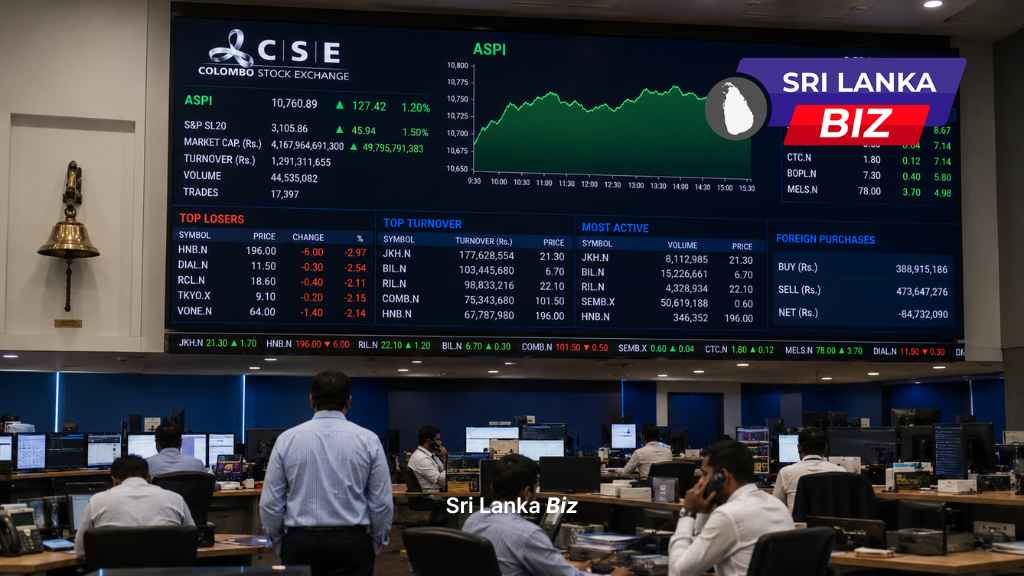
Meanwhile, trading on the Colombo Stock Exchange ended lower on Monday, reflecting a cautious mood among equity investors. The benchmark All Share Price Index (ASPI) declined 82.18 points, or 0.38 percent, to close at 21,661.95.
The S&P SL20 Index, which tracks the performance of the exchange’s most liquid and largest listed companies, also recorded losses. The index fell 21.83 points, or 0.36 percent, to close at 6,002.17.
Market analysts said the decline in equities was relatively modest and reflected normal profit-taking activity rather than a significant deterioration in investor sentiment. Trading volumes remained within expected levels, with investors continuing to assess corporate earnings prospects and macroeconomic developments.
The performance of the rupee, government securities, and equities remains closely interconnected as investors evaluate the direction of interest rates, inflation, and economic growth. While Sri Lanka rupee at 336.25/35 to US dollar spot marked a slight weakening in the local currency, broader financial market indicators suggested a largely stable trading environment.
Looking ahead, market participants are expected to remain focused on monetary policy developments, government fiscal measures, and global economic trends that could influence both exchange rates and bond yields. Investors will also continue to monitor activity on the Colombo Stock Exchange as they gauge confidence in Sri Lanka’s ongoing economic recovery.