


Three- to seven-year government bond yields dropped between 23 and 30 basis points week-on-week even as the 10-year tenor climbed 30 basis points in the opposite direction
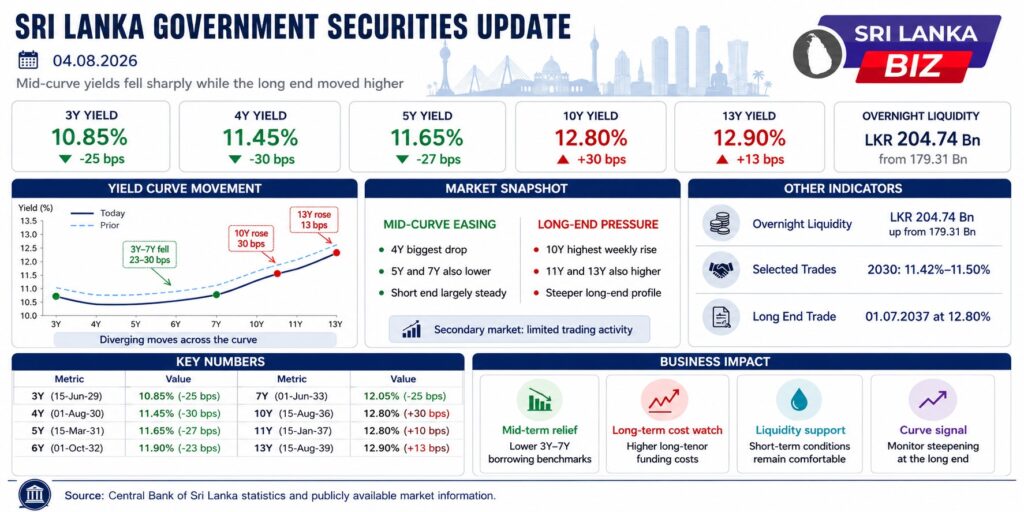
Sri Lanka’s government securities market recorded significant, and notably uneven, movement in secondary market yields over the past week, with several tenors shifting by more than 20 basis points in opposite directions.
The most pronounced moves were concentrated in the middle of the yield curve. The 4-year tenor (maturing 01-Aug-30) fell 30 basis points week-on-week to 11.45%, the steepest decline on the curve. The 5-year tenor (15-Mar-31) dropped 27 basis points to 11.65%, while the 3-year (15-Jun-29) and 7-year (01-Jun-33) tenors each fell 25 basis points, to 10.85% and 12.05% respectively. The 6-year tenor (01-Oct-32) declined 23 basis points to 11.90%. Taken together, five consecutive tenors spanning three to seven years all moved lower by more than 20 basis points, marking a broad and consistent decline across the belly of the curve.
The picture at the long end of the curve was markedly different. The 10-year tenor (15-Aug-36) rose 30 basis points week-on-week to 12.80%, the sharpest increase on the curve and a move in the opposite direction to the mid-curve decline. The 13-year tenor (15-Aug-39) also edged higher, up 13 basis points to 12.90%, while the 11-year tenor (15-Jan-37) rose a more modest 10 basis points to 12.80%. Short-dated tenors under two years were largely unchanged over the week.
This divergence means the week’s activity cannot be characterized simply as yields rising or falling — it reflects a curve that steepened at the long end relative to the belly, even as the belly itself richened relative to the prior week. Trading in the secondary market was otherwise described as limited, with a dull session and few executed trades. Among the trades that did go through, the 01.08.2030 and 15.10.2030 maturities changed hands between 11.42% and 11.50%, the 01.02.2031 and 15.10.2034 maturities traded at 11.60% and 12.30% respectively, and the 01.07.2037 maturity traded at 12.80% at the long end.
Separately, overnight liquidity in the banking system expanded to LKR 204.74 billion from LKR 179.31 billion previously, a factor that can influence short-term funding costs and demand for government securities, though the report did not establish a direct causal link between the liquidity expansion and the week’s yield moves.
Key Numbers
| Tenure | Today’s Yield | Change vs. Last Week |
|---|---|---|
| 3-Year (15-Jun-29) | 10.85% | –25 bps |
| 4-Year (01-Aug-30) | 11.45% | –30 bps |
| 5-Year (15-Mar-31) | 11.65% | –27 bps |
| 6-Year (01-Oct-32) | 11.90% | –23 bps |
| 7-Year (01-Jun-33) | 12.05% | –25 bps |
| 10-Year (15-Aug-36) | 12.80% | +30 bps |
| 11-Year (15-Jan-37) | 12.80% | +10 bps |
| 13-Year (15-Aug-39) | 12.90% | +13 bps |
| Overnight liquidity | LKR 204.74 Bn | vs. LKR 179.31 Bn prior |
Business Impact
Diverging yield moves across the curve carry different implications depending on where a business or investor sits. The sharp decline in mid-curve yields (3–7 years) is favorable for entities looking to raise or refinance medium-term debt in that maturity range, potentially lowering borrowing costs relative to the prior week. Conversely, the rise in the 10-year and longer tenors suggests investors are demanding higher compensation for long-dated duration risk, which could raise the cost of long-term government and, indirectly, corporate borrowing benchmarked off the sovereign curve. For fixed income investors and treasury desks, a steepening long end relative to the belly is typically read as a signal worth monitoring rather than a one-off anomaly, particularly given the thin trading volumes reported in the underlying secondary market this week — a caveat that should temper how much weight is placed on any single week’s yield changes.
Source Attribution
Source: Central Bank of Sri Lanka statistics and publicly available market information.