


External sector data shows a USD 149 million shortfall in June, even as the rupee edged marginally stronger against the dollar
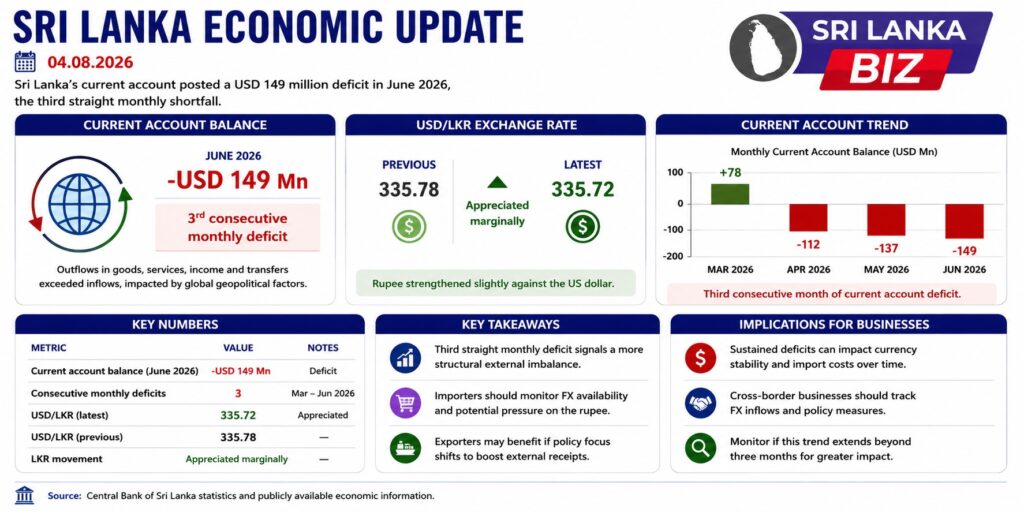
Sri Lanka’s current account registered a deficit of USD 149 million in June 2026, marking the third consecutive month the country has recorded a shortfall on this measure, according to data published by the Central Bank of Sri Lanka.
The current account is a broad measure of a country’s transactions with the rest of the world, capturing trade in goods and services, income flows, and transfers such as remittances. A sustained deficit indicates that outflows on these fronts have consistently exceeded inflows over the period, a trend the central bank’s data attributes in part to the broader repercussions of the global geopolitical landscape on Sri Lanka’s external sector.
The persistence of the deficit across three straight months distinguishes it from a single-month fluctuation, which can often be driven by temporary or seasonal factors. A multi-month run is typically read as a more structural signal about the balance between the country’s external receipts and its external obligations.
Despite the widening current account gap, the rupee showed marginal strength against the US dollar over the same period, appreciating slightly to LKR 335.72 per dollar from LKR 335.78 previously. The modest currency movement suggests that, for now, other factors — including foreign exchange inflows from sources outside the current account, central bank market operations, or broader supply and demand dynamics in the domestic forex market — have been sufficient to offset any pressure the widening deficit might otherwise place on the currency. The report did not indicate a direct link between the two data points, and the rupee’s movement was too marginal to be characterized as a significant shift in either direction.
Key Numbers
| Metric | Value |
|---|---|
| Current account balance (June 2026) | –USD 149 Mn |
| Consecutive monthly deficits | 3 |
| USD/LKR (latest) | 335.72 |
| USD/LKR (previous) | 335.78 |
| LKR movement | Appreciated marginally |
Business Impact
A widening and persistent current account deficit is a metric closely watched by importers, exporters, and businesses with foreign currency exposure, since it reflects the underlying balance of dollar inflows and outflows across the economy. For importers, a structural external deficit can, over time, translate into pressure on foreign exchange availability or the exchange rate, even if that pressure has not yet materialized in the currency’s day-to-day trading. For exporters, sustained deficits are sometimes viewed as a signal for policymakers to consider measures supporting export competitiveness or foreign inflows. Businesses engaged in cross-border trade, debt servicing in foreign currency, or import-dependent supply chains may wish to monitor whether this becomes a longer trend beyond three months, as that would carry greater implications for currency stability and import costs than a shorter-term fluctuation.
Source Attribution
Source: Central Bank of Sri Lanka statistics and publicly available economic information.