

Government security yields declined 25 to 45 basis points week-on-week across nearly every maturity, even as secondary market trading remained thin
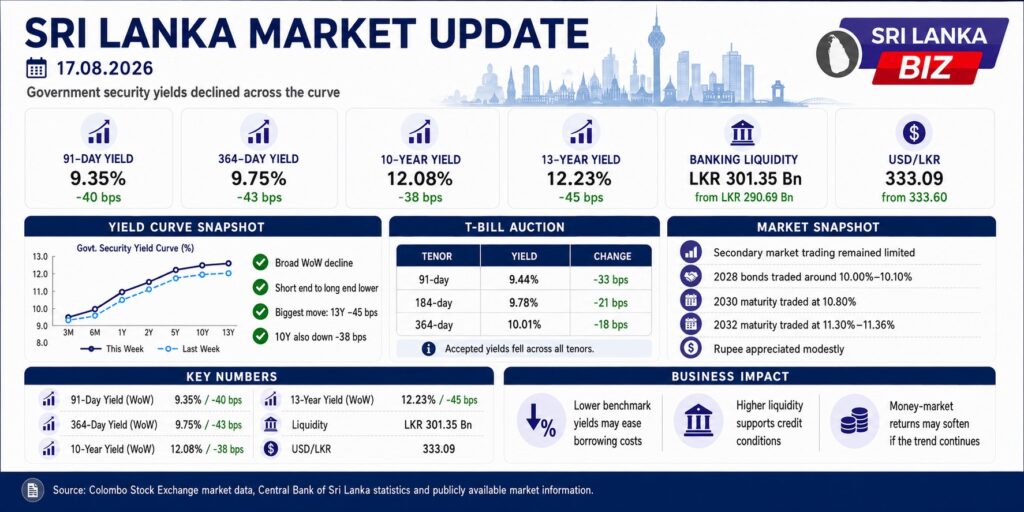
Yields on Sri Lankan government securities fell broadly across the curve over the past week, marking one of the more significant moves in the fixed income market in recent sessions, even as actual trading activity in the secondary market remained limited.
Comparing yield levels from August 10 to August 17, declines ranged from roughly 25 to 45 basis points depending on tenor, with the shift most pronounced at the short end and long end of the curve. The 91-day tenor fell 40 basis points, while the 364-day tenor declined 43 basis points. Further out, the 10-year and 11-year tenors each fell 38 basis points, and the 13-year tenor recorded the largest single move, down 45 basis points.
Despite the scale of the move across the curve, actual secondary market activity was modest. Trading was concentrated mainly at the short to mid-end of the curve, with a limited number of transactions reported. Bonds maturing on 15 February 2028 and 15 March 2028 both traded at 10.00%, while the 1 May 2028 maturity traded slightly higher at 10.10%. Further along the curve, the bond maturing 1 August 2030 changed hands at 10.80%, and the 15 December 2032 maturity traded in a range of 11.30% to 11.36%. At the long end, the 1 November 2033 and 15 October 2034 maturities traded at 11.50% and 11.75% respectively.
The move lower in yields was echoed at the primary market level. At the government’s most recent Treasury bill auction, settled on August 14, accepted weighted average yields fell across all three tenors compared to the prior auction: the 91-day rate declined 33 basis points to 9.44%, the 184-day rate fell 21 basis points to 9.78%, and the 364-day rate dropped 18 basis points to 10.01%.
Conditions in the banking system also pointed toward easier liquidity. Excess liquidity in the banking system expanded to LKR 301.35 billion, up from LKR 290.69 billion previously, providing a supportive backdrop for the move lower in yields.
On the currency side, the rupee appreciated against the US dollar over the same period, trading at LKR 333.09 compared with LKR 333.60 previously.
Key Numbers
| Metric | Value |
|---|---|
| 91-Day Yield (WoW change) | 9.35% (-40 bps) |
| 364-Day Yield (WoW change) | 9.75% (-43 bps) |
| 10-Year Yield (WoW change) | 12.08% (-38 bps) |
| 13-Year Yield (WoW change) | 12.23% (-45 bps) |
| T-Bill Auction: 91-Day | 9.44% (-33 bps vs. prior auction) |
| T-Bill Auction: 184-Day | 9.78% (-21 bps vs. prior auction) |
| T-Bill Auction: 364-Day | 10.01% (-18 bps vs. prior auction) |
| Banking System Liquidity | LKR 301.35 Bn (up from LKR 290.69 Bn) |
| USD/LKR | 333.09 (appreciation from 333.60) |
Business Impact
A sustained decline in government security yields is typically an early signal of softer borrowing costs more broadly across the economy. For businesses, this can eventually translate into cheaper credit as banks and other lenders reprice against a lower government yield benchmark. Corporate treasurers and finance teams managing short-term cash may find improved returns diminishing on money market instruments tied to T-bill rates, while longer-term borrowers — including companies planning capital raises — may benefit from a lower cost of debt if the trend holds. The expansion in banking system liquidity also suggests more accommodative conditions for credit growth in the near term.
Source Attribution
Source: Colombo Stock Exchange market data, Central Bank of Sri Lanka statistics and publicly available market information.