


Yields at the government’s most recent Treasury bill auction declined between 18 and 33 basis points across the three tenors offered
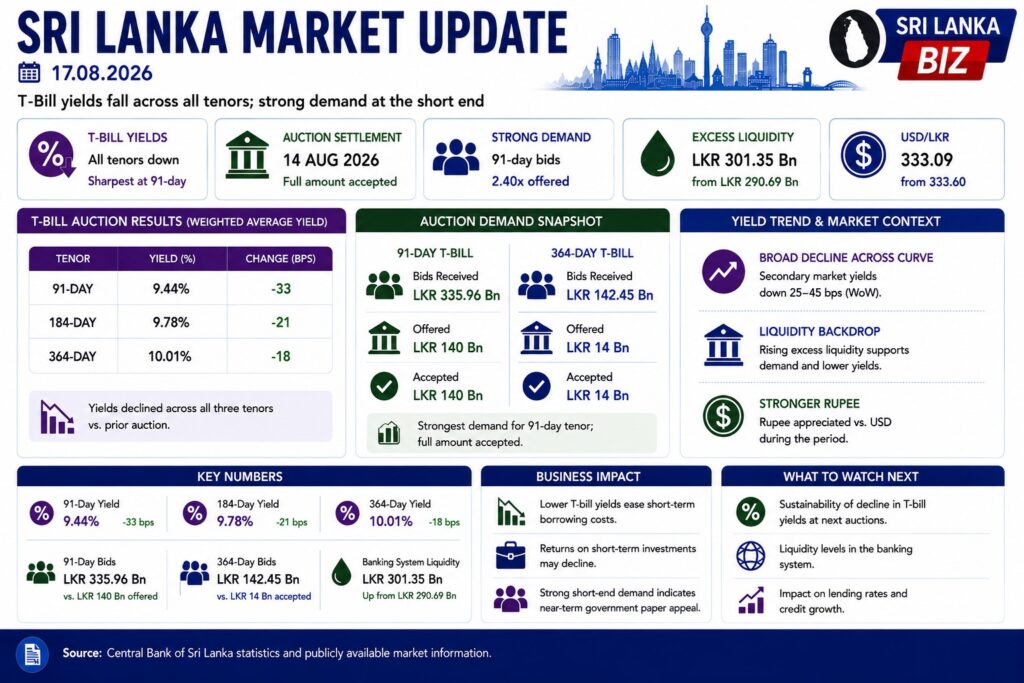
Yields at Sri Lanka’s latest Treasury bill auction fell across all three tenors on offer, extending a broader decline seen in short-term government borrowing costs.
At the auction, with settlement on August 14, the weighted average accepted yield on the 91-day bill fell to 9.44%, down 33 basis points from the previous auction. The 184-day bill settled at 9.78%, a decline of 21 basis points, while the 364-day bill came in at 10.01%, down 18 basis points. The move was most pronounced at the shorter end of the curve, suggesting stronger demand for near-term instruments relative to the one-year tenor.
Demand at the auction was strongest for the 91-day tenor, where total bids reached LKR 335.96 billion against LKR 140 billion offered, with the full offered amount accepted. Bidding for the 364-day tenor was comparatively muted, with total bids of LKR 142.45 billion against which only LKR 14 billion was accepted.
The decline in auction yields mirrors a broader move lower across the government securities curve over the past week, with secondary market Treasury bill and bond yields also easing between 25 and 45 basis points depending on tenor. Conditions in the banking system pointed toward an easier liquidity backdrop for the move: excess liquidity expanded to LKR 301.35 billion, up from LKR 290.69 billion previously.
Key Numbers
| Tenor | Latest Yield | Change vs. Prior Auction |
|---|---|---|
| 91-Day | 9.44% | -33 bps |
| 184-Day | 9.78% | -21 bps |
| 364-Day | 10.01% | -18 bps |
| 91-Day Bids Received | LKR 335.96 Bn | vs. LKR 140 Bn offered |
| 364-Day Bids Received | LKR 142.45 Bn | vs. LKR 14 Bn accepted |
| Banking System Liquidity | LKR 301.35 Bn | Up from LKR 290.69 Bn |
Business Impact
Falling T-bill yields have a direct bearing on short-term borrowing and investment decisions across the economy. Businesses that rely on short-term government-linked instruments for treasury management may see lower returns on new placements, while companies and financial institutions that price short-term lending off T-bill benchmarks could see borrowing costs ease. Strong demand at the short end of the curve, reflected in the bid-to-offer ratio for the 91-day tenor, suggests investors continue to see near-term government paper as an attractive, low-risk option even as yields decline.
Source Attribution
Source: Central Bank of Sri Lanka statistics and publicly available market information.