

Weekly auction fully subscribed at LKR 140 billion as short-term borrowing costs ease across the curve
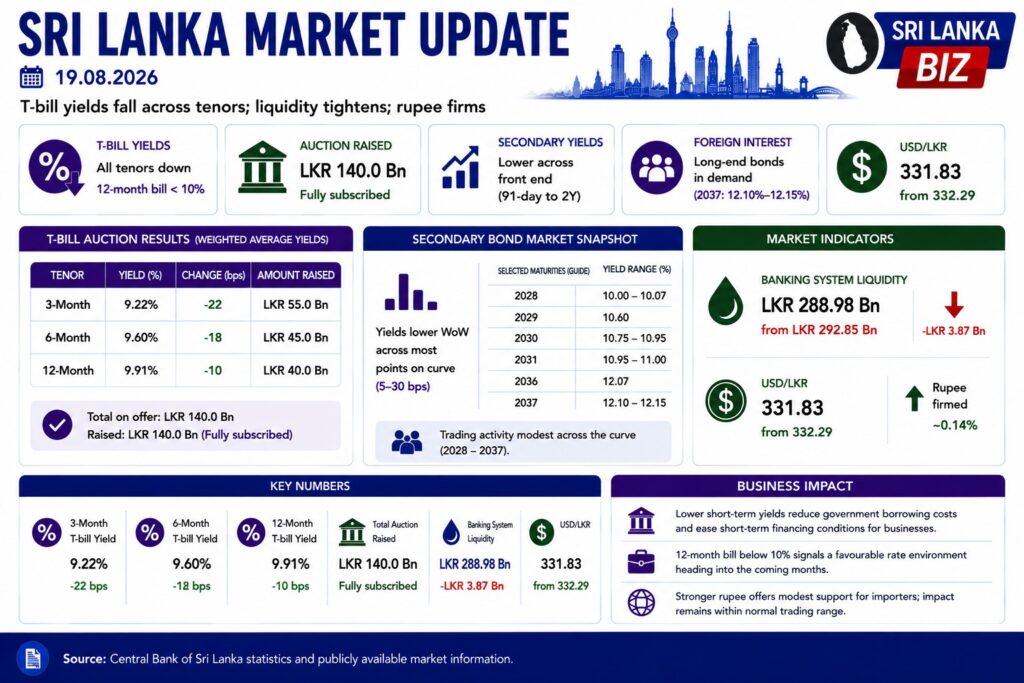
Yields on Sri Lanka’s Treasury bills fell across all three tenors at the Public Debt Management Office’s weekly auction, with the 12-month bill dropping into single-digit territory for the first time since May.
The auction raised the full LKR 140.0 billion on offer, split between LKR 55.0 billion in 3-month bills, LKR 45.0 billion in 6-month bills, and LKR 40.0 billion in 12-month bills — each tenor matching the amount initially offered.
The weighted average yield on the 3-month bill fell 22 basis points to 9.22%, while the 6-month bill declined 18 basis points to 9.60%. The 12-month bill eased 10 basis points to 9.91%, marking its return below the 10% mark.
The move in short-term rates was echoed in the secondary bond market, where yields also softened across most points on the curve compared with the prior week. Tenors from the 91-day bill through to the 2-year bond recorded week-on-week declines ranging from 5 to 30 basis points, pointing to a broader easing across the front end of the curve rather than a single-auction move.
Secondary market trading in government bonds was described as modest in volume, with activity spread across maturities from 2028 through 2037. Bonds at the long end of the curve, including the 2037 maturity, drew foreign investor interest, trading in a range of 12.10% to 12.15%.
Separately, market liquidity in the banking system contracted to LKR 288.98 billion from LKR 292.85 billion in the prior session, while the rupee firmed slightly against the US dollar to LKR 331.83, from LKR 332.29 previously.
Key Numbers
| Metric | Value | Change |
|---|---|---|
| 3-month T-bill yield | 9.22% | -22 bps |
| 6-month T-bill yield | 9.60% | -18 bps |
| 12-month T-bill yield | 9.91% | -10 bps |
| Total auction offer/raised | LKR 140.0 Bn | Fully subscribed |
| Banking system liquidity | LKR 288.98 Bn | -LKR 3.87 Bn |
| USD/LKR | 331.83 | Rupee firmed from 332.29 |
Business Impact
Lower short-term yields translate into cheaper government borrowing costs and typically feed through to reduced rates on money market instruments and short-term corporate paper, easing financing conditions for businesses reliant on short-duration credit. The 12-month bill’s move below 10% is a symbolic threshold that treasury managers and corporate finance teams may watch as an indicator of the broader rate trajectory heading into the coming months. Exporters and importers should note the rupee’s modest strengthening, though the move remains within normal daily trading ranges rather than signaling a structural shift.
Source Attribution
Source: Central Bank of Sri Lanka statistics and publicly available market information.