

ASPI and S&P SL20 both close lower as escalating global tensions weigh on sentiment, even as record crossings push daily turnover well above the monthly average
Key Highlights
The Colombo Stock Exchange recorded its highest single-day turnover in more than a year on August 24, driven by large negotiated trades, even as broader sentiment stayed weak. Both benchmark indices closed in negative territory, foreign investors extended their selling streak, and government securities yields eased modestly at the week’s T-Bill auction. Banking system liquidity expanded and the rupee firmed slightly against the US dollar.
Stock Market Summary
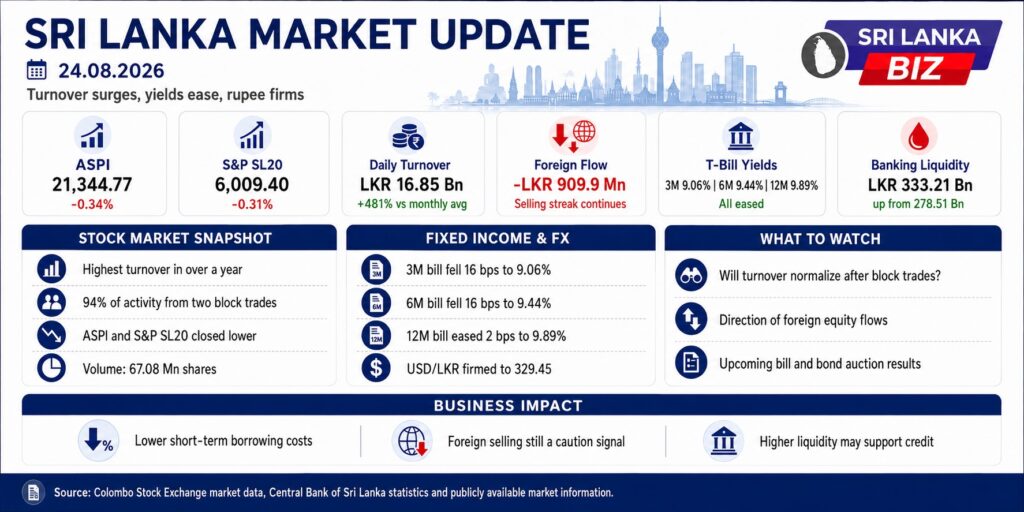
The All Share Price Index declined 71.84 points, or 0.34%, to close at 21,344.77, while the S&P SL20 fell 18.69 points, or 0.31%, to 6,009.40. Trading was shaped largely by broader geopolitical tensions rather than domestic company developments. Daily turnover came in at LKR 16.85Bn, roughly 481% above the monthly average of LKR 2.9Bn, but the increase was concentrated in two counters — Ceylon Tobacco-linked and Cargills-linked crossings — which together accounted for around 94% of the day’s activity. Market capitalisation slipped 0.4% to LKR 7.73Tn. Trading volume rose to 67.08 million shares, up 33.4% from the prior session.
Fixed Income Summary
Secondary bond market activity was subdued, with light buying interest and moderate volumes across maturities. Yields on shorter and mid-dated bonds were mixed on a week-on-week basis, with the 2029 maturity easing 13 basis points and the 2032 maturity rising 12 basis points, while other benchmark maturities held broadly steady. At the weekly Treasury Bill auction, the Public Debt Management Office raised its full LKR 120Bn target. Weighted average yields fell 16 basis points on both 3-month and 6-month bills, to 9.06% and 9.44% respectively, while the 12-month yield eased 2 basis points to 9.89%.
Currency Market Update
The rupee strengthened marginally against the US dollar, trading at LKR 329.45 compared with LKR 330.17 previously.
Business Impact
The easing in short-term Treasury yields points to modestly lower near-term borrowing costs for businesses reliant on short-tenor government-linked benchmarks. Continued foreign selling in equities, however, signals caution among overseas investors that exporters and businesses with foreign-currency exposure may want to monitor. The jump in banking system liquidity, to LKR 333.21Bn from LKR 278.51Bn, could support credit conditions in the near term.
What to Watch Next
Market participants will watch whether elevated turnover persists beyond block-trade-driven sessions, the trajectory of foreign equity flows following today’s outflow, and results of upcoming Treasury Bill and Bond auctions later this month.
Key Numbers
| Metric | Value |
|---|---|
| ASPI | 21,344.77 (-0.34%) |
| S&P SL20 | 6,009.40 (-0.31%) |
| Turnover | LKR 16.85Bn (+481% vs monthly avg) |
| Market Cap | LKR 7.73Tn (-0.4%) |
| Foreign Flow (daily) | -LKR 909.9Mn |
| 3M T-Bill Yield | 9.06% (-16bps) |
| 6M T-Bill Yield | 9.44% (-16bps) |
| 12M T-Bill Yield | 9.89% (-2bps) |
| USD/LKR | 329.45 (vs 330.17 previously) |
| Banking System Liquidity | LKR 333.21Bn (vs LKR 278.51Bn previously) |
Source Attribution
Source: Colombo Stock Exchange market data, Central Bank of Sri Lanka statistics and publicly available market information.