

Government securities yields rose by as much as 55 basis points week-on-week, with the sharpest gains concentrated in the 2 to 5-year segment, even as isolated secondary market trades showed marginal declines
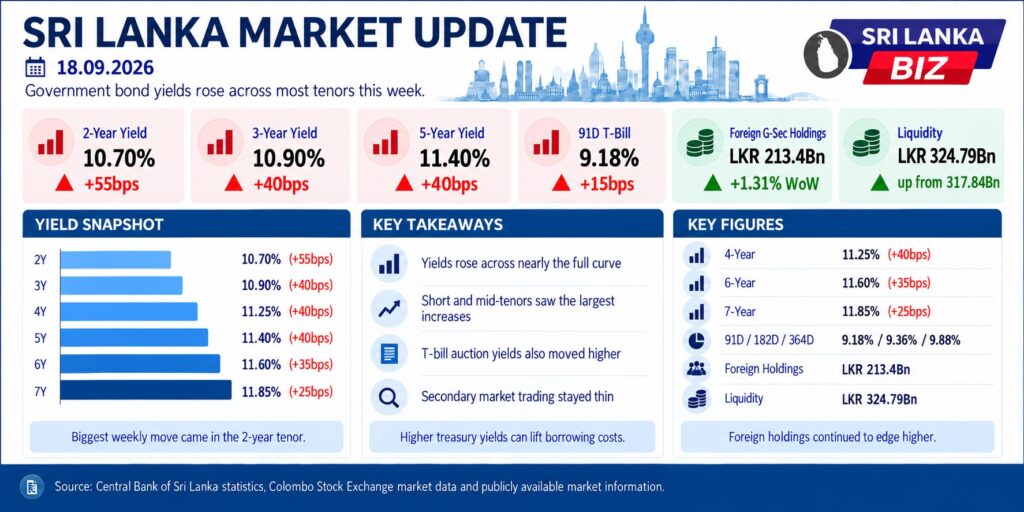
Yields on Sri Lankan government securities rose across nearly the entire maturity curve this week, with the most pronounced increases concentrated in shorter and medium-dated tenors, according to market data as of September 18.
The 2-year tenor recorded the sharpest weekly increase, rising 55 basis points to 10.70%. The 3-year, 4-year and 5-year tenors each climbed 40 basis points, to 10.90%, 11.25% and 11.40% respectively, while the 6-year rose 35 basis points to 11.60%. Further along the curve, gains moderated but remained broad-based: the 7-year added 25 basis points to 11.85%, the 8-year and 11-year each rose 20 basis points, and the 9-year and 13-year tenors gained 18 basis points apiece. Only the shortest end of the curve, the sub-3-month and sub-6-month segments, saw more modest movement, up 20 and 10 basis points respectively.
The weekly increase stands in contrast to a narrower set of session-level secondary market trades, where a limited number of mid-tenor bonds, including issues maturing in 2030 and 2032, changed hands at marginally lower yields during the day. Trading activity in the secondary market was described as thin, with activity clustered around mid-tenor maturities.
The shift was echoed in the primary market. At Wednesday’s Treasury bill auction, yields rose across all three tenors on offer: the 91-day accepted yield increased by 15 basis points to 9.18%, the 182-day rose 12 basis points to 9.36%, and the 364-day increased 11 basis points to 9.88%.
Foreign holdings of local currency government securities rose 1.31% over the week to LKR 213.4 billion, up from LKR 210.7 billion previously, continuing a gradual upward trend seen over recent weeks. Banking system liquidity expanded to LKR 324.79 billion from LKR 317.84 billion.
Business Impact
Rising Treasury yields typically feed through to broader borrowing costs, as banks and other lenders price loans and deposits with reference to government security rates. Businesses planning debt issuance, project financing, or working capital facilities may see this reflected in financing costs over coming weeks. The move also affects fixed income investors, including unit trusts and pension funds holding government securities, whose portfolio valuations are sensitive to yield movements.
Key Numbers
| Tenor | Yield | Weekly Change |
|---|---|---|
| 2-Year | 10.70% | +55bps |
| 3-Year | 10.90% | +40bps |
| 4-Year | 11.25% | +40bps |
| 5-Year | 11.40% | +40bps |
| 6-Year | 11.60% | +35bps |
| 7-Year | 11.85% | +25bps |
| 91-day T-bill (auction) | 9.18% | +15bps |
| Foreign holdings of GSec | LKR 213.4Bn | +1.31% WoW |
Source: Central Bank of Sri Lanka statistics, Colombo Stock Exchange market data and publicly available market information.