

Huawei IP Summit 2026 highlights AI-driven enterprise datacom networks as Sri Lanka accelerates its digital transformation journey amid expanding 5G capabilities. The event brought together industry leaders to examine how intelligent infrastructure is reshaping enterprise connectivity.
Huawei IP Summit 2026 highlights AI-driven enterprise datacom networks and 5G evolution
Huawei recently hosted its Intelligent IP Summit 2026 in Sri Lanka, convening technology experts, policymakers, and enterprise leaders to explore the future of data communication networks in an era increasingly shaped by artificial intelligence and next-generation connectivity. The discussions underscored how enterprise networks are evolving beyond traditional connectivity frameworks into intelligent, integrated platforms capable of supporting complex digital ecosystems.
At the core of the summit’s message was the recognition that enterprise networks are no longer merely operational backbones but strategic assets enabling digital transformation across sectors. From banking and finance to government services, manufacturing, education, and real estate, organisations are increasingly dependent on high-performance, secure, and scalable infrastructure. Huawei Sri Lanka emphasized that modern enterprises require seamless integration between campus networks, data centres, and cloud environments to support real-time applications and AI-driven workloads.
The convergence of AI and 5G emerged as a defining theme throughout the summit. As Sri Lanka continues to roll out 5G infrastructure, the focus is shifting toward how effectively organisations can leverage this enhanced connectivity. Experts highlighted that while 5G offers unprecedented speed and low latency, its true value lies in the strength of the underlying datacom architecture. Enterprise networks must therefore evolve to support distributed operations, edge computing, and data-intensive applications that demand reliability and resilience.
Huawei positioned datacom as the critical bridge linking 5G capabilities with enterprise use cases. Whether enabling digital banking platforms, e-government services, or smart manufacturing systems, robust network infrastructure ensures that these technologies can operate efficiently and securely. This perspective reflects a broader industry shift, where network intelligence and automation are becoming essential components of enterprise IT strategies.
In his remarks, Huawei Sri Lanka Chief Executive Officer Zhang Jinze reiterated the company’s longstanding role in supporting the country’s telecom infrastructure while expanding its footprint in the enterprise segment. He noted that Huawei is working closely with key industries to deliver secure, intelligent, and future-ready solutions tailored to evolving business needs. This dual focus on telecom and enterprise domains positions the company to play a central role in Sri Lanka’s digital transformation.
The summit also served as a platform to introduce Huawei’s latest innovations in enterprise networking. Among the أبرز launches was the NetEngine AR 5G Secure Router, designed to integrate 5G connectivity seamlessly into enterprise environments. The solution enables organisations to achieve high-speed, secure access across distributed operations, addressing the growing demand for flexible and scalable network architectures.
Another key highlight was the unveiling of the AirEngine 8771-X1T, a Pre-Wi-Fi 8 access point engineered for the AI era. The device delivers significant improvements in speed, reliability, and mobility, transforming wireless connectivity into a production-grade platform capable of supporting mission-critical applications. As enterprise networks become more complex, such advancements are essential in maintaining consistent performance across diverse operating environments.
Huawei also introduced its CloudEngine twin switches, built on a dual-plane architecture designed to ensure zero downtime and rapid fault recovery. These features are particularly critical for sectors such as banking and government, where uninterrupted service delivery is paramount. Together, these solutions reflect a comprehensive approach to building resilient, AI-ready enterprise networks that can adapt to evolving technological demands.
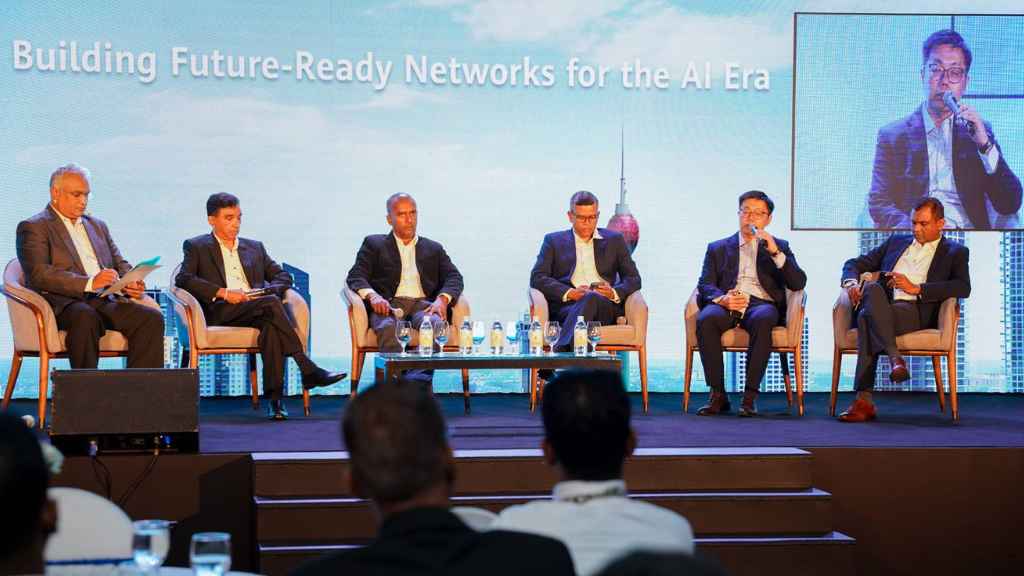
A panel discussion featuring industry stakeholders provided further insights into the challenges and opportunities associated with adopting AI-driven infrastructure. Participants from financial services, telecommunications, and the public sector highlighted the importance of collaboration in accelerating digital transformation. The consensus was that while technology adoption is essential, aligning regulatory frameworks, investment strategies, and talent development will be equally important in achieving sustainable growth.
The discussions also touched on the broader implications of digital transformation for Sri Lanka’s economy. As enterprise networks become more sophisticated, they are expected to play a pivotal role in enhancing productivity, improving service delivery, and fostering innovation. However, this transition requires careful planning and investment to ensure that infrastructure development keeps pace with technological advancements.
Huawei IP Summit 2026 highlights AI-driven enterprise datacom networks as a central pillar of this transformation, reinforcing the idea that connectivity alone is no longer sufficient. Instead, intelligent, integrated, and secure networks will define the next phase of digital evolution.
As Sri Lanka moves forward with its digital agenda, the convergence of AI, 5G, and advanced enterprise networks will shape the country’s competitive landscape. With continued collaboration between industry stakeholders and technology providers like Huawei Sri Lanka, the foundations are being laid for a more connected, efficient, and innovation-driven economy.