

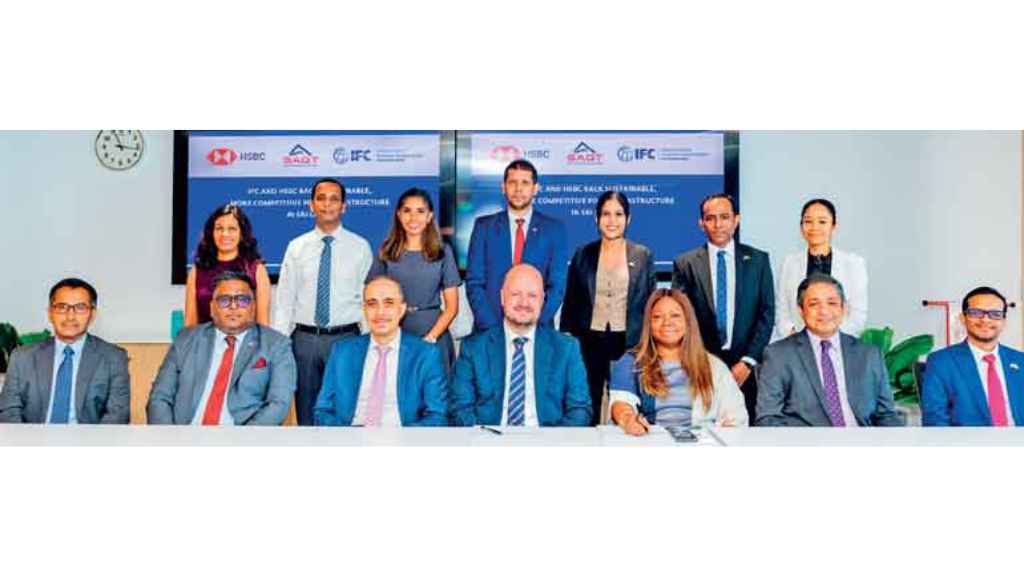
IFC and HSBC to invest $ 40 m in SAGT as the two global financial institutions back the modernisation and decarbonisation of South Asia Gateway Terminals (SAGT), strengthening the Port of Colombo’s position as South Asia’s leading transshipment hub.
IFC and HSBC to invest $ 40 m in SAGT to modernise Port of Colombo operations
The World Bank Group’s International Finance Corporation (IFC) and The Hongkong and Shanghai Banking Corporation (HSBC) have announced a financing package of up to US$40 million for South Asia Gateway Terminals Ltd. (SAGT) to support the acquisition of advanced port equipment and improve the efficiency, sustainability and competitiveness of the Port of Colombo.
The financing consists of a sustainability-linked loan of up to US$20 million from IFC, including up to US$8.57 million mobilised through IFC’s Managed Co-Lending Portfolio Program (MCPP), alongside a parallel green loan of up to US$20 million from HSBC. The investment marks the IFC’s first sustainability-linked financing for an infrastructure company in Sri Lanka and its return to the country’s ports sector after two decades.
According to the joint statement, the proceeds will finance advanced twin-lift ship-to-shore cranes designed to improve cargo handling capacity while reducing energy consumption. The new equipment is expected to enhance operational reliability, increase productivity and enable SAGT to meet growing demand from global shipping lines with faster and more efficient container handling services.
The investment is expected to increase quay-side productivity by at least 11%, allowing the Port of Colombo to accommodate higher volumes of both transshipment and domestic container traffic. It will also contribute to reducing SAGT’s carbon footprint while supporting job creation and creating more opportunities for women in Sri Lanka’s maritime sector, where female participation remains relatively low.
Sri Lanka occupies a strategic position along one of the world’s busiest maritime trade corridors, with nearly half of global container traffic passing close to the island. As the country’s principal maritime gateway, the Port of Colombo plays a vital role in regional logistics and contributes approximately 2.5% of Sri Lanka’s Gross Domestic Product (GDP).
SAGT Chief Executive Officer Steen Knudsen described the financing as a significant milestone for both the company and Sri Lanka’s maritime industry. He said the investment reflects SAGT’s continued commitment to expanding world-class port infrastructure, improving operational performance and strengthening Colombo’s position as a leading regional transshipment hub.
Knudsen also noted that becoming the recipient of the IFC’s first sustainability-linked infrastructure financing in Sri Lanka demonstrates the company’s commitment to driving sustainable growth while setting new standards for the industry.
World Bank Group Country Manager for Sri Lanka and Maldives Gevorg Sargsyan said efficient trade infrastructure is essential for long-term economic development. He stated that the investment illustrates how innovative sustainable finance solutions can modernise critical national infrastructure, support decarbonisation efforts and promote sustainable economic growth.
HSBC Sri Lanka Director of Banking – Corporate and Institutional Banking Amesh Dissanayake said the bank remains committed to supporting sectors that play a strategic role in Sri Lanka’s economy. He explained that HSBC’s green loan will enable SAGT to modernise key port equipment, improving productivity and operational reliability while lowering energy consumption and carbon dioxide emissions.
The transaction also highlights the growing role of sustainable finance in infrastructure development, demonstrating how blended private capital can deliver measurable environmental and operational improvements alongside long-term economic benefits.
The latest investment builds on a longstanding relationship between IFC and SAGT that began in 1999, when IFC supported Sri Lanka’s first public-private partnership container terminal. Since then, SAGT has played a significant role in transforming the Port of Colombo into one of South Asia’s busiest transshipment hubs through continued investment, innovation and operational excellence.
The financing is aligned with the World Bank Group’s Country Partnership Framework for Sri Lanka and supports the Government’s strategy of strengthening the country’s logistics sector and expanding its integration into global trade networks. As international shipping volumes continue to grow, investments in modern port infrastructure are expected to reinforce Sri Lanka’s competitiveness while supporting a lower-carbon future for the maritime industry.