

The Public Debt Management Office concluded a three-tranche Treasury bond auction on Thursday, with the 2030 maturity absorbing nearly half of total proceeds as secondary market yields drifted higher across the curve.
Sri Lanka’s Public Debt Management Office (PDMO) raised a total of LKR 150 billion through a Treasury bond auction on Thursday, drawing on three separate maturities as the government continued to fund its borrowing programme through the domestic debt market.
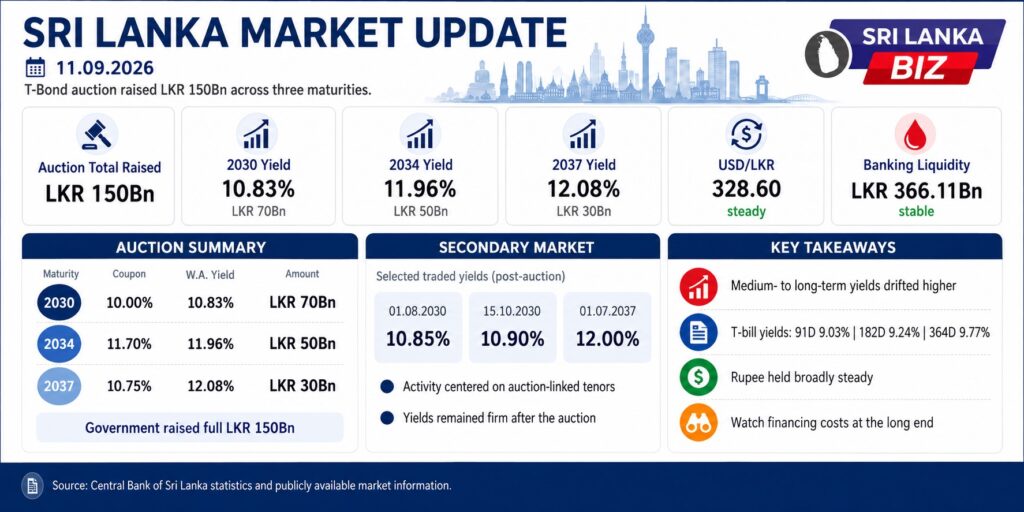
The largest share of the auction, LKR 70 billion, was raised through a bond maturing in 2030, carrying a coupon rate of 10.00 percent. This tranche was accepted at a weighted average yield of 10.83 percent. A further LKR 50 billion was raised via a 2034 maturity bearing an 11.70 percent coupon, accepted at a weighted average yield of 11.96 percent, while LKR 30 billion was raised through a 2037 maturity with a 10.75 percent coupon, accepted at a weighted average yield of 12.08 percent.
Ahead of the auction, secondary market activity was concentrated in the tenors due for issuance, with investors positioning around the 2030 segment in particular. The 01.08.2030 and 15.10.2030 bonds changed hands between 10.75 and 10.80 percent in trading prior to the auction, reflecting a degree of selling pressure as the market adjusted ahead of the new supply.
Following the auction’s conclusion, secondary market activity picked up modestly, though investor interest remained largely confined to the auction-linked tenors. Sentiment in the secondary market was mixed following the auction, with the 01.08.2030 bond trading at 10.85 percent and the 15.10.2030 bond changing hands at a higher 10.90 percent. The 01.07.2037 bond was seen trading at 12.00 percent, below the 12.08 percent weighted average yield recorded at the auction itself.
Broader yield movements over the week showed an upward drift across medium- and long-term tenors, with the steepest increases concentrated in the 5-to-9-year segment of the curve, an area that includes two of the three maturities auctioned Thursday. This suggests the higher yields accepted at auction are consistent with, rather than isolated from, a wider firming of rates across the government securities market this week.
Separately, a Treasury bill auction settling the same week cleared at 9.03 percent for 91-day bills, 9.24 percent for 182-day bills and 9.77 percent for 364-day bills, providing a short-term reference point alongside the longer-dated bond issuance.
On the currency front, the rupee was little changed against the US dollar, trading at LKR 328.60 compared to LKR 328.75 previously. Liquidity in the banking system remained stable, standing at LKR 366.11 billion against LKR 366.20 billion in the prior session.
Key Numbers
| Metric | Value |
|---|---|
| Total Raised | LKR 150.0 billion |
| 2030 Maturity — Amount / Coupon / Yield | LKR 70.0Bn / 10.00% / 10.83% (weighted avg.) |
| 2034 Maturity — Amount / Coupon / Yield | LKR 50.0Bn / 11.70% / 11.96% (weighted avg.) |
| 2037 Maturity — Amount / Coupon / Yield | LKR 30.0Bn / 10.75% / 12.08% (weighted avg.) |
| Secondary Market — 01.08.2030 (post-auction) | 10.85% |
| Secondary Market — 15.10.2030 (post-auction) | 10.90% |
| Secondary Market — 01.07.2037 (post-auction) | 12.00% |
| 91-Day T-Bill Yield | 9.03% |
| 182-Day T-Bill Yield | 9.24% |
| 364-Day T-Bill Yield | 9.77% |
| USD/LKR | 328.60 |
| Banking System Liquidity | LKR 366.11 billion |
Business Impact
The auction results give businesses, banks and institutional investors a fresh benchmark for government borrowing costs across the medium- to long-term curve. The gap between the 2030 maturity’s yield (10.83%) and the 2037 maturity’s yield (12.08%) points to a steepening curve at the long end, which corporate treasurers may want to factor into decisions on the timing and tenor of their own debt issuance. The broader upward drift in secondary market yields this week suggests borrowing costs may continue to firm in the near term, a relevant consideration for businesses planning fixed income investments or debt refinancing.
Source Attribution
Source: Central Bank of Sri Lanka statistics and publicly available market information.