

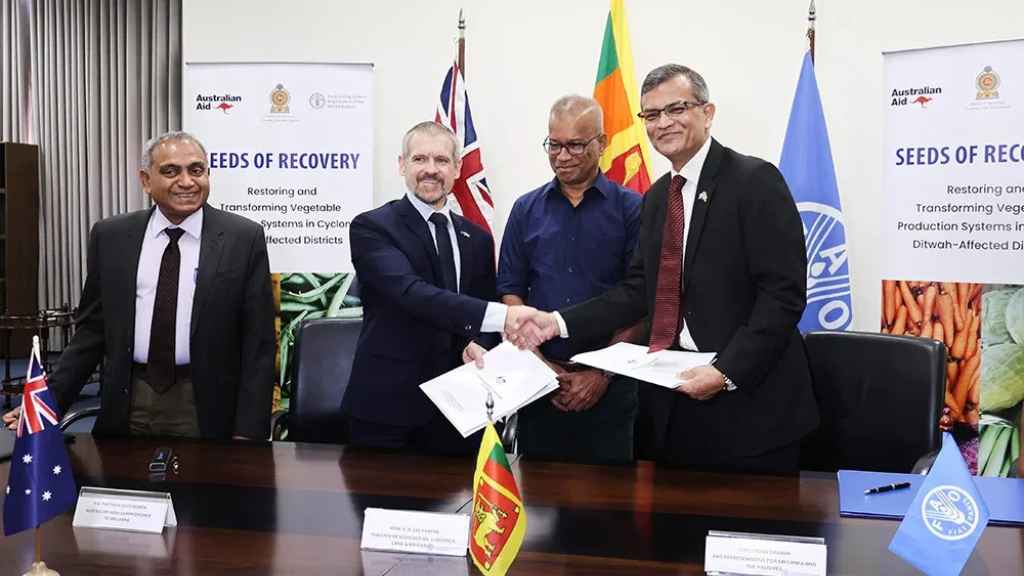
Sri Lanka and Australia partner FAO to launch a new recovery initiative aimed at rebuilding climate-resilient vegetable farming systems in cyclone-affected highland districts. The AUD 2 million ($1.4 million) program will support smallholder farmers in Nuwara Eliya and Badulla following the devastating impact of Cyclone Ditwah.
Sri Lanka and Australia partner FAO to restore climate-resilient farming
The initiative was formally launched through the signing of a grant agreement between the Government of Australia and the Food and Agriculture Organization, alongside Sri Lanka’s Agriculture, Livestock, Lands and Irrigation Ministry. The project seeks to restore agricultural livelihoods while strengthening long-term resilience in the country’s vegetable production sector.
The agreement was signed by Australian High Commissioner Matthew Duckworth and FAO Representative for Sri Lanka and the Maldives Vimlendra Sharan. Agriculture Secretary D.P. Wickramasinghe and Sharan also signed the project documentation in the presence of Agriculture Minister K.D. Lalkantha.
Cyclone Ditwah, which struck Sri Lanka in November 2025, caused severe damage to agricultural production systems across several regions. The highland districts of Nuwara Eliya and Badulla were among the hardest hit areas due to their critical role in supplying vegetables such as carrots, beans, potatoes, tomatoes, cabbage and leeks to domestic markets.
Thousands of smallholder farmers reportedly lost crops, seed stocks and productive assets during the disaster, creating major disruptions to local food supply chains and rural livelihoods. Authorities and development partners say restoring production capacity in these regions is essential for improving food security and stabilising vegetable markets.
The 12-month project will focus on rebuilding climate-resilient agriculture systems through improved seed and seedling production, climate-smart farming methods, small-scale machinery support and market access initiatives. More than 2,400 smallholder farmers are expected to directly benefit from the program, while thousands more may receive indirect support through strengthened agricultural supply chains and community-based interventions.
Particular emphasis will be placed on supporting women farmers and persons with disabilities to ensure inclusive participation in agricultural recovery efforts. Officials noted that vulnerable farming communities often face greater challenges in recovering from climate-related disasters and require targeted assistance to restore livelihoods.
Minister Lalkantha said the initiative represented an important step toward building a stronger and more sustainable agricultural sector. He stressed that improving local seed systems and empowering vulnerable farming communities would contribute to the long-term resilience of Sri Lanka’s food production systems.
Australian High Commissioner Duckworth reaffirmed Australia’s commitment to supporting Sri Lanka’s recovery efforts following the cyclone. He said the agriculture sector remains critical to food security, rural development and economic resilience, adding that the project would promote climate-smart practices and farmer-led solutions capable of delivering sustainable benefits to affected communities.
The project will prioritise restoring farmer-led seed systems for beans and potatoes while supporting the re-establishment of open-field and protected cultivation systems. Women-led seedling nurseries will also be established to strengthen local agricultural entrepreneurship and improve access to high-quality planting materials.
A major component of the initiative involves the creation of six accessible and inclusive nurseries across Nuwara Eliya and Badulla. These facilities are expected to operate as sustainable agri-based enterprises, producing vegetable seedlings while creating additional income opportunities for local communities.
The initiative also aims to reduce Sri Lanka’s dependence on imported seeds by strengthening local seed production systems. Development experts say this approach could improve food system resilience and reduce vulnerabilities associated with global supply chain disruptions.
FAO Representative Sharan described the project as an opportunity to “build back better” through integrated recovery and climate adaptation measures. He noted that strengthening seed systems, promoting inclusive agri-entrepreneurship and expanding climate-smart farming practices would help communities better withstand future climate shocks.
The Cyclone Ditwah recovery initiative is aligned with Sri Lanka’s broader national priorities on food security, rural development and climate adaptation. The program will be implemented in collaboration with the Department of Agriculture and Provincial Departments of Agriculture to ensure effective coordination and long-term sustainability.
Officials believe the project could serve as a model for future climate resilience initiatives in Sri Lanka’s agriculture sector as the country continues to confront increasing climate-related risks affecting rural livelihoods and food production.