

Weekly yield increases of up to 30 basis points on the 4-to-8-year segment signal a repricing of medium-term borrowing costs, even as short-term bill rates continue to ease
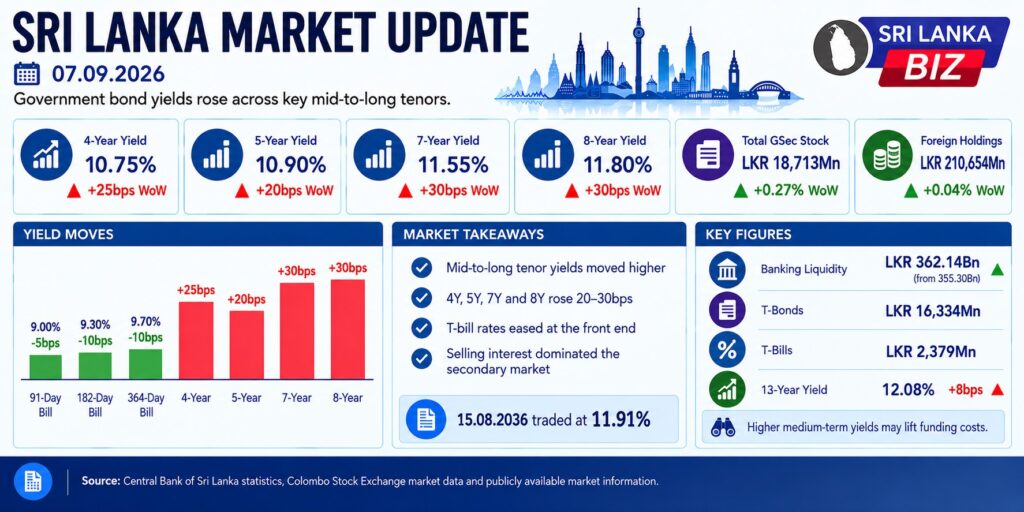
Yields on Sri Lanka’s government securities rose across the middle-to-long end of the curve over the past week, as selling interest in the secondary market pushed several key tenors 20 to 30 basis points higher.
The most pronounced moves came in the 4-year, 5-year, 7-year and 8-year maturities. Bid yields on the 01.08.2030 (4-year) tenor rose 25 basis points week-on-week, while the 15.05.2031 (5-year) segment gained 20 basis points. The 01.06.2033 (7-year) and 15.10.2034 (8-year) maturities each rose 30 basis points over the same period. Trading activity in the 2030 segment specifically showed yields increasing by approximately 5 to 10 basis points during the day’s session, with bonds in that maturity changing hands between 10.37% and 10.85% depending on the specific issue.
At the longer end of the curve, the 15.08.2036 maturity was dealt at 11.91%, among the highest levels traded across the curve. Shorter-dated maturities were comparatively more stable, with tenors under two years showing smaller movements, and in some cases yields eased slightly.
The rise in medium-to-long yields stands in contrast to the front end of the curve, where Treasury bill rates have continued to decline. The most recent bill auction saw the 91-day, 182-day and 364-day rates fall 8 to 17 basis points from the prior auction, settling at 8.96%, 9.27% and 9.81% respectively. The divergence points to a market pricing near-term rates lower while demanding higher compensation for holding duration risk further out on the curve.
Total outstanding government securities stock stood at LKR 18,713Mn, comprising LKR 2,379Mn in Treasury bills and LKR 16,334Mn in Treasury bonds, up 0.27% week-on-week. Foreign holdings of rupee-denominated government securities were largely flat, edging up 0.04% for the week to LKR 210,654Mn.
Separately, liquidity conditions in the banking system improved, with excess liquidity rising to LKR 362.14Bn from LKR 355.30Bn recorded previously.
Business Impact
The increase in mid-to-long tenor yields is relevant for businesses and institutions with financing tied to government securities benchmarks, including corporate bond pricing and medium-term loan structures that reference the sovereign curve. Companies planning debt issuance in the 4-to-8-year range may face a higher cost of funds than in recent weeks. At the same time, the continued decline in short-term bill rates may offer some relief for businesses relying on shorter-tenor working capital facilities. The broader liquidity improvement in the banking system could support credit availability across both segments in the near term.
Key Numbers
| Tenor | Today’s Yield (Bid) | Change vs Last Week |
|---|---|---|
| 91-Day Bill | 9.00% | -5bps |
| 182-Day Bill | 9.30% | -10bps |
| 364-Day Bill | 9.70% | -10bps |
| 4-Year (01.08.2030) | 10.75% | +25bps |
| 5-Year (15.05.2031) | 10.90% | +20bps |
| 7-Year (01.06.2033) | 11.55% | +30bps |
| 8-Year (15.10.2034) | 11.80% | +30bps |
| 13-Year (15.08.2039) | 12.08% | +8bps |
| Total Outstanding GSec Stock | LKR 18,713Mn | +0.27% WoW |
| Foreign Holdings of GSecs | LKR 210,654Mn | +0.04% WoW |
| Banking System Excess Liquidity | LKR 362.14Bn | Up from LKR 355.30Bn |
Source: Central Bank of Sri Lanka statistics, Colombo Stock Exchange market data and publicly available market information.