

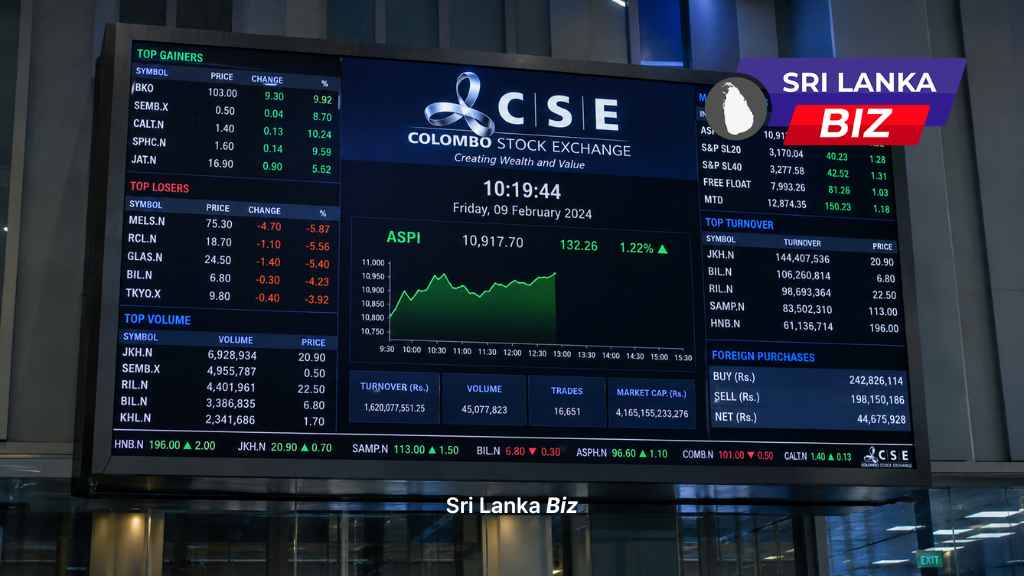
Sri Lanka stocks close down, capital goods lead turnover as the Colombo bourse ended Wednesday’s trading session in negative territory, with the benchmark index slipping amid mixed investor sentiment and subdued market activity.
Sri Lanka stocks close down, capital goods lead turnover amid mixed regional markets
The Colombo Stock Exchange recorded a modest decline during the session, with the benchmark All Share Price Index (ASPI) losing 85.54 points, or 0.40 percent, to close at 21,461.63. The more liquid S&P SL20 Index also edged lower, declining 9.12 points, or 0.15 percent, to settle at 5,991.56.
Despite the overall downturn, several heavyweight counters helped cushion losses during the day. Among the positive contributors to the ASPI were Bukit Darah, which gained 6.02 percent to close at 845.50 rupees, and John Keells Holdings, which rose 0.51 percent to 19.80 rupees. Aitken Spence also posted a gain of 1.48 percent to close at 137.00 rupees, while Associated Motor Finance Company advanced 3.33 percent to 46.50 rupees.
However, these gains were outweighed by declines in several major stocks. CT Holdings emerged as one of the biggest drags on the market, falling 7.81 percent to 525.50 rupees. Melstacorp declined 0.98 percent to 177.25 rupees, while Janashakthi Insurance dropped 7.79 percent to close at 36.70 rupees. The losses in these counters contributed significantly to the downward movement in the broader market index.
Market turnover reached 1.67 billion rupees, reflecting moderate investor participation during the trading session. The capital goods sector led turnover, accounting for approximately 469.3 million rupees of total market activity. Analysts noted that continued investor interest in selected capital goods counters helped support trading volumes even as broader market sentiment remained cautious.
The performance of the Colombo Stock Exchange came against a backdrop of mixed movements across Asian equity markets. Investors across the region remained focused on global economic signals, interest rate expectations, and geopolitical developments, resulting in varied performances among key stock indices.
In Hong Kong, the Hang Seng Index fell 157.94 points, or 0.64 percent, to close at 24,407.96. South Korea’s KOSPI recorded a sharper decline, losing 366.11 points, or 4.52 percent, to end the day at 7,730.82. In contrast, India’s NIFTY 50 managed to post a modest gain, rising 18.25 points, or 0.079 percent, to close at 23,260.35.
Market participants said investor sentiment in Sri Lanka continues to be influenced by both domestic and international developments. While improving economic conditions and easing inflationary pressures have supported confidence in recent months, traders remain selective in their stock picks amid ongoing uncertainty in global financial markets.
The latest trading session highlighted the importance of sector-specific activity in shaping overall market performance. Although the broader indices ended lower, strong turnover in capital goods counters indicated that investors continue to identify opportunities in selected segments of the market.
Analysts also pointed out that movements in large-cap stocks continue to have a significant influence on overall market direction. Gains recorded by several blue-chip companies helped limit the decline, though they were insufficient to offset losses elsewhere in the market.
The performance of the ASPI remains closely watched by investors as a key indicator of market sentiment and economic confidence. Future trading sessions are expected to be influenced by corporate earnings, macroeconomic developments, foreign investor activity, and broader regional market trends.
Overall, Sri Lanka stocks close down, capital goods lead turnover reflected a session marked by cautious trading, moderate turnover, and mixed investor sentiment. While the market ended in negative territory, continued activity within the capital goods sector suggests that investors remain engaged as they assess opportunities within the evolving economic landscape.