

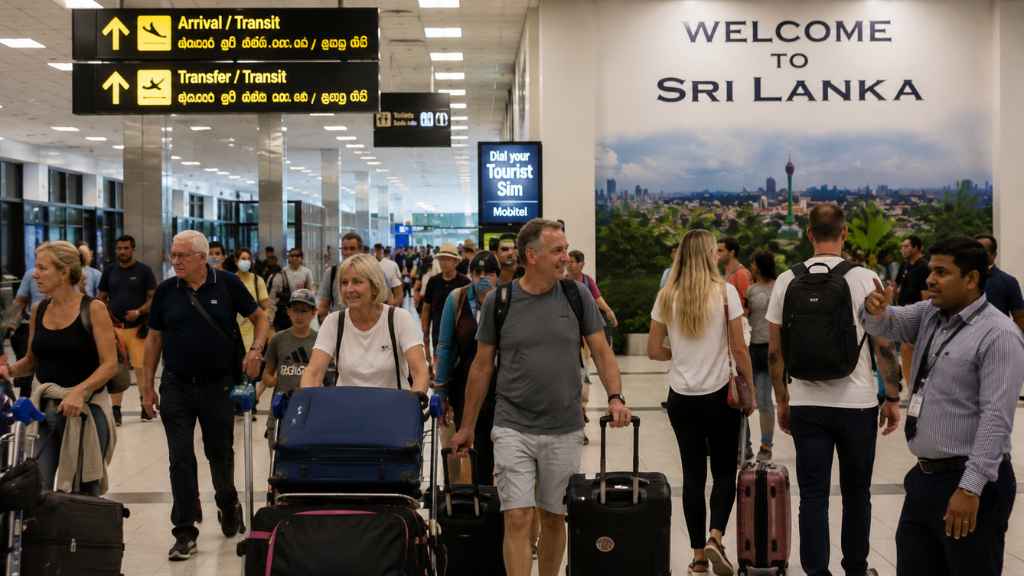
Tourist arrivals in first 19 days slip 0.6% YoY as Middle East disruptions continue to weigh on Sri Lanka’s tourism sector, even as the country recorded a strong month-on-month recovery in visitor numbers during the first three weeks of July.
Tourist arrivals in first 19 days slip 0.6% YoY as Middle East disruptions continue to weigh despite seasonal rebound
According to the latest figures released by the Sri Lanka Tourism Development Authority (SLTDA), the country welcomed 118,935 international visitors during the first 19 days of July, representing a marginal 0.6% year-on-year (YoY) decline. However, compared with the corresponding period in June, arrivals surged 61.5%, pointing to a seasonal improvement in travel demand.
The latest performance reflects the mixed outlook facing Sri Lanka tourism, where stronger seasonal travel is being offset by continued geopolitical uncertainty affecting international air connectivity. Industry observers say the lingering impact of tensions in the Middle East remains the biggest obstacle to a sustained recovery, particularly for long-haul European markets that rely heavily on Gulf transit hubs.
Sri Lanka recorded its strongest single-day arrival figure for the month on 18 July, when 7,690 tourists entered the country. Average daily arrivals during the first 19 days stood at approximately 6,260 visitors, indicating relatively steady inbound demand despite external challenges.
India maintained its position as Sri Lanka’s largest source market, contributing 27,574 visitors, accounting for around 23% of total arrivals during the period. The United Kingdom ranked second with 12,786 visitors, followed by China with 7,147, the Netherlands with 6,770, and Australia with 6,699.
Although the month has shown encouraging momentum compared to June, the broader picture remains subdued. Year-to-date tourist arrivals reached more than 1.26 million between 1 January and 19 July, compared with approximately 1.28 million during the same period in 2025, representing a 1.72% decline.
Industry analysts attribute much of this slowdown to continued disruptions affecting Middle Eastern aviation routes. Earlier airspace closures across the region significantly impacted the Gulf corridor, which serves as a vital transit gateway for travellers from Europe and several other long-haul markets visiting Sri Lanka.
While a temporary ceasefire previously offered hope of improving flight schedules, renewed tensions around the Strait of Hormuz have once again created uncertainty for airlines, limiting the restoration of normal flight capacity and affecting booking confidence among international travellers.
Recognising these headwinds, the Government has introduced several measures aimed at supporting Sri Lanka tourism, including accelerating the implementation of a visa-free entry programme covering citizens from 40 countries. Authorities hope the initiative will encourage additional visitor arrivals by making travel to the island more convenient and competitive.
Nevertheless, officials acknowledge that external geopolitical developments remain largely beyond the country’s control and could continue to weigh on tourism performance during the third quarter of the year.
Reflecting the more challenging operating environment, the Government recently revised its tourism projections for 2026. Deputy Minister of Tourism Prof. Ruwan Ranasinghe said the decision was driven primarily by the impact of the Middle East conflict, which disrupted regional aviation networks and reduced visitor growth expectations.
Under the revised forecast, Sri Lanka now expects to welcome 2.5 million visitors and generate approximately US$3.5 billion in tourism earnings during 2026. The original targets had aimed for 3 million arrivals and US$4 billion in tourism revenue.
Despite lowering the projections, authorities remain optimistic about the sector’s longer-term prospects. Prof. Ranasinghe said 2026 still has the potential to become Sri Lanka’s strongest tourism year on record if recovery continues through the remainder of the year.
Sri Lanka Tourism Chairman Buddhika Hewawasam also expressed confidence that the revised earnings target remains achievable. He noted that maintaining monthly tourist arrivals of around 200,000 visitors, supported by between 75,000 and 100,000 high-spending Indian travellers, would significantly improve the industry’s revenue performance, as Indian tourists continue to record higher-than-average spending patterns.
The coming months are expected to be crucial for Sri Lanka’s tourism industry as authorities monitor geopolitical developments, airline capacity and seasonal demand while working to sustain the recovery despite ongoing regional uncertainties.