

Government securities yields eased by as much as 40 basis points week-on-week across multiple tenors, while banking system liquidity climbed to LKR 274 billion.
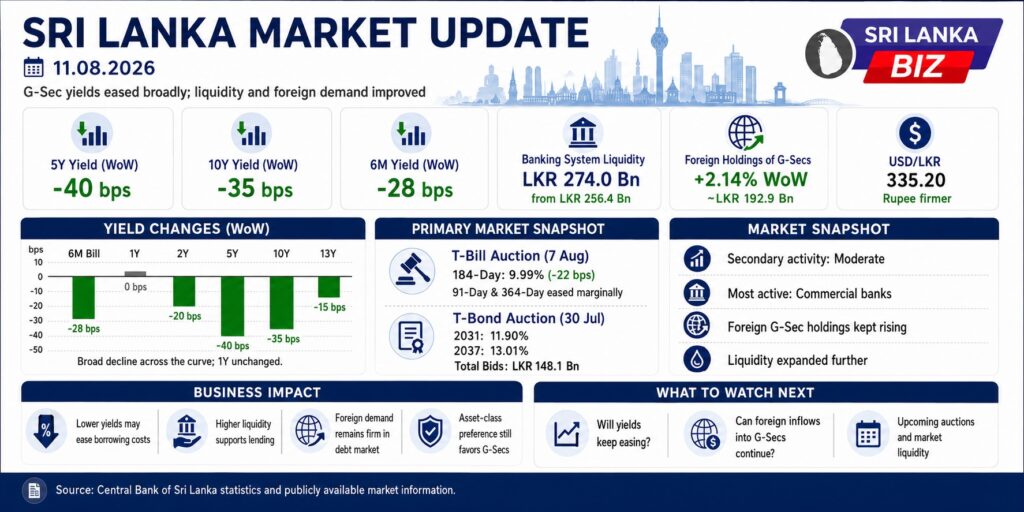
Yields on Sri Lankan government securities declined broadly across the curve over the past week, with the steepest moves concentrated in the five- to ten-year segment. Data as of August 11 showed the five-year tenor easing 40 basis points week-on-week, the largest single decline on the curve, while the ten-year tenor fell 35 basis points. Most other maturities from the six-month bill through to the 13-year bond recorded declines in the 15 to 30 basis point range. The one-year tenor was the only point on the curve that held steady, unchanged from the prior week.
The move was broad-based rather than concentrated in a single segment, spanning short-dated bills through to the long end of the curve, and points to a general softening in yield levels across the government securities market over the week.
Supporting the move, banking system liquidity expanded to LKR 274.0 billion from LKR 256.4 billion recorded previously, giving the market more room to absorb government paper at lower yields. Foreign participation also continued to build: foreign holdings of rupee government securities rose 2.14% week-on-week to approximately LKR 192.9 billion, extending a steady climb from roughly LKR 135.9 billion in late June.
At the primary market level, the most recent Treasury bill auction — settled August 7 — saw yields decline versus the prior auction across all three maturities offered, with the 184-day bill falling 22 basis points and the 91-day and 364-day bills easing marginally. At the most recent Treasury bond auction on July 30, weighted average yields ranged from 11.90% on the 2031 maturity to 13.01% on the 2037 maturity, with total bids received of LKR 148.1 billion.
Secondary market activity was described as moderate, with commercial banks the most active participants across trades spanning maturities from 2028 through to 2037.
Business Impact
A broad decline in government securities yields, if sustained, typically points to lower funding costs for the state and can filter through to corporate borrowing rates priced off the sovereign curve, easing pressure on companies planning debt issuance or refinancing. The rise in banking system liquidity gives banks more capacity to lend and invest, while continued foreign inflows into government debt — even as foreign investors remain net sellers of equities — suggest international investors are differentiating between Sri Lankan asset classes rather than reducing exposure to the country broadly.
What to Watch Next
Whether the decline in yields continues into subsequent auctions and secondary trading sessions, and whether foreign inflows into government securities keep pace with the recent multi-week uptrend.
Key Numbers
| Metric | Value |
|---|---|
| 5-Year Yield (WoW change) | -40 bps |
| 10-Year Yield (WoW change) | -35 bps |
| 6-Month Yield (WoW change) | -28 bps |
| 2-Year Yield (WoW change) | -20 bps |
| Banking System Liquidity | LKR 274.0Bn (from LKR 256.4Bn) |
| Foreign Holdings of Govt. Securities (WoW) | +2.14% (~LKR 192.9Bn) |
| T-Bill Auction (184-day, latest) | 9.99% (-22 bps) |
| T-Bond Auction WAvg (2037, 30-Jul) | 13.01% |
Source: Central Bank of Sri Lanka statistics and publicly available market information.