

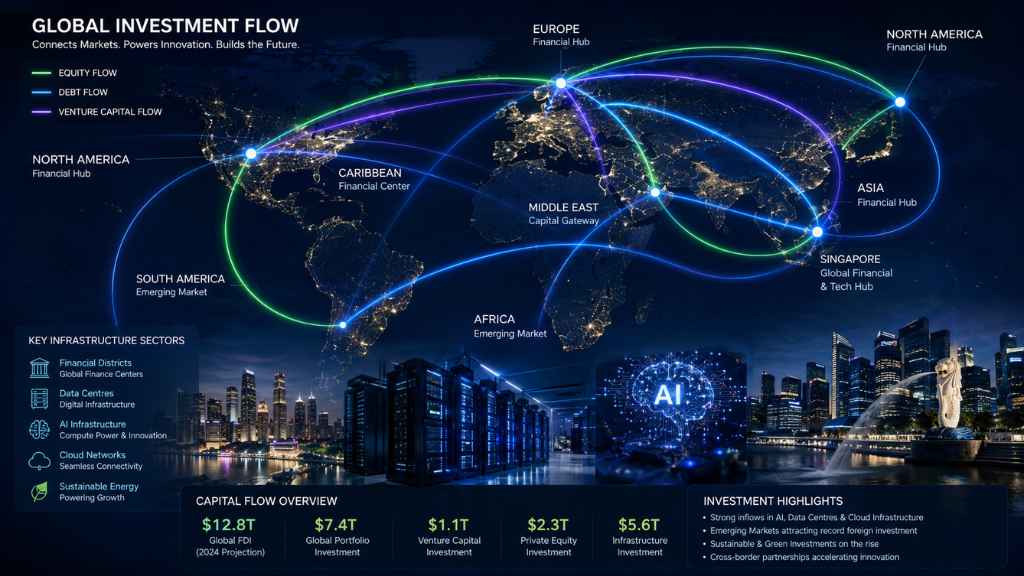
World Investment Report 2026 shows that global foreign direct investment (FDI) rebounded in 2025 after two consecutive years of decline, but the recovery remains uneven, with investment increasingly concentrated in a handful of economies, sectors and large-scale projects.
World Investment Report 2026 says global FDI rises but development gains remain uneven
The latest report, published by UN Trade and Development (UNCTAD), found that global foreign direct investment increased by 6% to US$1.6 trillion in 2025. While the figures signal renewed investor confidence, the agency cautions that the recovery has yet to translate into broad-based development benefits, particularly for developing economies.
According to the World Investment Report 2026, inflows to developed economies grew by 11%, while developing economies recorded only 2% growth, reaching US$901 billion. Although developing countries continued to receive more than half of global FDI, the gains were uneven across regions and sectors.
Developing Asia remained the world’s largest investment destination, attracting US$644 billion, while Latin America and the Caribbean recorded a 14% increase to US$188 billion. Africa received approximately US$70 billion, remaining well above its long-term average despite declining from exceptionally high levels recorded in 2024. Least developed countries experienced a 21% increase in inflows to US$43 billion, although they accounted for just 2.7% of global investment.
UNCTAD noted that the recovery was driven largely by a relatively small number of major investment projects rather than broad expansion across industries. The world’s 20 largest host economies attracted more than 80% of global FDI, highlighting the increasing concentration of international investment.
The report also emphasises that headline investment figures do not necessarily reflect new factories, productive capacity, employment opportunities or technology transfer. Instead, much of the increase was linked to large projects in digital infrastructure, particularly those supporting Artificial Intelligence (AI).
Strategic sectors including AI infrastructure, semiconductors, critical minerals and energy transition technologies accounted for 44% of global greenfield investment project values in 2025, compared with just 16% in 2020. Data centres represented the largest contributor to project growth, followed by oil and gas developments and semiconductor investments.
In contrast, several traditional investment sectors—including renewable energy, infrastructure and manufacturing—recorded declines, underscoring the narrow nature of the recovery.
The report also found that lower-income economies continue to face significant challenges in attracting investment into high-value industries. Between 2020 and 2025, low-income and lower-middle-income countries secured only around 10% of investment in strategic sectors, compared with more than 20% in other industries.
Governments worldwide are playing a more active role in directing investment flows. During 2025, countries introduced a record 229 investment policy measures, with many designed to attract strategic industries, strengthen domestic industrial capabilities and address economic security concerns.
According to UNCTAD, developing economies need to move beyond traditional investment promotion strategies if they are to compete successfully. Building stronger infrastructure, improving workforce skills, enhancing investment facilitation, supporting local suppliers and expanding regional market integration will be essential to attracting higher-quality investment capable of generating sustainable economic development.
Looking ahead, the World Investment Report 2026 warns that the outlook for 2026 remains uncertain. Trade policy uncertainty, geopolitical tensions, ongoing conflicts, elevated financing costs and increasing economic fragmentation are expected to continue influencing investor decisions. At the same time, global competition for investments in strategic industries is likely to intensify as countries seek to strengthen technological capabilities and secure future economic growth.
The report’s findings are expected to shape discussions at UNCTAD’s World Investment Forum 2026, scheduled to take place in Doha, Qatar, from 25 to 27 October, where policymakers, investors and development partners will explore how international investment can deliver broader and more inclusive development outcomes.
Ultimately, the report concludes that the future of global investment should not be measured solely by the volume of capital crossing borders, but by whether foreign direct investment creates productive industries, quality employment, technology transfer and long-term economic resilience for host countries.