

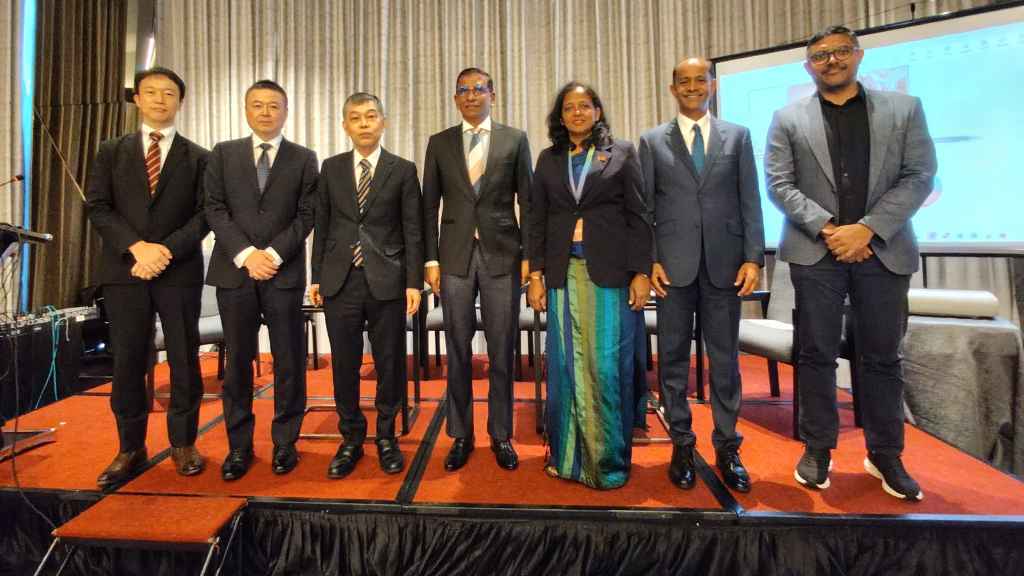
JICA, World Bank and Presidential Secretariat co-host seminar on Competition Policy and Law, bringing together key stakeholders to examine how stronger competition frameworks can support Sri Lanka’s economic reform agenda and long-term growth prospects.
JICA, World Bank and Presidential Secretariat co-host seminar on Competition Policy and Law in Colombo
The seminar, held in Colombo, was jointly organised by Japan International Cooperation Agency (JICA), the World Bank, and the Presidential Secretariat of Sri Lanka. The event attracted over 70 participants, including government policymakers, regulators, private sector leaders, development partners, think tanks, and both local and international experts.
Discussions focused on the role of competition policy and law in strengthening Sri Lanka’s economic resilience and improving market efficiency. The seminar was conducted as a panel discussion moderated by Harsha Fernando, featuring six panelists representing diverse perspectives on competition policy, regulatory enforcement, and economic development.
Participants explored how fair competition can drive export growth, prevent monopolistic practices, and enhance consumer protection. The dialogue also examined how competitive markets can stimulate innovation, expand consumer choice, and support digital transformation across industries. The JICA, World Bank and Presidential Secretariat co-host seminar on Competition Policy and Law initiative reflects a growing recognition that robust competition frameworks are essential for sustainable economic development.
A key highlight of the seminar was the participation of representatives from the Japan Fair Trade Commission (JFTC), including Secretary General Hiroo Iwanari. The Japanese delegation shared insights into Japan’s experience in developing and enforcing competition policy, including its role in liberalising the electricity market. Their contributions provided valuable comparative perspectives for Sri Lanka as it seeks to modernise its own regulatory systems.
In his keynote address, Senior Additional Secretary to the President Russell Aponsu emphasised the government’s commitment to fostering a competitive economic environment. He noted that ongoing reforms, including the introduction of an e-procurement platform, tariff adjustments, and the development of a National Single Window system, are expected to significantly improve the ease of doing business in Sri Lanka.
Aponsu highlighted that strengthening competition policy would be particularly beneficial for small and medium enterprises, enabling them to compete more effectively in both domestic and international markets. He underscored the importance of creating a level playing field where businesses can thrive based on efficiency and innovation rather than market dominance.
JICA Sri Lanka Office Chief Representative Kenji Kuronuma also stressed the importance of competition policy as a cornerstone of economic recovery. He noted that enhancing competition would not only improve the performance of domestic industries but also support Sri Lanka’s integration into global markets. According to Kuronuma, a well-functioning competitive environment can help expand the overall economy, ensuring that growth benefits are more widely shared.
The JICA, World Bank and Presidential Secretariat co-host seminar on Competition Policy and Law discussions also underscored the need for a comprehensive and coherent policy framework. Experts pointed out that while legislation is a critical component, effective implementation requires strong institutional capacity, clear enforcement mechanisms, and coordinated action among stakeholders.
Participants agreed that building an effective competition regime involves multiple dimensions, including legal reform, regulatory strengthening, and active engagement with the private sector and civil society. Enhancing enforcement capacity and ensuring transparency were identified as key priorities to ensure that competition laws are applied consistently and fairly.
The seminar concluded with a consensus that Sri Lanka’s path toward a modern competition framework will require sustained effort and collaboration. Stakeholders emphasised the importance of aligning policy objectives with practical implementation strategies to achieve meaningful outcomes.
The JICA, World Bank and Presidential Secretariat co-host seminar on Competition Policy and Law initiative is seen as a timely step in supporting Sri Lanka’s broader economic reform programme. As the country continues to navigate its post-crisis recovery, strengthening competition policy is expected to play a critical role in promoting efficiency, attracting investment, and fostering inclusive growth.