

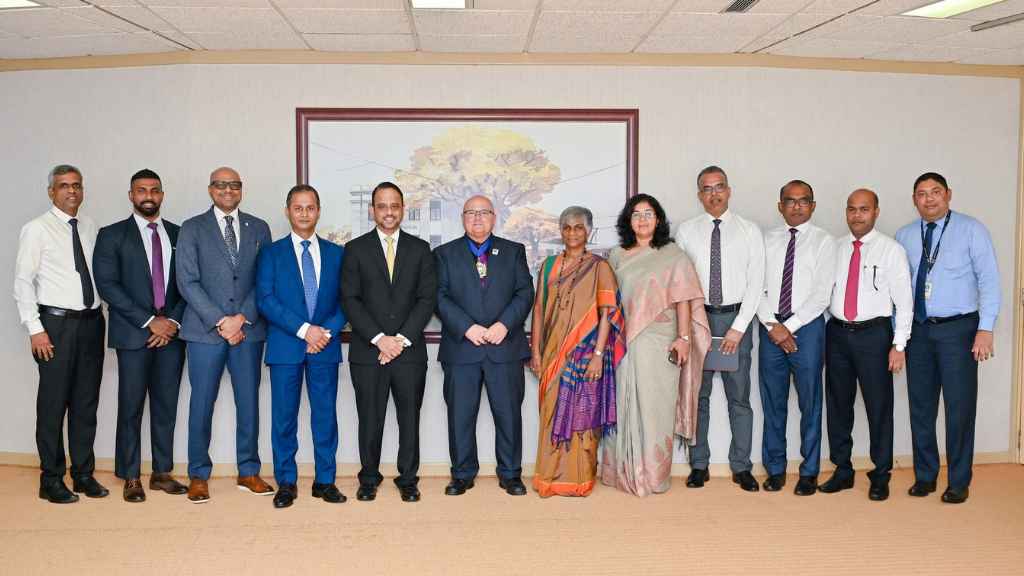
CIMA President holds highlevel meeting with BOC as senior leaders convene to strengthen collaboration between Sri Lanka’s banking sector and the global professional accounting community, focusing on governance, resilience, and talent development.
CIMA President holds highlevel meeting with BOC on governance and finance leadership
CIMA President holds highlevel meeting with BOC in a strategic engagement that signals a deepening alignment between Sri Lanka’s financial institutions and global professional accounting standards. The discussions brought together senior leadership from the Bank of Ceylon (BOC), its Board of Directors, and representatives from the Chartered Institute of Management Accountants (CIMA), reflecting a shared commitment to advancing institutional strength and long-term economic stability.
The meeting served as a platform to address critical priorities shaping the modern banking environment. Among the key themes were leadership, governance, and financial resilience—areas that have become increasingly important amid evolving regulatory frameworks and macroeconomic uncertainty. For banks operating in emerging markets like Sri Lanka, maintaining stability while pursuing growth requires a careful balance of risk management, strategic planning, and operational efficiency.
At the center of the discussion was the evolving role of management accountants within financial institutions. Traditionally associated with reporting and compliance functions, management accountants are now expected to act as strategic advisors, contributing directly to business decision-making processes. Their role has expanded to include performance analysis, risk assessment, and long-term financial planning—functions that are critical in navigating complex economic environments. The engagement highlighted how integrating management accounting expertise into leadership structures can enhance decision quality and organizational agility.
The significance of the CIMA President holds highlevel meeting with BOC also lies in its focus on governance. In the banking sector, governance frameworks are fundamental to maintaining public trust and ensuring regulatory compliance. Both parties emphasized the importance of ethical leadership and transparency in strengthening institutional credibility. CGMA-qualified professionals, with their structured approach to financial management and ethical standards, are seen as key contributors in this regard.
Another major area of discussion was financial resilience. In a context where global economic conditions remain uncertain, banks must be equipped to withstand external shocks while continuing to support economic activity. This requires robust capital management, prudent lending practices, and forward-looking risk assessment models. The dialogue explored how finance professionals can contribute to building resilient systems that not only respond to challenges but also anticipate potential disruptions.
Talent development emerged as a central pillar of the engagement. The banking sector’s ability to adapt to changing market conditions depends heavily on the quality of its human capital. Both CIMA and the Bank of Ceylon recognized the need to invest in developing finance professionals who possess not only technical expertise but also strategic thinking and leadership capabilities. This aligns with broader global trends where the finance function is increasingly expected to drive value creation rather than simply monitor performance.
CIMA reaffirmed its commitment to supporting this transition by equipping professionals with future-ready skills. This includes training in areas such as digital finance, data analytics, and integrated reporting—capabilities that are becoming essential in modern banking operations. The collaboration between CIMA and BOC is expected to facilitate knowledge sharing, capacity building, and the adoption of best practices across the financial sector.
The CIMA President holds highlevel meeting with BOC further underscored the importance of collaboration between professional bodies and industry institutions. Such partnerships create a feedback loop where academic frameworks and professional standards are continuously refined based on real-world business challenges. This ensures that training programs remain relevant and aligned with the evolving needs of the market.
From a broader economic perspective, the engagement reflects a shared vision of contributing to Sri Lanka’s long-term growth and stability. Banks play a central role in economic development by facilitating investment, supporting businesses, and enabling financial inclusion. Strengthening the capabilities of finance professionals within these institutions has a direct impact on the efficiency and effectiveness of the financial system as a whole.
The discussion also highlighted Sri Lanka’s strategic importance within CIMA’s global network. Despite economic headwinds, the country continues to be recognized for its strong pool of finance talent. This creates opportunities for Sri Lankan professionals to engage with global markets while bringing international best practices back into the local context. Such dynamics contribute to the overall competitiveness of the country’s financial services sector.
Ultimately, the CIMA President holds highlevel meeting with BOC represents more than a routine corporate interaction. It reflects a deliberate effort to align professional standards with industry needs, fostering a more integrated and resilient financial ecosystem. As the banking sector continues to evolve, such engagements will play a crucial role in shaping leadership capabilities, strengthening governance frameworks, and driving sustainable growth across the economy.