

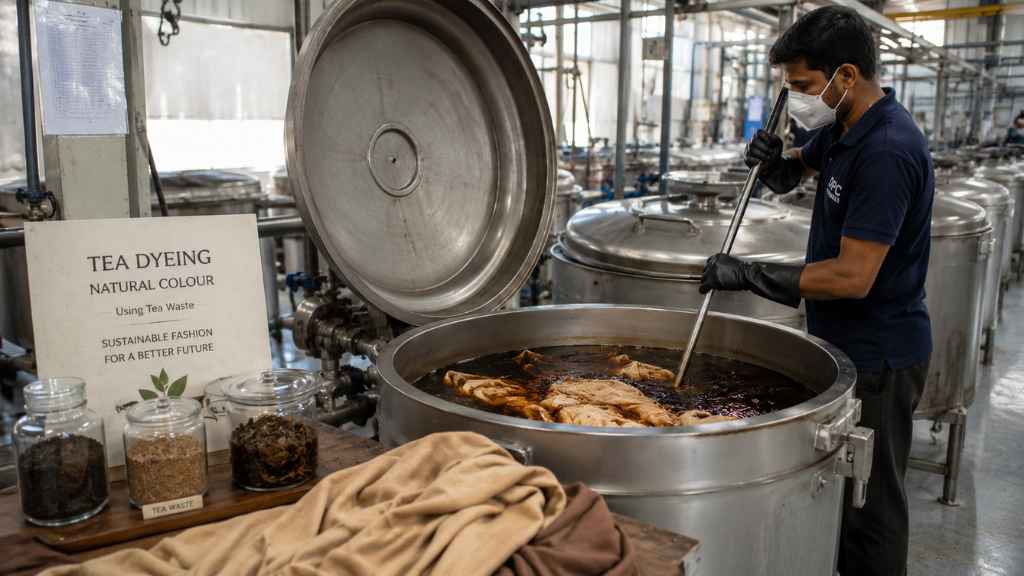
Tea Dye Innovation developed by Dynawash Ltd. in partnership with Lipton Ice Tea is drawing international attention as Sri Lanka strengthens its position in sustainable apparel manufacturing and environmentally responsible textile processing.
Tea Dye Innovation gains global attention during Pepsi Lipton visit to Sri Lanka
The latest breakthrough, which uses byproducts from Lipton Ice Tea to create natural dyes for apparel production, was showcased during a high-profile visit by senior executives from Pepsi Lipton to Dynawash’s facility at the Biyagama Export Processing Zone.
Dynawash Ltd., one of Sri Lanka’s leading apparel washing and finishing specialists, said the initiative reflects its ongoing commitment to circular manufacturing practices and sustainable industrial innovation. The company believes the new dyeing solution could contribute significantly to reducing textile waste and minimizing the environmental impact of conventional dyeing processes.
The visiting delegation included Pepsi Lipton Chief Executive Officer Bjorn Bernemann, marking the first official visit to Sri Lanka by a Pepsi CEO. Senior representatives from research and development, global supply chain management, sustainability, and digital marketing also participated in the visit.
Among the delegates were Pepsi Lipton JV Vice President – Global Research and Development Julie Merrick, Vice President – Global Supply Chain and Sustainability Herlu Rautenbach, Pepsi Lipton Unilever Senior Digital Marketing Manager Lona Borer, and Maya Jabrallah.
During the visit, executives toured the advanced processing facility operated by Dynawash Sri Lanka, where they observed the operational aspects of the Tea Dye process and discussed its scalability for international apparel supply chains.
Industry observers say the collaboration highlights a growing trend within the global fashion and textile industry toward environmentally sustainable production methods. Major global brands are increasingly seeking innovative solutions capable of reducing water usage, chemical dependency, and industrial waste generation across supply chains.
The Tea Dye Innovation initiative utilizes residual byproducts generated from Lipton Ice Tea production to create natural color dyes suitable for apparel manufacturing. By repurposing waste materials into usable textile inputs, the process supports broader circular economy principles increasingly adopted across the global apparel industry.
Environmental experts note that traditional textile dyeing remains one of the most resource-intensive stages in garment manufacturing, often involving high water consumption and chemical discharge. Innovations focused on natural and recycled dyeing solutions are therefore gaining increased importance among international fashion brands and sustainability-focused investors.
Sri Lanka’s apparel sector has spent years building a reputation as a sustainable sourcing destination, with manufacturers investing heavily in green factories, renewable energy adoption, water recycling systems, and low-impact production technologies. The latest development is expected to further strengthen the country’s position in eco-conscious apparel manufacturing.
The sustainable apparel Sri Lanka industry continues to attract attention from international buyers seeking ethically produced and environmentally responsible garments. Industry leaders say innovations such as Tea Dye could create new opportunities for Sri Lankan manufacturers in premium global markets where sustainability standards are becoming increasingly stringent.
Executives from Pepsi Lipton reportedly explored the broader commercial potential of the technology during the visit, including possibilities for integration into international apparel production networks. The project also reflects the growing intersection between food industry sustainability initiatives and textile manufacturing innovation.
The Tea Dye Innovation project is being viewed as an example of cross-industry collaboration capable of generating practical environmental solutions while supporting commercial scalability. Analysts say partnerships between global consumer brands and apparel manufacturers may become increasingly important as companies seek to meet ambitious climate and sustainability targets.
Dynawash officials said the company remains focused on expanding sustainable processing capabilities while investing in advanced technologies that reduce environmental impact without compromising product quality. The company’s operations at the Biyagama Export Processing Zone are already recognized for incorporating modern washing and finishing techniques aimed at improving efficiency and resource management.
The visit by Pepsi Lipton executives also signals growing international confidence in Sri Lanka’s manufacturing capabilities and innovation potential within the apparel sector. Industry stakeholders believe continued investment in research-driven sustainability projects could help local manufacturers remain competitive amid rapidly evolving global compliance requirements.
The Dynawash Sri Lanka collaboration with Pepsi Lipton comes at a time when apparel buyers worldwide are placing greater emphasis on traceability, carbon reduction, and responsible sourcing practices. Companies capable of offering innovative low-impact production solutions are expected to gain stronger positioning within international supply chains.
As sustainability continues to reshape the future of global fashion, Sri Lankan manufacturers are increasingly focusing on technological innovation and environmentally responsible production methods to maintain competitiveness in export markets. Industry observers say projects like Tea Dye demonstrate how local manufacturers can contribute to the next phase of sustainable industrial transformation.