

Sri Lanka rupee weaker to dollar in Tuesday’s spot market trading as investor attention shifted toward ongoing Treasury bond auctions and upcoming Treasury bill issuances, while government bond yields remained largely stable amid cautious market sentiment.
Sri Lanka rupee weaker to dollar as bond yields stay steady
Sri Lanka’s currency was quoted at 322.25/65 against the US dollar on Tuesday, weakening slightly from Monday’s close of 322.00/30, according to market dealers. The rupee’s movement comes as financial markets closely monitor liquidity conditions, foreign exchange demand, and government borrowing activity ahead of fresh debt auctions.
The local currency has experienced notable pressure compared to levels recorded at the end of last year. On December 30, 2025, the rupee was quoted at 309.50/60 to the dollar, reflecting the gradual depreciation seen over recent months as import demand and external payment obligations continued to influence the foreign exchange market.
Meanwhile, activity in the government securities market remained relatively subdued, with Sri Lanka bond yields holding mostly steady ahead of a major Treasury bond auction. Market participants appeared cautious as authorities proceeded with the issuance of 250 billion rupees in Treasury bonds, while an additional 80 billion rupees in Treasury bills is scheduled to be offered on Wednesday.
Among actively traded maturities, the Treasury bond maturing on December 15, 2028 was quoted at 9.75/80 percent. The bond maturing on October 15, 2029 eased marginally to 9.85/90 percent from 9.85/95 percent recorded previously.
The bond maturing on March 1, 2030 remained unchanged at 10.05/10 percent, while the July 1, 2030 maturity also stayed flat at 10.10/15 percent. Longer-dated securities showed mixed movements, reflecting investor caution over medium- and long-term interest rate expectations.
The Treasury bond maturing on December 15, 2032 edged slightly higher to 10.80/85 percent from the earlier 10.75/85 percent range. In contrast, the June 15, 2034 bond was quoted at 11.18/22 percent, slightly lower from the previous 11.15/25 percent level.
Analysts said market participants are continuing to assess the Central Bank’s monetary stance, inflation trends, and future borrowing requirements, all of which could influence both currency performance and sovereign debt yields in the coming months.
Commercial bank telegraphic transfer rates also reflected the softer rupee trend. The US dollar was quoted at 318.5000 buying and 325.5000 selling. The British pound traded at 431.7738 buying and 443.2190 selling, while the euro was quoted at 372.2660 buying and 383.8058 selling.
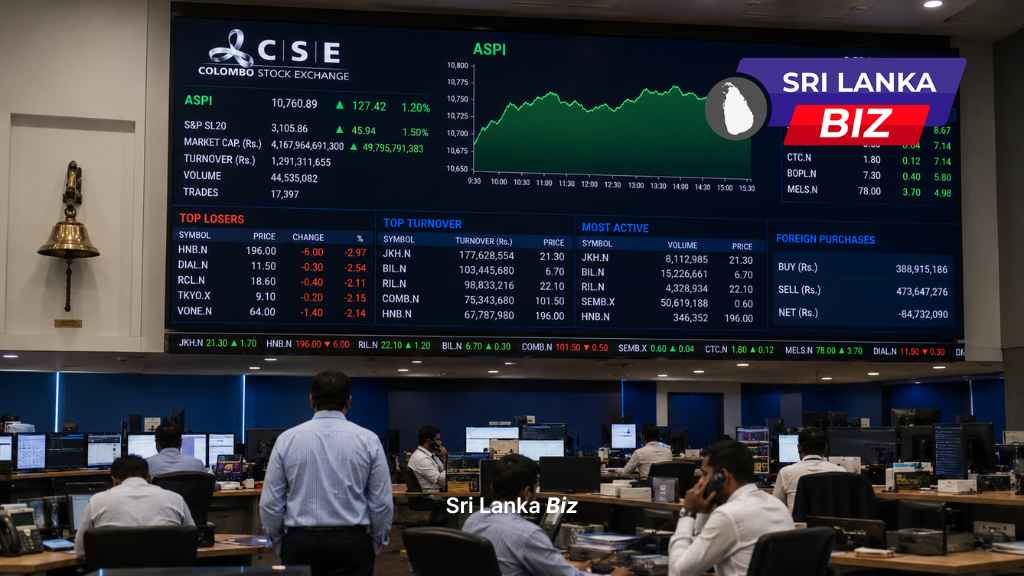
On the equities front, the Colombo Stock Exchange recorded modest gains during Tuesday’s session despite cautious investor sentiment in the broader financial market. The All Share Price Index rose 0.14 percent, or 32.52 points, to close at 23,044.
The S&P SL20 index, which tracks leading blue-chip companies, gained 0.05 percent, or 3.46 points, to end at 6,303.
Market analysts noted that investor activity remained selective, with attention focused on banking, diversified holdings, and export-oriented shares as traders evaluated broader macroeconomic developments, including exchange rate movements and government financing operations.
The slight weakening of the rupee and stable bond yields indicate that financial markets are currently balancing expectations surrounding liquidity management and fiscal financing needs. Investors are also watching external economic conditions, including US dollar strength and global interest rate trends, which continue to affect emerging and frontier market currencies including Sri Lanka.
With large-scale Treasury issuances underway this week, dealers expect bond market activity to remain active over the next few sessions, while currency traders are likely to monitor demand for dollars from importers and corporate entities.
The Sri Lanka rupee weaker to dollar trend also remains a key indicator for businesses, importers, exporters, and investors assessing broader economic stability and market direction in the near term.