

Sri Lanka rupee weaker at 323.75/324.25 against the US dollar in Wednesday’s spot market, reflecting marginal currency depreciation amid steady but cautious trading conditions and ongoing developments in the domestic debt market.
Sri Lanka rupee weaker at 323.75/324.25 as bond yields edge lower
Currency dealers said the rupee was quoted at 323.75/324.25 in the spot market, slightly weaker than the previous day’s closing range of 323.70/90. The movement comes amid continued adjustments in foreign exchange demand and supply dynamics, with no significant spot trading activity reported during the session.
The rupee had been quoted at 309.50/60 against the US dollar on December 30, 2025, highlighting a broader depreciation trend over the past several months. Market participants said the currency continues to reflect underlying pressures linked to import demand and external sector adjustments, although volatility has remained relatively contained in recent sessions.
At the same time, Sri Lanka bond yields showed a mild downward trend across selected maturities, suggesting stable investor appetite for government securities despite currency fluctuations. Analysts noted that easing yields may indicate improved liquidity conditions in the banking system and expectations of steady monetary policy in the near term.
In the Treasury market, an 80,000 million rupee Treasury bill auction Sri Lanka is currently underway, drawing close attention from investors and market participants. The outcome of the auction is expected to provide key signals regarding short-term interest rate expectations and liquidity demand within the domestic financial system.
Among actively quoted government bonds, the bond maturing on 1 August 2030 was quoted at 10.00/05 percent, reflecting stable demand for mid-term maturities. Meanwhile, the 15 June 2034 bond remained flat at 11.08/12 percent, indicating limited directional movement in longer-term yields.
The 15 August 2036 bond was quoted at 11.25/40 percent, suggesting that investors continue to price in longer-term fiscal and inflation expectations while maintaining cautious positioning in extended maturities.
Dealers said overall sentiment in the bond market remains balanced, with investors selectively positioning across maturities depending on liquidity needs and yield expectations. The slight easing in selected yields is being closely monitored alongside currency movements to assess broader macroeconomic stability.
The Sri Lanka rupee weaker at 323.75/324.25 range also coincided with broader foreign exchange rate movements in international markets. Telecommunication and banking sector participants said telegraphic transfer rates for major currencies showed continued adjustments in line with global dollar strength and regional currency trends.
The US dollar was quoted at 319.0000 buying and 326.0000 selling in TT rates. Meanwhile, the British pound was recorded at 430.9052 buying and 442.3504 selling, while the euro stood at 372.0801 buying and 383.6199 selling. These rates reflect ongoing adjustments by commercial banks based on demand conditions and external currency movements.
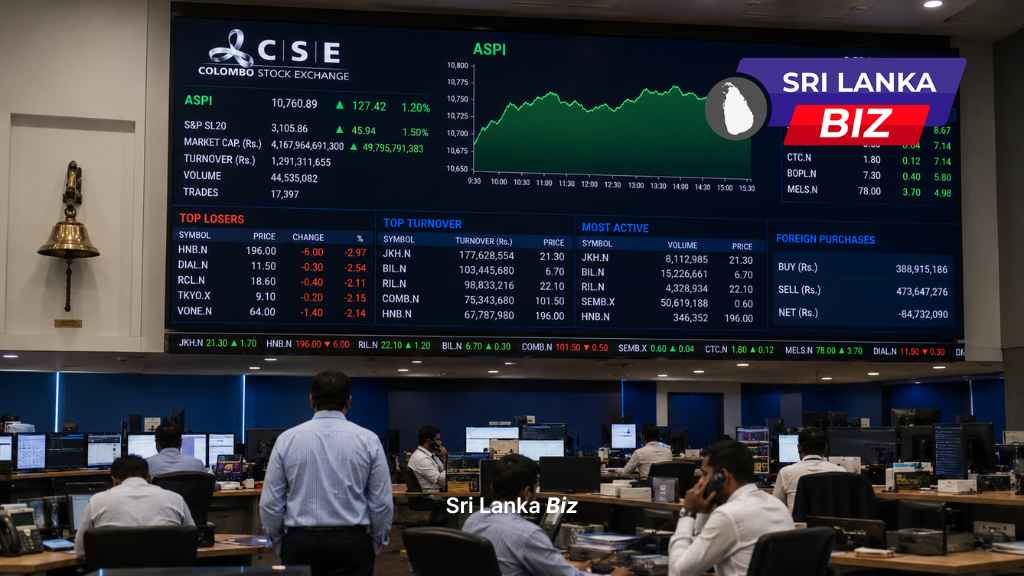
In parallel, equity markets in Colombo also closed slightly lower, adding to the cautious tone across financial markets. The All Share Price Index (ASPI) declined by 27.60 points, or 0.12 percent, to close at 22,987. The S&P SL20 index also fell by 11.92 points, or 0.19 percent, ending the session at 6,282.
Market analysts said the simultaneous movement across currency, bond, and equity markets reflects a broadly cautious investor environment. However, they added that no significant panic or disorderly trading conditions were observed, suggesting that market participants continue to operate within a relatively stable framework.
The Treasury bill auction Sri Lanka remains a key focal point for investors, as it is expected to provide direction on short-term interest rate expectations. Market watchers say the auction outcome could influence liquidity conditions in the banking sector and guide future pricing in both bond and money markets.
Economists also noted that currency stability will remain closely linked to external inflows, import demand, and monetary policy signals in the coming weeks. While the rupee has shown gradual depreciation over time, authorities have maintained efforts to ensure orderly market functioning and avoid excessive volatility.
The Sri Lanka rupee weaker at 323.75/324.25 thus reflects a continuation of incremental adjustments rather than abrupt market shifts, with participants closely watching both domestic debt issuance and global currency trends for further direction.