

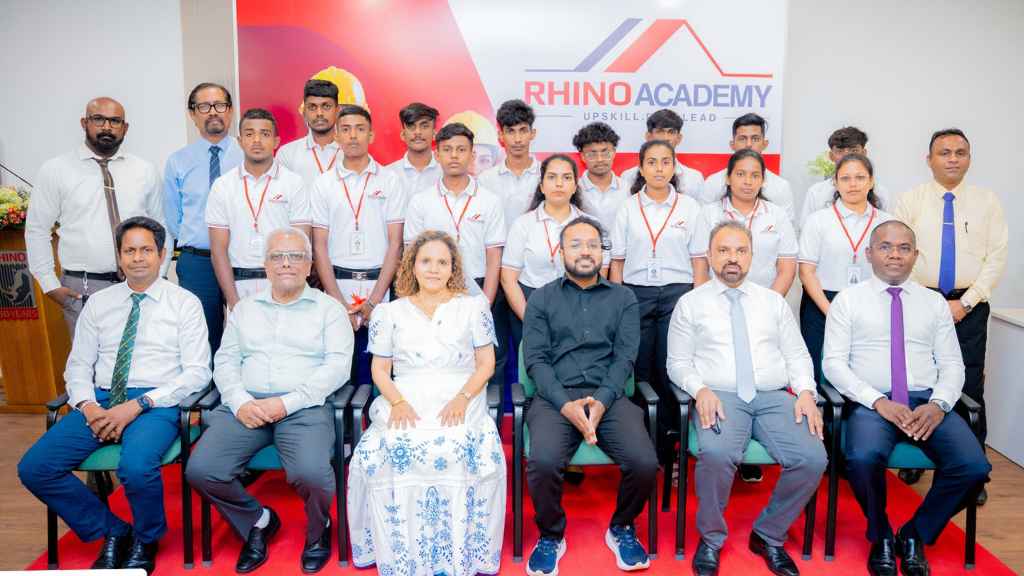
Rhino Roofing launches Rhino Academy as part of a broader initiative to strengthen technical education and create new career pathways for Sri Lankan youth amid rising demand for skilled industrial workers.
Rhino Roofing launches Rhino Academy to address industrial skills gap
Rhino Roofing Products Limited announced the launch of the Rhino Academy in a move aimed at addressing the country’s growing industrial skills gap while promoting vocational education as a viable and respected career path.
The launch carries symbolic significance for the company, as it coincides with the birth anniversary of the late Chairman A.Y.S. Gnanam, who was widely recognised for his belief in the capabilities and potential of Sri Lankan youth. Throughout his career, Gnanam consistently advocated for discipline, technical expertise, and workmanship as critical foundations for national development and economic competitiveness.
The newly established academy has been designed to provide young Sri Lankans with practical industry-focused training combined with theoretical education. Company officials said the initiative aims to elevate vocational and technical careers by positioning them as professional and sustainable employment opportunities rather than secondary alternatives to traditional academic pathways.
As Sri Lanka continues to experience shortages of technically skilled workers across multiple sectors, the academy is expected to play an important role in supporting industrial skills development and workforce readiness. Industry experts have increasingly highlighted the need for stronger technical education systems to meet the evolving requirements of manufacturing, construction, engineering, and industrial operations.
Rhino Roofing launches Rhino Academy at a time when many companies are struggling to recruit qualified technical personnel, particularly in specialised industrial trades. Business leaders have repeatedly stressed that improving technical competency and workforce productivity is essential to supporting long-term economic growth and industrial competitiveness.
The academy’s curriculum focuses on both hands-on practical learning and theoretical instruction, enabling students to develop industry-relevant competencies while also gaining recognised qualifications. Company representatives noted that the programme is intended to prepare students for stable, long-term careers with opportunities for professional growth both locally and internationally.
A key component of the academy’s credibility lies in its collaboration with nationally recognised vocational institutions, including National Apprentice and Industrial Training Authority and Tertiary and Vocational Education Commission. Through these partnerships, students will have access to certified National Vocational Qualifications (NVQ), which are internationally recognised and aligned with formal vocational standards.
The introduction of certified vocational programmes is expected to strengthen confidence in vocational training Sri Lanka initiatives, particularly among young people seeking practical employment-oriented education. Analysts note that demand for technical training has increased in recent years as industries modernise operations and adopt more advanced manufacturing and engineering technologies.
In addition to addressing labour shortages, the initiative also aligns with broader social and economic development goals. The company stated that the academy reflects its commitment to the United Nations Sustainable Development Goals, particularly those related to quality education, decent work, and reducing inequalities within the workforce.
Observers say private sector participation in education and workforce development is becoming increasingly important as Sri Lanka seeks to rebuild economic momentum and improve employment opportunities for youth. Industry-led technical education programmes are viewed as an effective mechanism for bridging the gap between academic learning and practical industry requirements.
Rhino Roofing launches Rhino Academy not only as a corporate initiative but also as a long-term investment in human capital development. The company believes that sustainable industrial growth depends on empowering future generations with the technical skills, discipline, and professional capabilities required to compete in modern industries.
The first intake of students is scheduled to begin training this May, marking the beginning of what the company describes as a long-term commitment to nurturing the next generation of skilled technical professionals. The academy is also expected to contribute to broader industrial skills development efforts by creating a pipeline of qualified workers capable of supporting Sri Lanka’s expanding industrial and manufacturing sectors.
Business analysts note that initiatives of this nature could help reshape public perceptions surrounding industrial employment by promoting technical professions as respected, high-value career opportunities. They add that stronger collaboration between the private sector and vocational institutions may become increasingly necessary to address future labour market demands.
As Sri Lanka continues to focus on economic recovery and workforce transformation, the launch of the Rhino Academy highlights the growing role businesses can play in shaping education, employment, and long-term national development.