

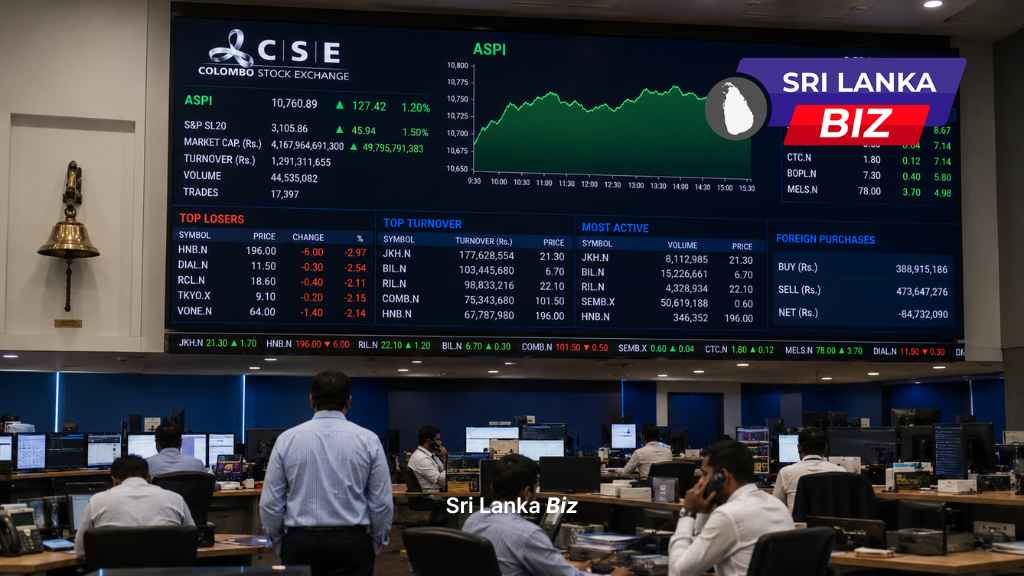
Sri Lanka rupee falls to 352.50 to US dollar for TTs as the local currency weakened in the telegraphic transfer market while government bond yields edged higher amid continued activity in the domestic financial sector.
Sri Lanka rupee falls to 352.50 to US dollar for TTs as bond yields rise
Market dealers said the telegraphic transfer buying rate for the Sri Lankan Rupee was quoted at 343.5000 against the US Dollar, while the selling rate weakened to 352.5000 during trading. The movement reflects ongoing fluctuations in the foreign exchange market as investors and financial institutions continue to monitor liquidity conditions, import demand, and external sector developments.
The latest currency movement comes as Sri Lanka’s financial markets remain sensitive to changes in foreign exchange inflows, interest rate expectations, and broader macroeconomic conditions. Analysts noted that demand for US Dollars from importers and corporate entities continues to influence short-term exchange rate movements despite improving external sector indicators over recent months.
Alongside the currency movement, Sri Lanka bond yields also recorded upward adjustments across several maturities in the secondary market. Dealers reported that a government bond maturing on 15 December 2029 was quoted at 10.30/40 percent, compared to the previous level of 10.30/45 percent.
Meanwhile, the bond maturing on 1 August 2030 was quoted at 10.45/55 percent, slightly higher from the earlier level of 10.35/50 percent. Longer-dated securities also recorded increases, with the bond maturing on 15 June 2034 quoted at 11.55/65 percent, compared to 11.40/50 percent previously.
In addition, the bond maturing on 15 August 2036 was quoted at 11.55/75 percent, compared to 11.55/70 percent recorded earlier. Analysts noted that movements in Sri Lanka bond yields often reflect investor sentiment regarding inflation expectations, government borrowing requirements, and overall economic conditions.
Financial market participants continue to closely monitor developments related to monetary policy, external financing inflows, and Treasury operations as the country navigates its ongoing economic recovery process. Bond market activity has remained active in recent months as investors assess long-term fiscal and economic outlooks.
Economists note that the foreign exchange market has shown signs of relative stabilisation compared to previous periods of severe volatility, supported by tourism earnings, worker remittances, and assistance from international financial institutions. However, exchange rate pressures continue to emerge intermittently due to import-related demand and global market developments.
The Sri Lankan Rupee remains particularly sensitive to movements in foreign currency reserves, trade flows, and investor confidence. Financial analysts also point to global economic uncertainty and international interest rate trends as factors influencing capital flows and currency market sentiment across emerging economies.
Recent improvements in external sector performance have helped ease pressure on the currency compared to the height of the country’s economic crisis. Growth in tourism arrivals and remittance inflows has contributed positively to reserve accumulation and foreign exchange liquidity conditions.
At the same time, investors remain attentive to domestic fiscal reforms, inflation management, and debt restructuring progress, all of which continue to influence activity within the bond and currency markets. Market participants expect financial conditions to remain closely tied to broader economic policy developments and international financing support.
Analysts say future movements in the Sri Lankan Rupee and government securities market will largely depend on the pace of economic recovery, reserve growth, and investor confidence in macroeconomic reforms. Developments in global commodity prices and external financing conditions are also expected to remain key drivers of market sentiment in the coming months.