

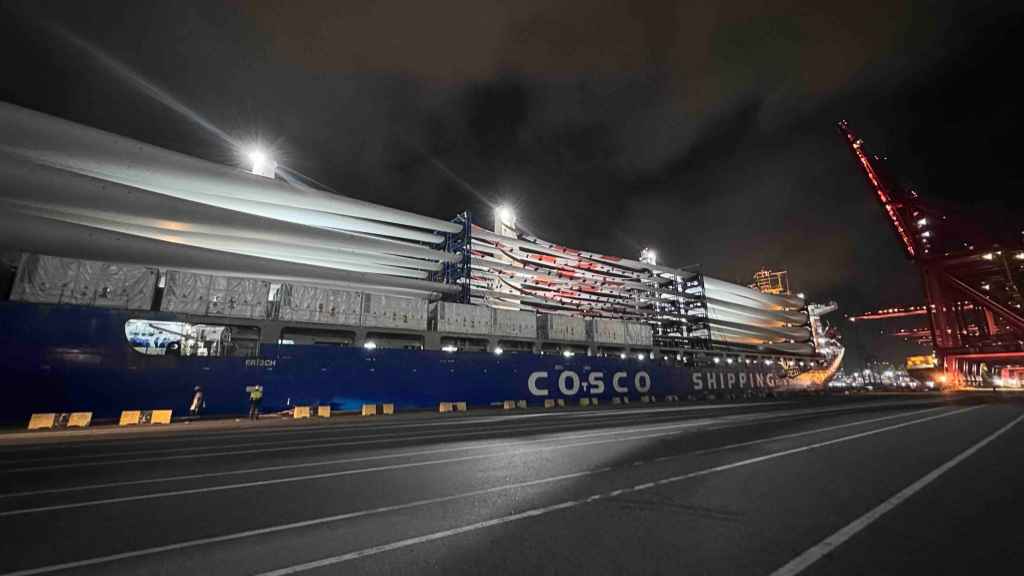
CICT handles record 2,241-tonne battery cargo for Sri Lanka grid as Colombo International Container Terminals (CICT) successfully completed a specialized operation to discharge one of the largest energy-related cargo shipments ever handled in Sri Lanka, supporting the country’s transition toward a cleaner and more resilient power sector.
CICT handles record 2,241-tonne battery cargo supporting renewable energy expansion
The terminal announced that it managed a 2,241-tonne Battery Energy Storage System (BESS) shipment during a carefully coordinated midnight operation designed to ensure safety, efficiency and precision. The cargo consisted of 54 battery units destined for what is being described as the largest energy storage project in Sri Lankan history.
According to CICT, the project is expected to strengthen the stability of Sri Lanka’s national electricity grid while facilitating greater integration of renewable energy sources. The Battery Energy Storage System (BESS) units will be deployed across 16 substations around the country, helping support national efforts to increase renewable power generation and improve energy security.
The large-scale storage initiative is expected to contribute to Sri Lanka’s target of achieving 70 percent renewable energy output by 2030. As solar and wind generation continue to expand, energy storage systems are becoming increasingly important for balancing electricity supply and demand, reducing fluctuations in power generation and enhancing overall grid reliability.
The battery units arrived aboard the heavy-lift vessel Da Xiang, operated by COSCO Shipping. Each unit weighed approximately 41.5 tonnes and was comparable in size to a standard 20-foot shipping container, presenting significant logistical and operational challenges during the unloading process.
To manage the complex discharge operation, CICT deployed two quay cranes, sixteen prime movers and two reach stackers. The operation was conducted during a specially planned midnight shift to ensure the safe transfer of the battery units from the vessel to the storage area within the terminal.
The terminal also had two Rubber Tyred Gantries (RTGs) on standby as part of its contingency planning. However, due to the exceptional weight of the battery units, which exceeded the RTGs’ load-handling capacity, the equipment was ultimately not utilized during the operation.
The successful handling of the shipment highlights CICT’s growing expertise in managing specialized project cargoes that require advanced planning, technical competence and strict safety procedures. Large-scale infrastructure projects often involve oversized or heavy cargo that demands customized handling solutions, making terminal capabilities a critical factor in project execution.
Commenting on the operation, Jan Zhang, Chief Executive Officer of CICT, said the successful handling of the shipment demonstrated the terminal’s ability to manage highly specialized cargoes while maintaining rigorous operational and safety standards.
He noted that as Sri Lanka accelerates investments in renewable energy and grid modernization, ports will play an increasingly important role in ensuring the timely delivery of strategic infrastructure required to support economic growth and sustainable development.
Zhang further emphasized that CICT is proud to contribute to a project that supports the country’s energy security objectives, sustainability ambitions and long-term economic progress.
The arrival and deployment of the Battery Energy Storage System (BESS) represent another important milestone in Sri Lanka’s evolving energy landscape. With increasing investments in renewable energy infrastructure, energy storage technology is expected to become a key component of the nation’s electricity network, helping improve resilience while supporting the transition toward cleaner power generation.
Industry observers note that modern ports and logistics operators are becoming essential partners in large infrastructure developments. The successful execution of this operation reinforces CICT’s position as a strategic logistics gateway capable of handling complex cargo requirements associated with major national development projects.
As Sri Lanka continues to modernize its power sector and expand renewable energy capacity, projects such as this are expected to play a significant role in creating a more sustainable and reliable energy future for the country.