

Excess liquidity in the banking system expanded further on July 6, reaching a level materially above the LKR 61 to 82 billion range that characterized late June, as CBSL holdings of government securities continued to climb.
Excess liquidity in Sri Lanka’s banking system expanded to LKR 132.29 billion on July 6, 2026, up from LKR 128.47 billion recorded in the prior session. The figure represents the highest level of system liquidity recorded across the reporting period tracked since late June, when excess liquidity had ranged between LKR 61 billion and LKR 82 billion.
The expansion marks a significant structural shift in the volume of surplus funds circulating within the interbank market. Over the six-week period from late June to early July, system liquidity has more than doubled from its recent lows, a trajectory that has direct implications for short-term lending rates, bank profitability and monetary policy considerations.
Elevated excess liquidity typically exerts downward pressure on overnight interbank lending rates, as commercial banks hold surplus funds well above their statutory reserve requirements. When system liquidity is this elevated, the marginal cost of short-term borrowing across the financial system tends to compress, which can flow through to lower effective rates on short-duration lending facilities over time.
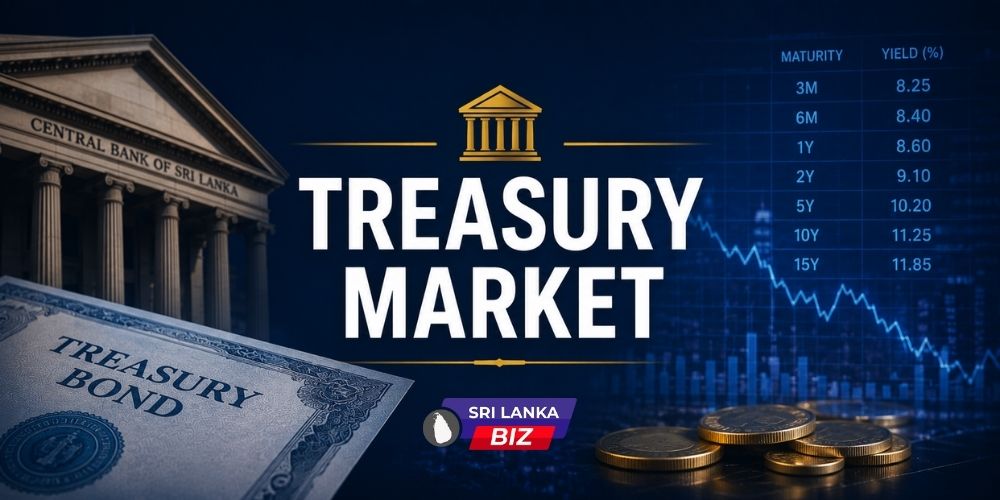
The liquidity expansion has occurred alongside a notable divergence in the yield curve. Short-end secondary market yields have risen week-on-week, with the 6-month T-Bill secondary yield up 17 basis points and the 3-month and 1-year tenors each rising 10 to 12 basis points compared to the prior week. At the same time, medium and longer-dated bond yields have continued to decline, with the 5-year tenor falling 15 basis points week-on-week to 11.35% and the 10-year tenor easing 5 basis points to 11.90%.
This divergence between rising short-end secondary yields and falling longer-dated bond yields, occurring against a backdrop of record-high system liquidity, reflects competing forces in the fixed income market. The recent T-Bill auctions have recorded weighted average yield increases of 9 basis points at both the 91-day and 184-day tenors, suggesting that auction pricing is moving independently of the system liquidity picture.
Secondary bond market activity on July 6 was subdued, with thin volumes traded. Maturities that changed hands included the 01.08.2030 bond at 11.25%, the 15.01.2033 at 11.60%, the 01.11.2033 at 11.66%, the 15.03.2035 at 11.70% and the 15.06.2035 at 11.75%. The overall yield curve remained broadly unchanged on the day.
Foreign holdings of government securities rose 0.74% week-on-week, a development that stands in contrast to the sustained foreign selling recorded in the equity market over the same period. Total outstanding government securities increased 0.36% week-on-week to LKR 18,507.41 million, comprising LKR 16,136 million in Treasury Bonds and LKR 2,372 million in Treasury Bills.
The Sri Lankan rupee appreciated modestly against the US dollar during the session, with USD/LKR moving to 335.26 from 336.03 recorded previously, extending the gradual appreciation trend from recent sessions.
Key Numbers:
| Metric | Value |
|---|---|
| Excess Liquidity (July 6) | LKR 132.29 Billion |
| Excess Liquidity (Prior Session) | LKR 128.47 Billion |
| Change | +LKR 3.82 Billion |
| Late June Liquidity Range | LKR 61 Bn — LKR 82 Bn |
| 5Y Bond Yield | 11.35% (-15 bps WoW) |
| 10Y Bond Yield | 11.90% (-5 bps WoW) |
| 6M T-Bill Secondary Yield | 10.25% (+17 bps WoW) |
| 3M T-Bill Secondary Yield | 10.15% (+10 bps WoW) |
| Foreign Holdings WoW Change | +0.74% |
| Total GSEC Outstanding | LKR 18,507.41 Million |
| USD/LKR | 335.26 |
Business Impact:
For commercial banks, system liquidity at LKR 132 billion represents a significant volume of surplus funds seeking deployment. Banks with strong short-term placement capabilities stand to benefit from the spread between overnight deposit rates and available short-term lending opportunities. For businesses monitoring borrowing costs, the key question is whether this elevated liquidity translates into lower effective lending rates at the short end, or whether upward auction yields at the T-Bill level offset the liquidity-driven compression. Importers and exporters should note the continued gradual appreciation of the rupee, which has now moved from 337.04 at end-June to 335.26 as of July 6, a cumulative strengthening of 1.78 rupees. For monetary policy watchers, the combination of record-high system liquidity, rising short-end auction yields and the sharp acceleration in headline inflation to 6.8% recorded in June creates a complex backdrop for the Central Bank as it balances accommodative conditions against price stability.
Source Attribution:
Source: Central Bank of Sri Lanka statistics and publicly available financial market information.