

Treasury bill rates decline at auction while secondary market yields ease by up to 35 basis points week-on-week, as foreign holdings of rupee bonds climb to LKR 188.8 billion
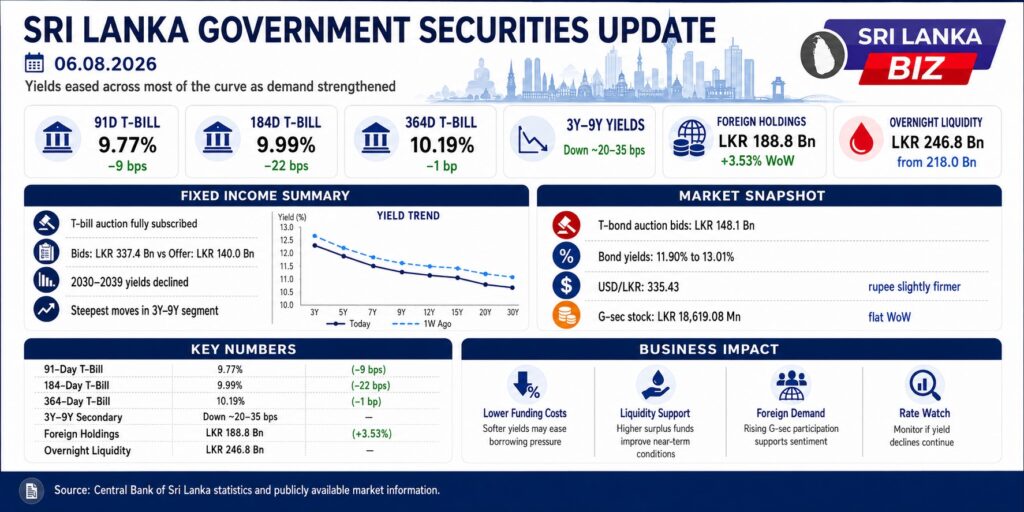
Yields on Sri Lanka’s government securities fell across most of the curve this week, extending a downward trend as buying interest picked up in both the primary and secondary markets.
At Wednesday’s Treasury bill auction, rates declined across all three tenors on offer. The 91-day bill settled at 9.77%, down 9 basis points from the previous auction, while the 184-day bill fell 22 basis points to 9.99%. The 364-day bill was largely unchanged, easing just 1 basis point to 10.19%. Total bids received across the auction reached LKR 337.4 billion against LKR 140.0 billion offered, with the full offered amount accepted.
In the secondary market, the movement was more pronounced further out the curve. Bonds maturing in 2030 through 2039 saw yields decline between roughly 20 and 35 basis points compared with the previous week, with the steepest declines concentrated in the 3-year to 9-year segment. Shorter-dated paper maturing in 2028 and 2029 saw more modest movement, with some tenors little changed week-on-week. At the long end, paper maturing in 2037 traded in a range of 12.56% to 12.66%.
The broad-based decline in yields comes as foreign investor participation in the local currency bond market continued to build. Foreign holdings of rupee-denominated government securities rose 3.53% over the week to LKR 188.8 billion, extending a steady climb seen over recent weeks. Total outstanding government securities stock stood at LKR 18,619.08 million, essentially flat week-on-week, comprising LKR 16,248 million in Treasury bonds and LKR 2,371 million in Treasury bills.
Separately, a Treasury bond auction settling this week drew total bids of LKR 148.1 billion across four re-issued bonds maturing between 2031 and 2037, with weighted average yields ranging from 11.90% on the shortest tenor to 13.01% on the longest.
On the currency front, the rupee firmed slightly against the US dollar, closing at LKR 335.43 compared to LKR 335.60 in the prior session. Overnight liquidity in the banking system expanded to LKR 246.8 billion from LKR 218.0 billion.
Key Numbers
| Metric | Value |
|---|---|
| 91-Day T-Bill | 9.77% (-9 bps) |
| 184-Day T-Bill | 9.99% (-22 bps) |
| 364-Day T-Bill | 10.19% (-1 bp) |
| 3Y–9Y Secondary Yields | Down ~20–35 bps WoW |
| 13Y Yield | 12.78% (-8 bps WoW) |
| Foreign Holdings of G-Secs | LKR 188.8 Bn (+3.53% WoW) |
| Total Outstanding G-Secs | LKR 18,619.08 Mn (flat WoW) |
| Overnight Liquidity | LKR 246.8 Bn (from LKR 218.0 Bn) |
| USD/LKR | 335.43 (from 335.60) |
Business Impact
A broad decline in government securities yields signals easing near-term borrowing costs for the state and could gradually feed through into commercial lending rates, a relevant development for businesses assessing the timing of debt-financed investment. Rising foreign participation in local currency bonds, alongside expanded banking system liquidity, points to more accommodative funding conditions, though the pace and durability of the yield decline bears watching in coming sessions.
Source Attribution
Source: Central Bank of Sri Lanka statistics and publicly available market information.