


Net foreign selling deepens on the Colombo Stock Exchange, pushing year-to-date outflows past LKR 52 billion
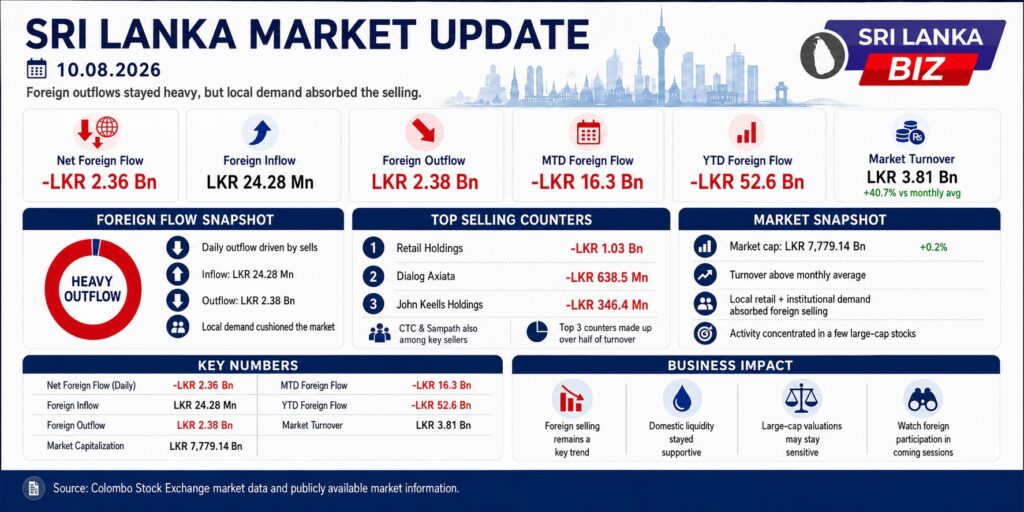
Foreign investors extended their retreat from the Colombo Stock Exchange, posting a net outflow of LKR 2.36 billion in a single trading session, according to market data. The outflow was driven almost entirely by sell-side activity, with foreign inflows totaling just LKR 24.28 million against outflows of LKR 2.38 billion.
The selling was concentrated in a handful of large-cap counters. Retail Holdings led net foreign selling at LKR 1.03 billion, followed by Dialog Axiata at LKR 638.5 million and John Keells Holdings at LKR 346.4 million. Ceylon Tobacco and Sampath Bank also featured among stocks with the largest net foreign selling for the day.
The single-day figure adds to a longer pattern of foreign disengagement from local equities. Month-to-date, net foreign outflows stand at LKR 16.3 billion, while year-to-date outflows have reached LKR 52.6 billion. Despite the day’s outflow, overall market capitalization edged up 0.2% and turnover rose to LKR 3.8 billion, suggesting the selling pressure was absorbed by active local participation rather than triggering a broader market pullback.
Retail and institutional local investors continued to provide counterbalancing demand, with turnover running 40.7% above the monthly average of LKR 2.7 billion. Trading activity remained concentrated in a small number of stocks, with Retail Holdings, John Keells Holdings, and Dialog Axiata jointly accounting for over half of daily turnover.
Key Numbers
| Metric | Value |
|---|---|
| Net Foreign Flow (Daily) | -LKR 2.36 billion |
| Foreign Inflow | LKR 24.28 million |
| Foreign Outflow | LKR 2.38 billion |
| Net Foreign Flow (MTD) | -LKR 16.3 billion |
| Net Foreign Flow (YTD) | -LKR 52.6 billion |
| Largest Net Sell — Single Stock | Retail Holdings: -LKR 1.03 billion |
| Market Turnover | LKR 3.81 billion |
| Market Capitalization | LKR 7,779.14 billion (+0.2%) |
Business Impact
Sustained foreign outflows have implications beyond portfolio performance. Persistent foreign selling can weigh on liquidity in large-cap counters that institutional and export-linked businesses rely on for valuation benchmarks, and it can be read by some as a signal on broader investor confidence in the domestic growth outlook. For listed companies with foreign shareholding, continued exits may affect free-float liquidity and share price stability over time. That said, today’s data shows local demand — both retail and institutional — was strong enough to absorb the selling without denting turnover or market capitalization, an indication that domestic liquidity conditions remain supportive for now.
Source Attribution
Source: Colombo Stock Exchange market data and publicly available market information.