

Foreign holdings of rupee-denominated government debt have climbed steadily for six consecutive weeks, even as overseas investors continue pulling money out of the stock market.
Foreign investors have been steadily increasing their exposure to Sri Lankan government securities over the past several weeks, even as they continue to withdraw capital from the equity market — a divergence that points to differing investor appetite across the country’s two main capital market segments.
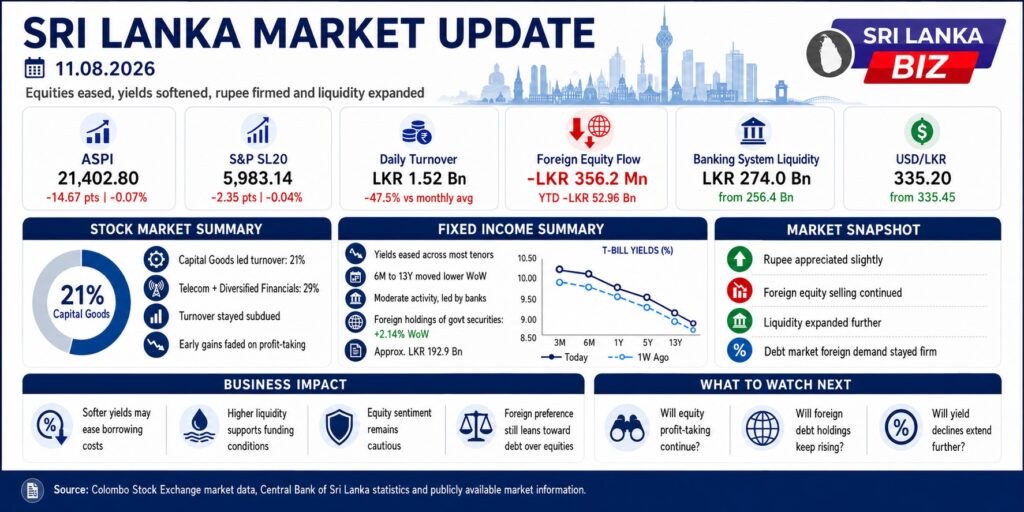
Data through August 11 shows foreign holdings of rupee-denominated government securities rising 2.14% week-on-week to approximately LKR 192.9 billion. This extends a consistent upward trend stretching back to late June, when holdings stood at roughly LKR 135.9 billion. Over that period, foreign holdings have climbed in six of the last seven weekly readings, adding close to LKR 57 billion in cumulative terms.
The buildup in government debt holdings stands in contrast to persistent foreign selling in equities. On the Colombo Stock Exchange, foreign investors posted a net outflow of LKR 356.2 million on August 11 alone. More significantly, cumulative foreign equity outflows have reached LKR 16.68 billion for the month to date and LKR 52.96 billion for the year to date, underscoring that the day’s outflow is part of a much longer-running pattern of foreign equity selling rather than an isolated data point.
The split suggests that while foreign investors have been reducing exposure to Sri Lankan equities over an extended period, the same investor base — or a distinct set of foreign participants — has found the yield environment in government securities attractive enough to keep adding exposure there. Yields across much of the government securities curve have eased over the past week, even as foreign buying continued, indicating that falling yields have not deterred the inflow so far.
Business Impact
The steady rise in foreign holdings of government debt is a supportive signal for the state’s ability to fund itself, and reflects continued external confidence in the government securities market specifically. However, the parallel and much larger foreign exit from equities is a reminder that capital flow trends differ meaningfully across asset classes, and businesses and investors should be cautious about reading broad “foreign sentiment” narratives from either market in isolation.
What to Watch Next
Whether foreign buying of government securities continues to build in the weeks ahead, and whether the gap between debt inflows and equity outflows narrows or widens further.
Key Numbers
| Metric | Value |
|---|---|
| Foreign Holdings of Govt. Securities (latest) | ~LKR 192.9Bn |
| Foreign Holdings (late June) | ~LKR 135.9Bn |
| Foreign Govt. Securities Holdings (WoW change) | +2.14% |
| Foreign Equity Flow (Day, Aug 11) | -LKR 356.2Mn |
| Foreign Equity Flow (MTD) | -LKR 16.68Bn |
| Foreign Equity Flow (YTD) | -LKR 52.96Bn |
Source: Central Bank of Sri Lanka statistics, Colombo Stock Exchange market data and publicly available market information.