


91-day rate drops 33 basis points as banking system liquidity continues to expand
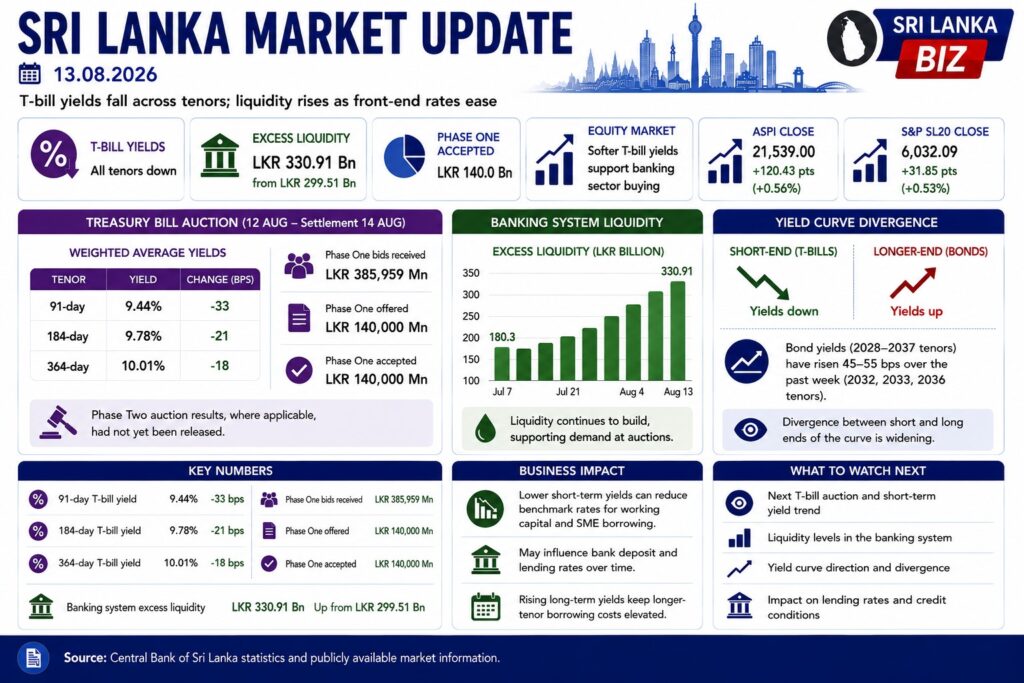
Yields on Treasury bills fell across all tenors at the government’s latest auction, with the sharpest decline recorded on the shortest-dated paper. The 91-day bill was accepted at a weighted average yield of 9.44%, down 33 basis points from the previous auction, while the 184-day bill fell 21 basis points to 9.78% and the 364-day bill eased 18 basis points to 10.01%.
The auction, held on August 12 with settlement due August 14, saw Phase One bids of LKR 385.96 billion against an offered amount of LKR 140 billion, with LKR 140 billion accepted. Results for a Phase Two auction, where applicable, had not yet been released at the time of reporting.
The decline in short-term government borrowing costs comes as liquidity in the banking system continues to build. Excess liquidity expanded to LKR 330.91 billion from LKR 299.51 billion in the prior session, extending an upward trend visible over the past several weeks. Ample liquidity in the banking system typically supports demand for government securities, which in turn can put downward pressure on yields at auction.
The move in T-bill rates also fed through to secondary market activity in equities, where the report cited softer T-bill yields alongside positive results from selected banks as a factor supporting buying interest in the banking sector during the day’s trading session.
Longer-dated government bonds have not moved in the same direction. Yields on bonds maturing between 2028 and 2037 have trended higher over the past week, with tenors toward the middle and long end of the curve — including the 2032, 2033 and 2036 maturities — showing yield increases of 45 to 55 basis points compared to the prior week, even as short-tenor T-bill rates fell. This divergence between the short and long ends of the curve is worth watching as it develops.
Key Numbers
| Tenor | Latest Yield | Change vs. Last Week |
|---|---|---|
| 91-day T-bill | 9.44% | -33 bps |
| 184-day T-bill | 9.78% | -21 bps |
| 364-day T-bill | 10.01% | -18 bps |
| Phase One bids received | LKR 385,959 million | — |
| Phase One offered | LKR 140,000 million | — |
| Phase One accepted | LKR 140,000 million | — |
| Banking system excess liquidity | LKR 330.91 billion | Up from LKR 299.51 billion |
Business Impact
Lower short-term T-bill yields typically translate into cheaper benchmark rates for short-term corporate and SME borrowing, and can influence bank deposit and lending rates over time. Businesses with near-term refinancing needs or those benchmarking working capital costs against government securities may see modestly improved terms if the trend holds. At the same time, rising yields further out on the curve suggest longer-term borrowing costs are not moving in the same direction, a distinction that matters for companies planning longer-tenor debt issuance or project financing.
Source: Central Bank of Sri Lanka statistics and publicly available market information.